
Balancing Efficiency and Contentment: A New Strategy for Social Network Restructuring
Multi-objective restructuring in social networks
This paper introduces a multi-objective framework for social network restructuring using two novel metrics: Information Flow Quality (IFQ) and Personal Satisfaction Quality (PSQ). It optimizes network connectivity during node addition and deletion by balancing global dissemination efficiency with individual node utility.
TL;DR
Social networks are living entities where members constantly join and leave. This paper presents a sophisticated approach to restructuring these networks by optimizing two conflicting goals: Information Flow Quality (IFQ)—how fast news travels—and Personal Satisfaction Quality (PSQ)—how well a person's role fits their skills. By moving beyond simple connectivity heuristics, the authors provide a framework that results in more efficient and stable networks.
Background: The Limits of Geodesic Distance
In classical graph theory, we often assume information spreads like a virus: instantly and equally to all neighbors. However, human behavior is "greedy." We call our most important contacts first. The authors identify this gap, noting that current "one-size-fits-all" restructuring methods ignore individual node significance and personal characteristics, leading to sub-optimal network performance and dissatisfied members.
Methodology: The IFQ and PSQ Framework
1. The Greedy Information Flow Policy
The core innovation is a policy where a node disseminates information to neighbors based on their Significance (centrality).
- If Node A has four neighbors, it contacts the most "significant" one in , the second in , and so on.
- This introduces a realistic "delay" model that geodesic distance ignores.
2. Multi-Objective Optimization
The authors treat restructuring as an optimization problem:
- IFQM (): A vector capturing the size of the largest component, maximum delay, best-case delay, and average delay.
- PSQM (): A measure of how much of a person's "potential" (e.g., mediation or communication skills) is being used in their current position.
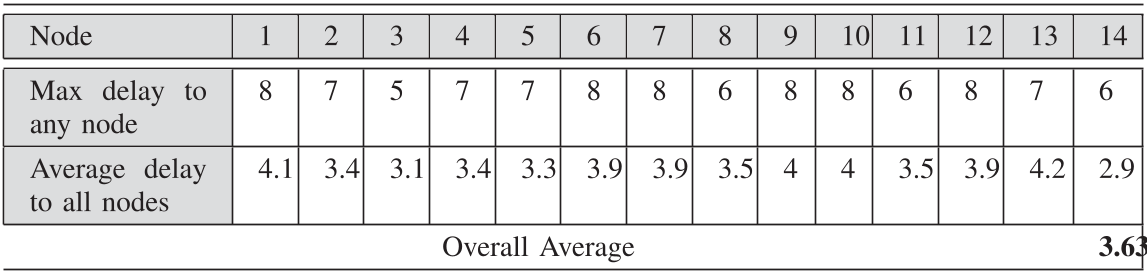 Table 1 illustrates how the significance-based policy calculates varying delays for nodes within the network.
Adding and Removing Members
When a new member joins, the algorithm doesn't just look for the first available slot. It ranks every possible connection combination based on a Combined Rank: By adjusting the weights (), an administrator can choose to prioritize organizational efficiency or the new hire's job satisfaction.
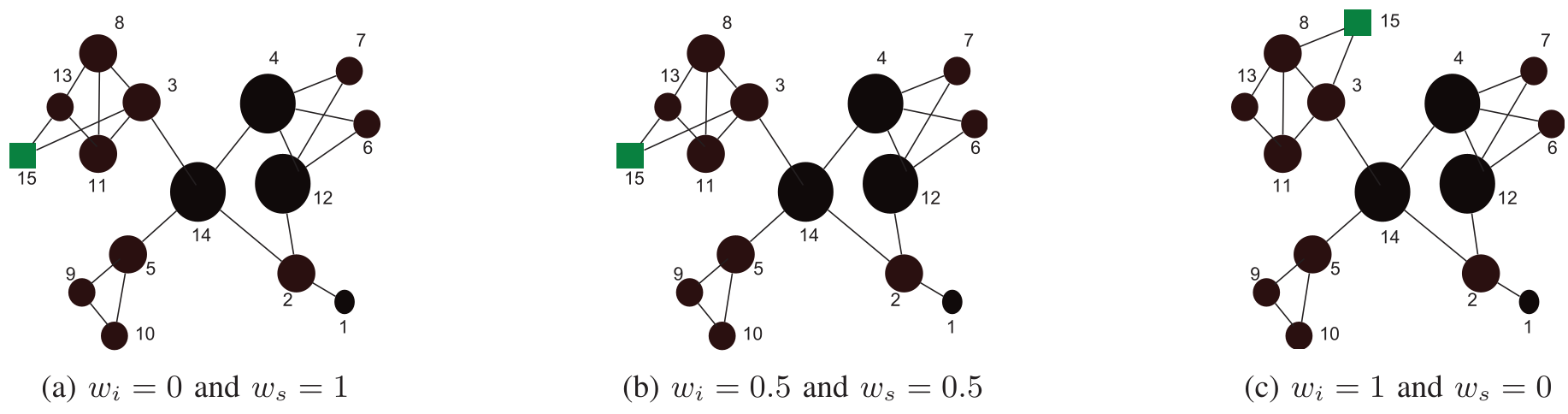 Figure 2: Different placements of Node 15 based on emphasizing global flow (c) vs. personal satisfaction (a).
Experimental Results: Better than SOTA
The authors tested their method against established benchmarks (Negre et al. and Sarr et al.) for node deletion. When a central node like "Node W" is removed, the network often fragments. The proposed "Pseudo-node" algorithm reconnects these fragments more effectively.
| Metric | Negre et al. | Sarr et al. | Proposed Method |
|---|---|---|---|
| Diameter | 5 | 5 | 4 |
| Avg. Distance | 2.4 | 2.4 | 2.22 |
These results indicate that the significance-based approach naturally creates "shortcuts" in the network that traditional methods miss, leading to a tighter, more robust structure.
Critical Insight & Conclusion
The true value of this paper lies in its Inductive Bias: the assumption that social networks are driven by social hierarchy and individual utility, not just mathematical proximity.
Limitations: The current model assumes we know a person's "maximum potential" for skills like mediation beforehand, which is difficult to quantify in practice without subjective bias.
Future Outlook: As we move toward more remote and decentralized work styles, algorithms that can "self-heal" organizational charts while keeping employees engaged will be vital. The next frontier will likely involve adding Content-Awareness—where the type of information being shared changes the priority of the flow.