
Social Network Optimization: Navigating Multi-Objective Trade-offs in Sparse Array Design
Different Approaches to Multi-Objective Sparse Array Problem with Social Network optimization
This paper investigates the performance of Social Network Optimization (SNO), a population-based evolutionary algorithm, in solving multi-objective sparse array antenna design. It specifically compares the weighted sum, epsilon-constrained, and simultaneous multi-objective search approaches for minimizing Side Lobe Levels (SLL) and the number of active radiating elements.
TL;DR
This research pushes the boundaries of antenna design by applying Social Network Optimization (SNO)—an algorithm inspired by digital human interaction—to the complex task of sparse array thinning. By comparing three distinct optimization strategies (Weighted Sum, Epsilon-Constrained, and Simultaneous Search), the authors reveal the strengths and limitations of social-inspired heuristics in identifying the Pareto front between Side Lobe Level (SLL) reduction and antenna cost.
Background: The Sparse Array Challenge
In modern radar and communication systems, designing a "sparse array" involves selecting a subset of radiating elements from a fixed grid (e.g., 12x12) to achieve a desired radiation pattern. This presents two conflicting challenges:
- SLL Minimization: Reducing unwanted noise/interference directions.
- Resource Efficiency: Minimizing the number of active elements to reduce power and complexity.
Because these objectives are non-linearly correlated (p-value ≈ 0), this is a classic multi-objective optimization problem where no single "best" solution exists, but rather a Pareto front of optimal trade-offs.
Methodology: The "Social" in Optimization
The core of this work is Social Network Optimization (SNO). Unlike Particle Swarm Optimization (PSO) which relies on physical trajectories, SNO mimics how ideas evolve in a social network.
The Interaction Mechanism
- Users and Posts: Population members (users) share candidate solutions (posts).
- Visibility: The "fitness" of a solution determines its visibility.
- Reputation & Trust: Global information is transferred via a "Trust Network," which changes rapidly based on performance, and a "Friend Network," which provides long-term exploration stability.
The mathematical engine (the "Complex Contagion" operator) balances current opinions with historical momentum and social attraction:
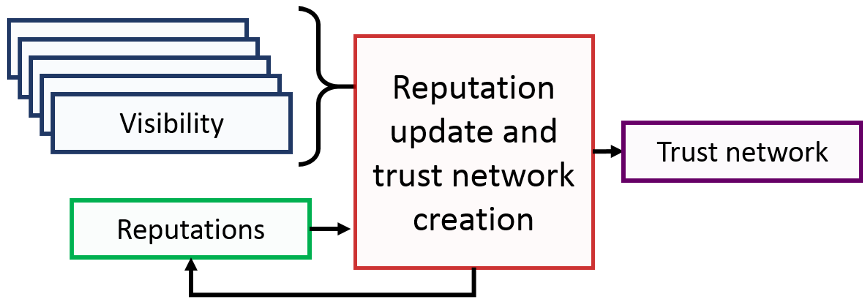 Fig 1: The process of reputation update and trust network creation within the SNO framework.
Three Approaches to the Pareto Front
The authors tested three methodologies to map the optimal solutions:
- Weighted Sum: Converting objectives into a single scalar value using weights.
- Epsilon-Constrained: Optimizing SLL while treating the number of elements as a hard constraint (e.g., "Find the best SLL for exactly 32 elements").
- Simultaneous Search: A native multi-objective SNO that evolves the entire set of non-dominated solutions in one run.
Results & Analysis
SNO was first validated against VEGA and NSGA-II on standard benchmarks, showing superior reliability and distribution (Diversity) in functions like ZDT1.
In the actual Sparse Array Optimization:
- Weighted Sum & Epsilon-Constrained: These proved most effective for pushing the limits of physics, achieving -20dB SLL reduction with 104 active elements.
- Simultaneous Search: While computationally efficient (150,000 function calls total), it showed "reduced pressure" toward SLL minimization compared to the scalar methods, though it provided a more continuous spread of solutions.
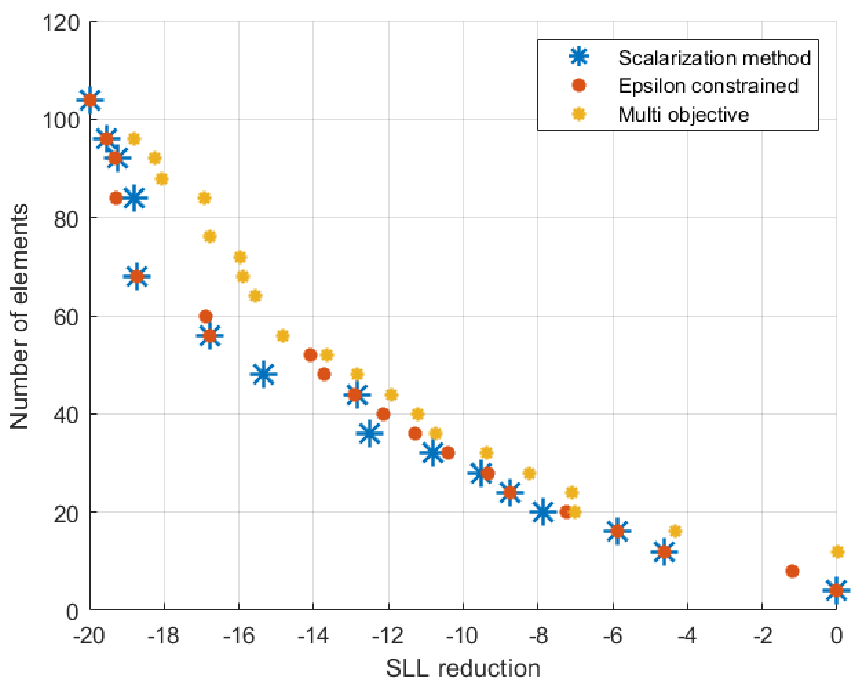 Fig 2: Comparison of Pareto fronts. The Weighted Sum method (circles) often finds the most extreme SLL reductions for high-density arrays.
Visualizing the Solution
The result of a -15dB reduction search yields a specific spatial distribution of active elements that breaks the symmetry of the regular grid to suppress side lobes effectively.
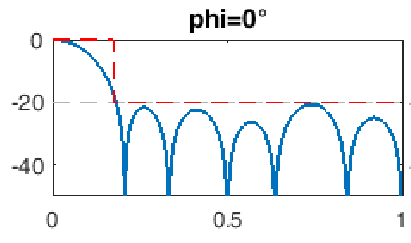 Fig 3: 3D Radiation pattern and element layout for a solution achieving -15dB SLL reduction.
Academic Insight & Conclusion
While SNO shows immense promise in handling multi-modal benchmarks, the authors provide a candid critique: when one objective is "simpler" than the other (like counting active elements vs. solving electromagnetic interference), standard multi-objective operators can lose convergence pressure.
The takeaway for engineers is that "Social" heuristics offer a powerful alternative to traditional swarm intelligence, particularly in maintaining diversity across complex, discontinuous search spaces like thinned antennas. Future work will likely focus on refining the hybrid binary-real operators to better handle the "pressure" imbalance in heterogeneous objectives.