
Elevating Media Consumption: The Cloud-Centric Path to Multi-Screen Social TV
13775_Multi-screen social TV over cloud-centric media platform.
This paper introduces a Cloud-Centric Media Platform (CCMP) designed to enable multi-screen social TV experiences. It integrates diverse content acquisition, adaptive streaming, and real-time social interaction—facilitating a shift from passive "laid-back" viewing to active "lean-forward" social engagement across various devices.
TL;DR
This work presents a transformative Cloud-Centric Media Platform (CCMP) that bridges the gap between traditional broadcasting and modern social networking. By introducing features like "video teleportation" and collaborative content overlays, the platform shifts TV from a passive "laid-back" activity to an interactive "lean-forward" experience, allowing users to share, migrate, and discuss content across multiple screens seamlessly.
Background: Moving Beyond the "Laid-Back" TV
For decades, television was a unidirectional medium. However, the rise of mobile devices and social networks created a "second screen" phenomenon where users would browse their phones while watching TV. The researchers from Nanyang Technological University identified that this fragmentation was a missed opportunity. Their goal was to unify these experiences into a single, cloud-managed ecosystem where the social layer and the media layer are natively integrated.
The Core Motivation: Solving the Multi-Screen Puzzle
Before this platform, moving a video session from a living room TV to a mobile tablet was often clunky, requiring manual searching or re-logging. The "pain point" was the lack of continuity. The authors realized that by moving the "intelligence" of the media session into the cloud, the physical screen simply becomes a flexible interface, rather than a siloed storage or playback device.
Methodology: The Architecture of Cloud Social TV
The CCMP relies on five key pillars to deliver a cohesive experience:
- Content Acquisition: A "one-button" engine that pulls from DVRs, OTT portals, and social shares.
- Adaptive Streaming: A player that dynamically adjusts bitrate and format based on device screen size and real-time network conditions.
- Integrated Communication: Native support for text, voice, and video chat within the media viewing UI.
- Video Teleportation: A proprietary technique enabling viewers to "push" or "pull" video sessions between devices with minimal latency and high intuitive interaction (HCI).
- Collaborative Overlay: A mechanism for multiple users to add metadata, comments, or edits to a live stream, creating a customized viewing version for their social circle.
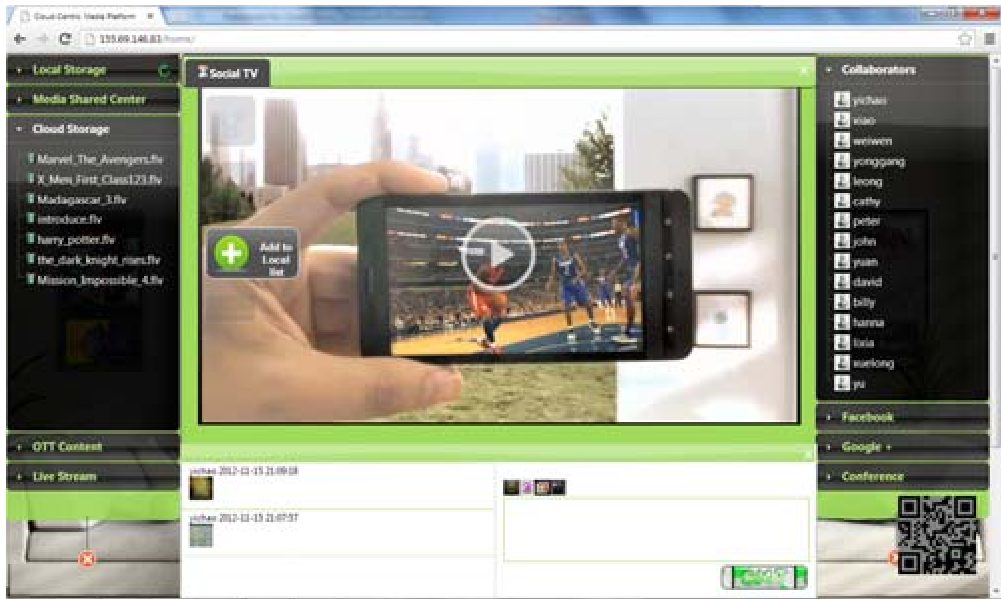 Figure 1: The Graphical User Interface (GUI) demonstrates the integration of live video with social sidebars and multi-device control options.
Impact and Real-World Validation
The prototype of this system achieved significant global attention, being featured in over 1600 news articles. The experimental success proved that:
- Session Migration works: Users can effectively move video between devices without losing progress.
- Social Integration increases engagement: Adding a collaborative layer turns a solitary activity into a community event.
- Cloud Scalability: By offloading heavy processing to the CCMP, low-power mobile devices can enjoy high-quality adaptive streams.
Critical Analysis & Future Outlook
While this paper was pioneering in 2013, it set the stage for current giants like Netflix (with their "Continue Watching" features) and Twitch (integrating live chat with high-bitrate streaming).
Takeaway: The true value of Social TV is not just the video itself, but the context of the viewer—who they are with, what device they are holding, and how they want to share that moment.
Limitations: At the time of publication, high-latency mobile networks (3G/Early 4G) remained a bottleneck for the "instant" feel of video teleportation. In today's 5G landscape, the visions of this paper have finally found the bandwidth required to become a mainstream reality.
Conclusion
The Cloud-Centric Media Platform proposed here was a blueprint for the modern interconnected media world. It recognized that the future of TV wasn't just better resolution, but better connectivity—between devices and between people.