
CAE-XGBoost: Fusing Multi-Source Heterogeneous Data for High-Precision Economic Forecasting
Multi-source data fusion for economic data analysis
The paper introduces CAE-XGBoost, a hybrid machine learning framework for economic forecasting that fuses multi-source heterogeneous data (macro, meso, and micro). It leverages a Convolutional Auto-Encoder (CAE) for unsupervised feature extraction from normalized sequences and an Extreme Gradient Boosting (XGBoost) model for final GDP prediction and factor importance evaluation.
TL;DR
Predicting the Gross Domestic Product (GDP) is notoriously difficult due to the "noise" and "heterogeneity" of data sources ranging from population stats to education funding. This paper introduces CAE-XGBoost, a framework that uses Convolutional Auto-Encoders to distill complex data features and XGBoost to execute the final prediction. The result? A robust forecasting model with an error margin under 11.7% and superior stability compared to traditional neural networks.
Problem & Motivation: Beyond Linear Regressions
Economic analysis has long been trapped between two extremes:
- Simple Qualitative/Quantitative Models: Easy to compute but lack accuracy for complex, long-term shifts.
- Econometric Models: Highly complex and often "theoretical," failing to capture the messy reality of multi-source big data.
The real challenge lies in Data Fusion. How do you combine "Number of Schools" (Education) with "Labor Force" data in a way that a machine can understand the underlying economic engine? Traditional Auto-Encoders (AE) treat data points as independent, but economic variables often have a "spatial" or sequential correlation.
Methodology: The Fusion Engine
The authors' insight was to treat multi-source economic parameters like a "1D Image" or sequence.
1. Feature Extraction via 2D-CAE
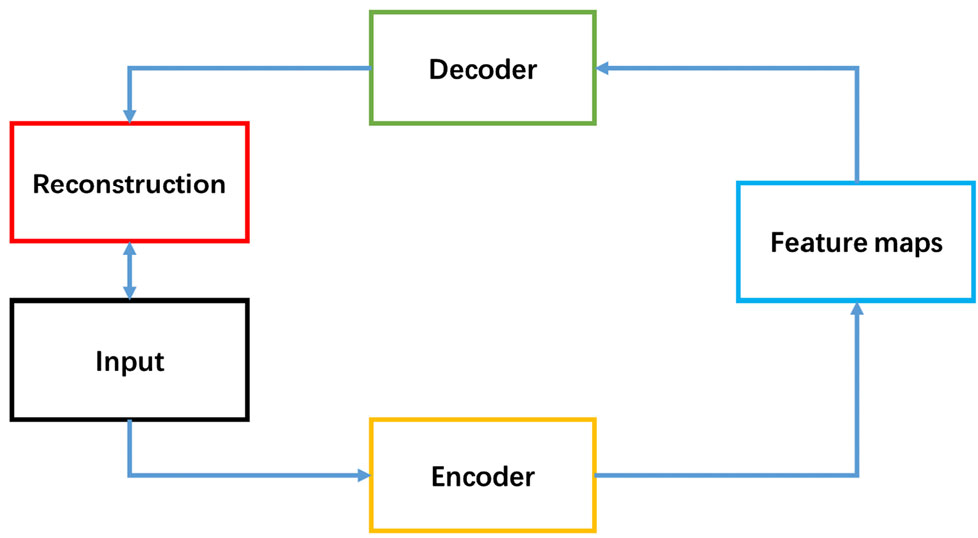
Instead of simple 1D convolution, the researchers utilized a Convolutional Auto-Encoder (CAE). The logic is elegant:
- Encoder: Convolves and pools normalized parameter sequences to find local correlations (like how a filter finds edges in an image).
- Latent Space: A compressed "feature vector" (28 values) representing the core economic state.
- Decoder: Reconstructs the original data to minimize MSE, ensuring the "compressed" features retain all vital information.
2. The Ordering Secret: Conditional Entropy
Convolution works best when "related" parameters are neighbors. The paper proposes a Conditional Entropy Growth Factor to determine the optimal order of input parameters. This ensures that the CAE extracts the most meaningful joint distributions between adjacent variables.
3. Boosting with XGBoost
Once features are extracted, they are fed into XGBoost. Why not a fully connected MLP? XGBoost provides:
- Regularization: Prevents overfitting on relatively small economic datasets.
- Interpretability: It allows for calculating the "Importance" of each factor (e.g., assessing the impact of Labor vs. Education).
Experiments & Results: Stability is King
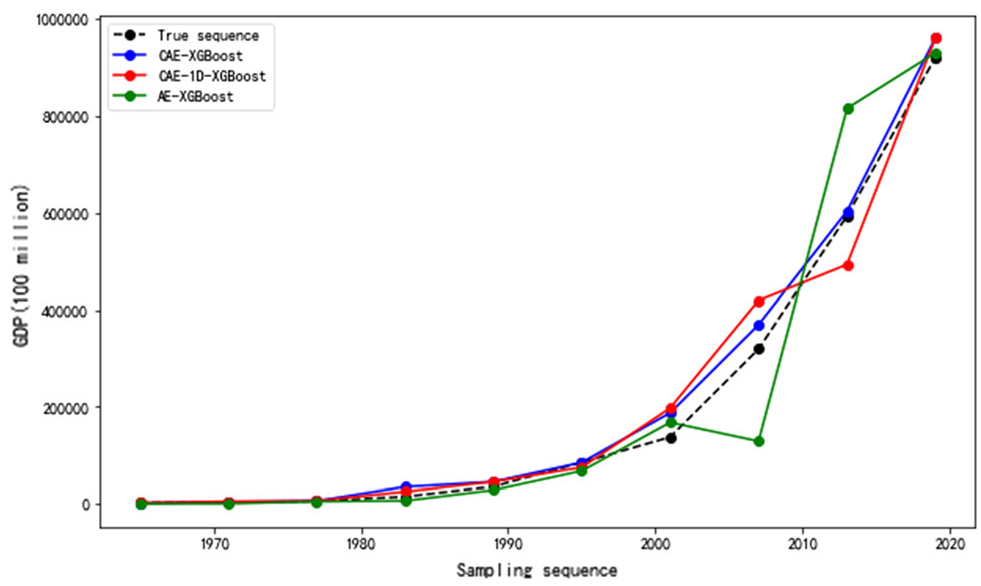
The authors compared their CAE-XGBoost against standard AE and 1D-CAE models.
Key Results Table:
| Method | MSE Variance (Stability) | MAE Mean (Accuracy) |
|---|---|---|
| AE-XGBoost | 8.099 | 3.402 |
| CAE-XGBoost | 0.091 | 4.136 |
While some models showed slightly lower Mean Absolute Error (MAE) in specific runs, CAE-XGBoost exhibited the lowest variance (0.091 vs 8.099). In economics, a stable prediction that is consistently "close" is far more valuable than a volatile model that is occasionally perfect but often wildly wrong.
Deep Insight: What Drives GDP?
Using the XGBoost feature importance tool, the study concluded that the Labor Force has the highest impact on GDP, followed closely by Population and Education. This quantification (Fig. 9 in the paper) provides actionable insights for policymakers.
Critical Analysis & Conclusion
Takeaway
CAE-XGBoost successfully bridges the gap between unsupervised deep learning (for data cleaning/compression) and supervised ensemble learning (for robust regression). It proves that the "spatial" arrangement of non-image data matters.
Limitations
- Static Ordering: While the entropy growth factor helps, economic relationships change over time (e.g., the transition from a labor-intensive to a tech-driven economy). The model may need dynamic re-ordering.
- Sample Size: Economic annual data is often limited in frequency. The model's performance on higher-frequency (monthly/daily) data remains to be seen.
Future Outlook
The authors suggest applying this fusion method to Transportation and Environmental monitoring—fields where multi-source sensors provide同样 heterogeneous data challenges.