
MADM: Cracking the Code of Asynchronous Video Diffusion in Social Networks
Multi-Source-Driven Asynchronous Diffusion Model for Video-Sharing in Online Social Networks
This paper introduces the Multi-source-driven Asynchronous Diffusion Model (MADM), a continuous-time framework for predicting video-sharing events in Online Social Networks (OSNs). By analyzing millions of traces from Renren, the authors find that activation latency follows an exponential mixture model, significantly outperforming traditional single-parametric models in predicting individual activation times.
TL;DR
Researchers have developed the Multi-source-driven Asynchronous Diffusion Model (MADM), a framework that moves beyond simplistic "one-size-fits-all" timing models for information spread. By leveraging a massive dataset from the Renren network, this work proves that information activation doesn't follow a simple curve but a complex exponential mixture, primarily driven by the timing of the most recent neighbor's action.
The "Single Parametric" Trap
In the world of social network analysis, we often describe how a video "goes viral." Traditional agent-based models like the Independent Cascade Model assume discrete time steps, which is far from reality. Continuous-time models were proposed as an alternative, but they usually assumed that the time it takes for User A to influence User B follows a simple, single distribution (like a pure Exponential or Power-law curve).
The authors identified two major gaps:
- Empirical Grounding: These single-curve assumptions hadn't been verified with real-world, large-scale video sharing data.
- The Multi-Source Headache: In reality, a user isn't just influenced by one friend. They might have five friends who shared a video at different times. How do you aggregate those overlapping influences?
Methodology: The Power of Exponential Mixtures
The core insight of this paper is the discovery of the Single-Source (SS) activation latency. After analyzing traces from 2.8 million users, the authors found that a pure exponential curve failed the Kolmogorov-Smirnov test. Instead, an exponential mixture model—which accounts for different "types" of users (active vs. inactive)—provided a near-perfect fit.
Mathematically Integrating Multi-Source Influence
The researchers derived a framework where the activation probability density function for a user with multiple active neighbors is a linear superposition of individual influences. A critical finding emerged:
- The Timing Shift: The time shift of the diffusion process is dictated solely by the Most Recent Source (MRS).
- The Weighted Influence: The proportions of the mixture components are determined by the cumulative history of all active sources.
 Note: The model uses an EM (Expectation-Maximization) algorithm to learn these parameters from massive datasets.
Experimental Results: Precision in Time
The authors validated MADM against four benchmarks: the Random Model (RM), the Most Recent Model (MRM), the Exponential Model (EXPM), and the Rayleigh Model (RAYM).
Key Performance Gains:
- Accuracy: Within a 4-hour tolerance window, MADM achieved 63% accuracy, significantly higher than the baseline models.
- Error Reduction: The Relative Expected Error was brought down to 4.24 hours, compared to nearly 10 hours for the random baseline.
- Popularity Factor: Interestingly, the study found that "popular" videos actually have a slower diffusion rate along social links because they maintain a "long tail" of interest, whereas non-popular videos experience a brief, fast surge before disappearing.
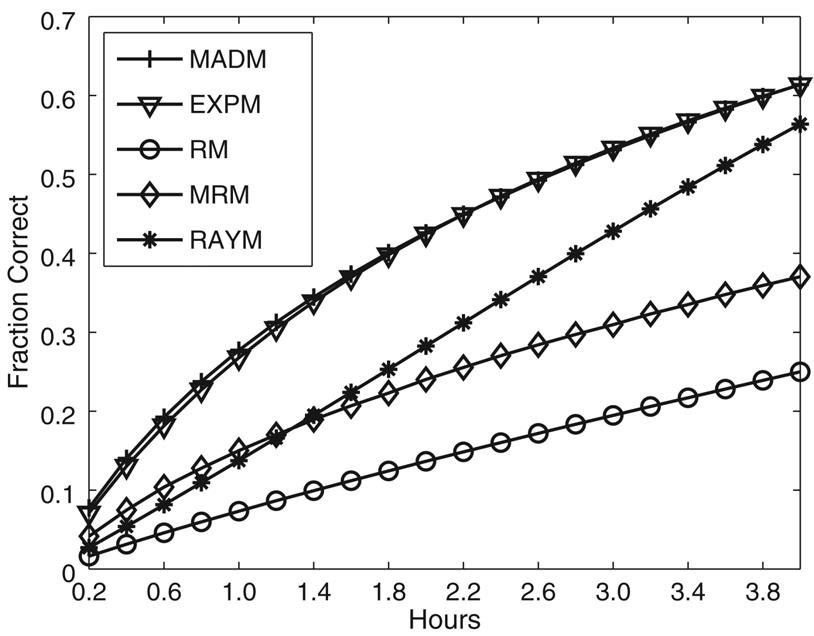 Fig: Comparison of prediction accuracy across different tolerance levels (hours).
Critical Insight & Future Outlook
This work demonstrates that the "pulse" of a social network is more complex than simple physics-based models suggest. The asynchronous nature of human sharing means that timing is relative.
Limitations: The model currently focuses only on internal social links. However, external "shocks" (like a breaking news story or a celebrity tweet) also drive diffusion. The authors suggest that future iterations of MADM should incorporate external influence factors to create a hybrid model.
Conclusion: For network engineers and marketers, MADM provides a far more accurate clock for predicting when content will be reshared, allowing for better traffic engineering and more effective social advertising strategies.