
Multi-source Semantic Profiling: Leveraging Provenance to Bridge the Social Web
Multi-source Provenance-aware User Interest Profiling on the Social Semantic Web
This research presents a Multi-source Provenance-aware User Interest Profiling framework that leverages Semantic Web and Linked Data technologies. It introduces a methodology to aggregate user activities from heterogeneous sources like Wikipedia and Twitter to solve the "cold start" problem and provide cross-domain personalization.
TL;DR
Providing personalized experiences across heterogeneous platforms remains a significant challenge due to the "cold start" problem and data silos. This research proposes a Provenance-aware User Profiling framework that uses Semantic Web technologies to interlink user activities from sites like Wikipedia and Twitter. By treating the Web of Data as a global "open corpus," the system builds high-fidelity interest profiles based on the verifiable history (provenance) of a user’s digital contributions.
Problem & Motivation: The Fragmented Digital Identity
Web service providers today face a paradox: users demand high-quality personalization immediately, yet they are hesitant to provide the manual input required to "train" a new system. This results in the Cold Start Problem.
While the Web of Data provides a wealth of structured information, it presents two major hurdles:
- Selection & Relevance: How do we filter through a massive open corpus to find features relevant to a specific user?
- Trust & Quality: In a decentralized environment where anyone can contribute, how do we measure the authority or expertise of a user?
The author identifies Data Provenance—the record of the origin and evolution of data—as the missing link to solve these issues.
Methodology: Semantic Interlinking and Provenance Management
The core innovation lies in using the Resource Description Framework (RDF) and specialized ontologies to map user activities into a unified graph.
1. Cross-Domain Extraction
The system extracts activity data from diverse sources. For instance, it tracks Wikipedia edits and realizes that certain structural edits directly influence DBpedia (the linked data version of Wikipedia). This link allows the system to derive a user's expertise in specific topics (e.g., "Quantum Physics" or "Renaissance Art") based on their contribution history.
2. Provenance Architecture
The research introduces a specific lightweight ontology for wiki provenance. This allows the profiler to not just see what a user did, but the context and impact of that action.
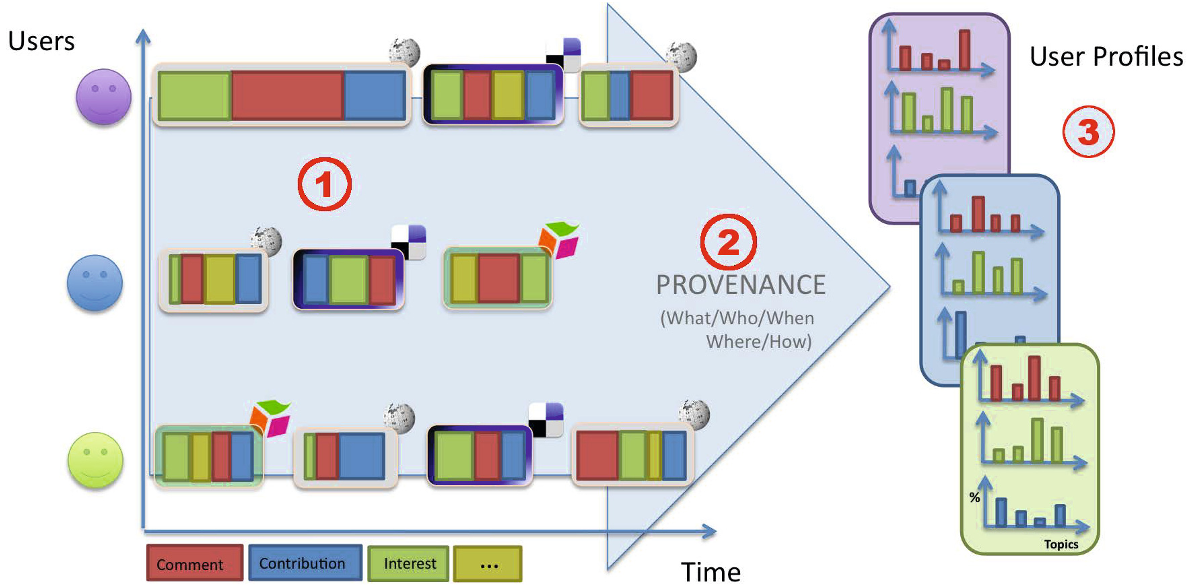 Figure 1: Conceptual illustration of the data flow from heterogeneous social sources to a unified semantic user profile.
3. Real-time Application
To demonstrate the utility of these profiles, the framework was applied to Twitter. By using the interests derived from a user's Wikipedia/DBpedia history, the system could filter the massive Twitter stream in real-time, delivering only the most relevant microblog posts to the user.
Experiments & Results: Validating the Semantic Layer
The research realized several key milestones:
- Semantic Wiki Search: Developed a framework that allows searching across interlinked wikis using structured data rather than just keywords.
- DBpedia Interlinking: Proved that Wikipedia contributions could be modeled as DBpedia provenance, creating a lineage of knowledge that identifies "Experts" in specific domains.
- Personalized Filtering: The Twitter stream filtering showed that multi-domain profiles (e.g., combining music interests from one site with tech interests from another) outperform single-source profiles in user satisfaction.
Critical Analysis & Future Outlook
Takeaway
The shift from isolated user profiles to Provenance-aware Linked Data profiles represents a move toward a "Global User Model." By focusing on the provenance of contributions, we move beyond simple click-stream data to a more nuanced understanding of user intent and authority.
Limitations
A primary challenge identified is the Evaluation Gap. Measuring the quality of these complex, cross-domain algorithms requires massive, well-curated datasets which are currently scarce. Furthermore, the profiling criteria must adapt to varying use cases—profiling a user for a "Music Recommendation" requires different feature weights than profiling for "Technical News Filtering."
Future Directions
Future work aims to automate the aggregation of ontology-based user models. As we move toward a more decentralized Web (Web3), the role of semantic provenance in verifying identity and interests without compromising privacy (via faceted profiles) will become a cornerstone of the next generation of social semantic applications.