
Beyond Simple Matching: A Multi-Stage Learning Strategy for Ontology Mapping
A multi-stage strategy for ontology mapping resolution
This paper presents a Multi-Stage Strategy for ontology mapping that integrates linguistic labels, instances, properties, and structural information. The core contribution is a hybrid pipeline—incorporating Case-Based Reasoning (CBR) and iterative graph matching—that achieved an accuracy jump from 0.81 to over 0.92 after experience accumulation.
TL;DR
Ontology mapping is the "Rosetta Stone" of the Semantic Web, yet most tools struggle with the sheer messiness of real-world data heterogeneity. This paper introduces a robust, multi-stage framework that doesn't just match labels; it learns from its own history. By combining statistical instance analysis, iterative graph structures, and Case-Based Reasoning, the system achieves a remarkable 92% accuracy in complex domains like vehicle manufacturing.
The Problem: Why Current Mappers Fail
Despite years of research (Cupid, COMA, GLUE), ontology mapping remains a bottleneck. The authors identify three fatal flaws in existing SOTA:
- Information Silos: Methods like GLUE focus on instances but ignore the rich hierarchy (taxonomy).
- Structural Heterogeneity traps: Graph-based methods often dive into details too quickly, getting stuck in local minima when two ontologies represent the same thing with completely different branching logic.
- Amnesia: Most software treats every mapping task as a "Day 1" problem, ignoring valuable domain-specific knowledge gained from previous hits and misses.
Methodology: The Five Stages of Alignment
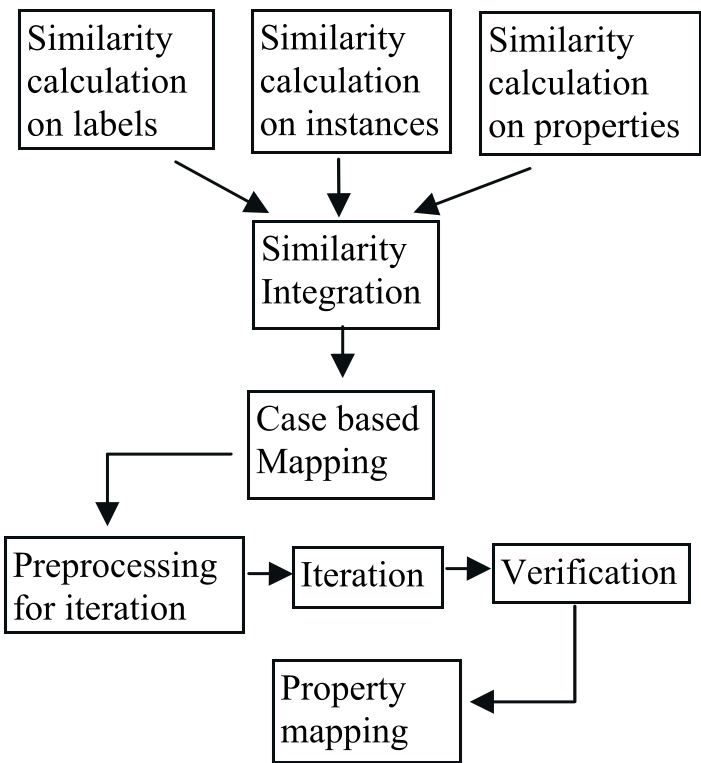
The authors propose a "coarse-to-fine" pipeline that ensures various data signals are synthesized logically.
1. Initial Similarity Integration
The system calculates a weighted similarity () based on four vectors:
- Labels (SL): EditDistance and WordNet/HowNet.
- Instances (SI): Using GLUE-style Naïve Bayes classifiers.
- Properties (SP): Categorized by type (Numeric, Text, Enumerated) and matched via the Hungarian Method.
- Structures (SS): Initial neighborhood context.
2. Experience Reuse (The Secret Sauce)
This is the paper’s stand-out feature. The system maintains a case base of past mapping successes and failures. When comparing two concepts, it extracts their "Nearest Neighbor" structures and searches the index.
- Insight: If "Engine" was successfully mapped to "Yin Qing" in a previous task, the system rewards that similarity, effectively embedding domain knowledge into the algorithm.
3. Preprocessing & Heterogeneity Reduction
Before running heavy graph iterations, the system "cleans" the structures. It moves common properties up to super-concepts and transforms mismatched subsumption relations into enumeration properties. This "normalizes" the two graphs to make them more comparable.
4. Graph-Based Iteration
Once the graphs are preprocessed, an iterative process reinforces the similarity: The similarity of a node is increasingly determined by the similarity of its neighbors, allowing the "context" to settle into a stable state.
5. Rule-Based Verification
Finally, the system applies logical sanity checks (e.g., checking for "Super concept cycle conflicts") to ensure the final mapping doesn't violate basic ontological principles.
Experiments & Results
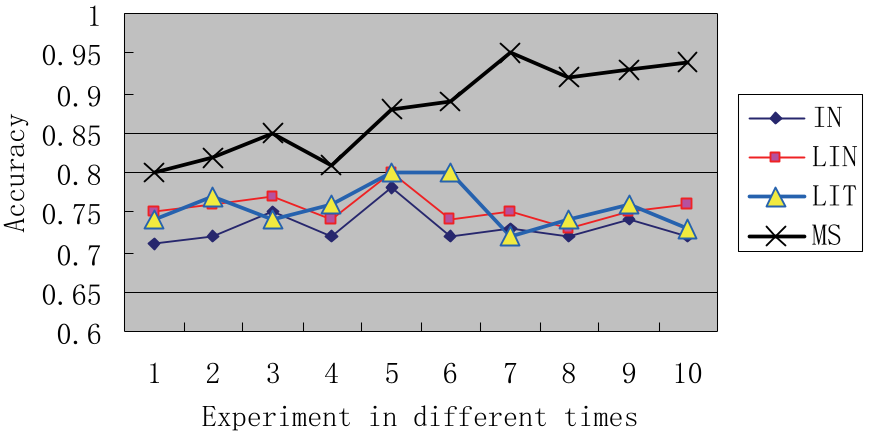
The authors tested their Multi-Stage (MS) approach against three baselines: LIN (Label+Instance), LIT (Label+Iteration), and IN (Instance only).
- Initial Performance: MS starts at 81% accuracy, already outperforming baselines due to its multi-signal integration.
- The Learning Curve: After just 7 domain-specific runs, the Experience Reuse mechanism pushed the accuracy to 92%.
Critical Insight & Conclusion
The real value of this work lies in its hybrid nature. By acknowledging that no single heuristic (be it machine learning on instances or graph theory on structures) is a silver bullet, the authors created a "meta-strategy" that adapts to available data.
Takeaway for Practitioners: When building knowledge integration systems, don't just optimize your classifier; build a memory for your domain. As the system processes more data, the "Experience Reuse" stage becomes the dominant driver of precision, turning a generic tool into a domain expert.
Future Outlook: While this paper uses classical ML and CBR, the framework is a perfect candidate for modern LLM-based refinement, where "Experiences" could be stored as vector embeddings in a RAG (Retrieval-Augmented Generation) system.