
Strategizing the Spark: Multi-Stage Seed Selection for Maximum Viral Spread
Multi-stage seed selection for viral marketing
This paper proposes a Multi-Stage Seed Selection approach for viral marketing in online social networks, moving beyond traditional single-stage "batch" selection. By iteratively selecting influential "seeds" based on updated network states, the method achieves up to a 31% improvement in information diffusion coverage compared to baseline methods.
TL;DR
Viral marketing aims to trigger a "chain reaction" of word-of-mouth (WOM) by targeting a few influential "seeds." While most strategies pick these seeds in one go, this paper argues that patience pays off. By selecting seeds in multiple stages and observing how information spreads in between, marketers can achieve up to 31% more reach by avoiding redundant connections.
The "Clutter" Problem in Viral Marketing
The fundamental challenge in viral marketing is Influence Maximization. Previous SOTA (State-of-the-Art) approaches, like the greedy hill-climbing algorithm by Kempe et al., often rely on known "influence factors" between users—data that is notoriously hard to measure in the real world.
Because of this, researchers moved toward Network Centrality (e.g., Degree Centrality), which only requires knowing the network's structure. However, a major flaw remains: Influential people tend to be friends with other influential people. If you pick the Top-10 most central nodes simultaneously, their influence spheres will likely overlap, making your marketing budget redundant.
Evolution: Multi-Stage and Inactive Centrality
The authors propose a shift from "Batch" to "Sequential" thinking. Instead of firing all your "seed" shots at once, you observe the impact of the first shot before firing the second.
1. The Multi-Stage Framework
The seed budget is divided into stages. After each stage, the Independent Cascade (IC) model simulates the spread. The next batch of seeds is then selected from the pool of users who remain inactive.
2. Global vs. Inactive Centrality
- Global Centrality: Ranks nodes based on their total connections across the entire network. Even if a node is inactive, if its neighbors are already "infected," its marginal value is low.
- Inactive Centrality (The Winning Insight): This calculates a node’s importance based only on its connections to nodes that haven't been reached yet. This ensures that new seeds are always pushing the message into "fresh" territory.
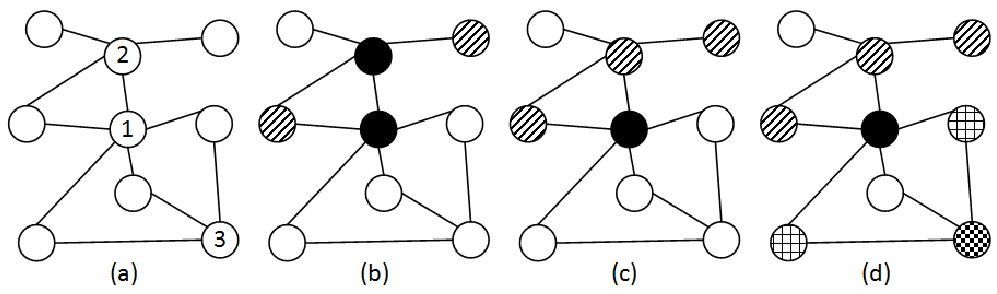 Figure 1: Comparison between single-stage (b) vs. two-stage (c-d) seeding. Notice how multi-stage allows the selection of Node 3 to reach a different cluster, significantly increasing the total activated nodes (from 4 to 7).
Experimental Proof: The Facebook Test
The researchers validated their methodology using a dataset from the Facebook New Orleans regional network, involving over 60,000 users and 1.5 million edges.
Key Findings:
- Stages Matter: Moving from 1 stage (Batch) to 10 stages increased performance by 18% using Global Centrality and 31% using Inactive Centrality.
- The Inactivation Advantage: Inactive Centrality consistently beat Global Centrality because it inherently avoids the "influential cluster" trap.
- Saturation Point: The gains are most prominent when the seed budget is small (less than 0.4% of the population). Once the budget is large enough, the "how" matters less than the "how many."
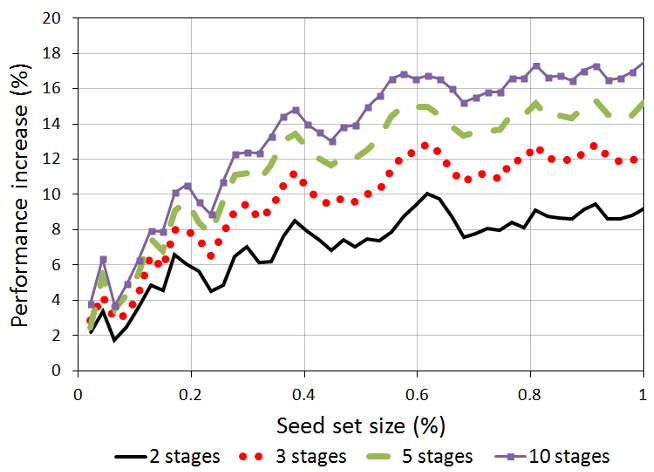 Figure 2: The experimental results show a clear upward trend in activation as the number of stages increases (from n=1 to n=10).
Critical Insight & Conclusion
The beauty of this approach lies in its simplicity and adaptability. It doesn't require complex machine learning—just basic graph theory applied dynamically.
The Takeaway for the Industry: In a real-world campaign, don't blow your entire influencer budget on day one. Launch in "waves." Use the data from the first wave to identify which communities are still "cold" and pick your next set of influencers specifically to bridge those gaps.
Limitations: The computational cost increases with each stage, as centrality needs to be recalculated times. However, as the authors note, the search space () shrinks in each stage, partially offsetting the cost. Future work should look at how these stages should be timed—do we wait for the spread to stop, or do we intervene mid-growth?