
Beyond Centralization: Navigating Task Allocation in Social Networks
Multiagent task allocation in social networks
The paper introduces the Social Task Allocation Problem (STAP), a framework where agents in a social network coordinate to complete tasks using distributed resources. It proposes a decentralized greedy algorithm (GDAP) and a cluster-based mechanism (MCLS) to achieve high-quality allocations in small-world, random, and scale-free networks.
TL;DR
Managing resources across a decentralized network is a classic "hard" problem. This paper formalizes the Social Task Allocation Problem (STAP), proving its NP-completeness. The authors introduce GDAP, a distributed greedy protocol that leverages "efficiency" heuristics to achieve near-optimal results, and MCLS, a cluster-based mechanism designed to force self-interested agents to report their resources truthfully.
Background: The Limits of the Global Market
In classical economics, "the market" is often viewed as a pool where any agent can interact with any other. However, real-world business—from supply chains to disaster relief—relies on Social Networks: preferred partners, geographical proximity, and established trust. Prior work often ignored these constraints or assumed a central auctioneer. This paper argues that the "interrelated structure" of these connections is not just a constraint, but a fundamental feature that dictates how tasks should be allocated.
Methodology: Efficiency and Clustering
1. The Social Task Allocation Problem (STAP)
The STAP models agents as nodes in a graph. An agent with a task (the manager) can only recruit resources from its direct neighbors (contractors). The goal is to maximize the total utility of completed tasks while respecting resource limits and network topology.
2. GDAP: The Power of Local Heuristics
The Greedy Distributed Allocation Protocol (GDAP) uses an "efficiency" metric: By prioritizing tasks that provide the most "bang for the buck" in terms of resource consumption, GDAP allows agents to make local decisions that collectively converge toward a high-quality global solution.
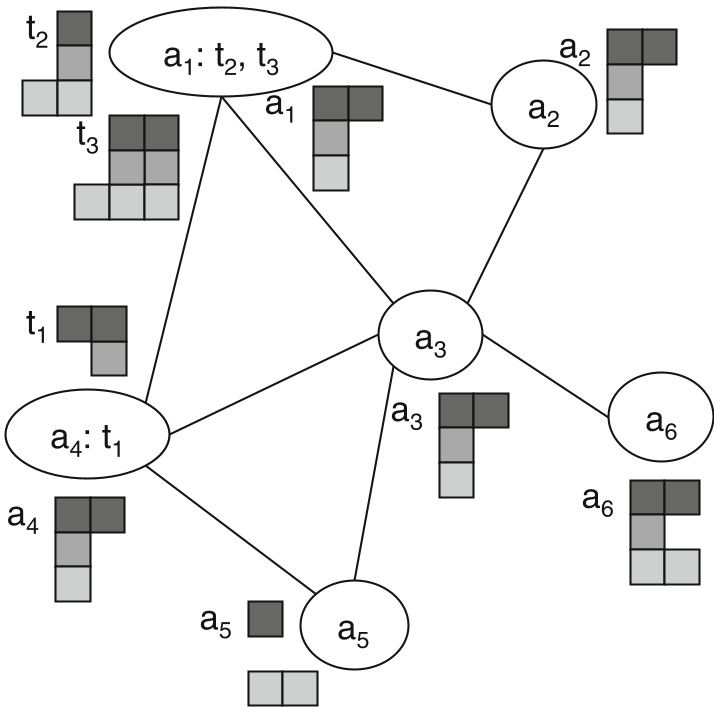 Figure 1: An instance of STAP showing agents, tasks, and resource requirements (shaded squares).
3. Solving for Self-Interest: The Cluster Mechanism
Greedy algorithms are notoriously easy to manipulate. If an agent knows a greedy protocol is running, it might hide resources to manipulate which tasks get picked. To solve this, the authors propose MCLS. It partitions the network into clusters small enough to be solved optimally via Integer Linear Programming (ILP). Because the partitioning is independent of the agents' private resource reports, and each cluster uses a VCG (Groves) payment scheme, truth-telling becomes the dominant strategy.
Experiments: Network Topology Matters
The authors tested their algorithms across three network types: Small-World, Random, and Scale-Free.
- Phase Transitions: Like SAT problems, STAP is most difficult when the "Resource Ratio" is around 0.5 (half of the required resources are available).
- Scalability: While the optimal ILP approach (MOPT) explodes in computation time as tasks increase, GDAP remains nearly linear.
- The Small-World Paradox: In small-world networks, optimal values are often lower because there are no "hub" agents with massive connectivity to aggregate resources for large tasks.
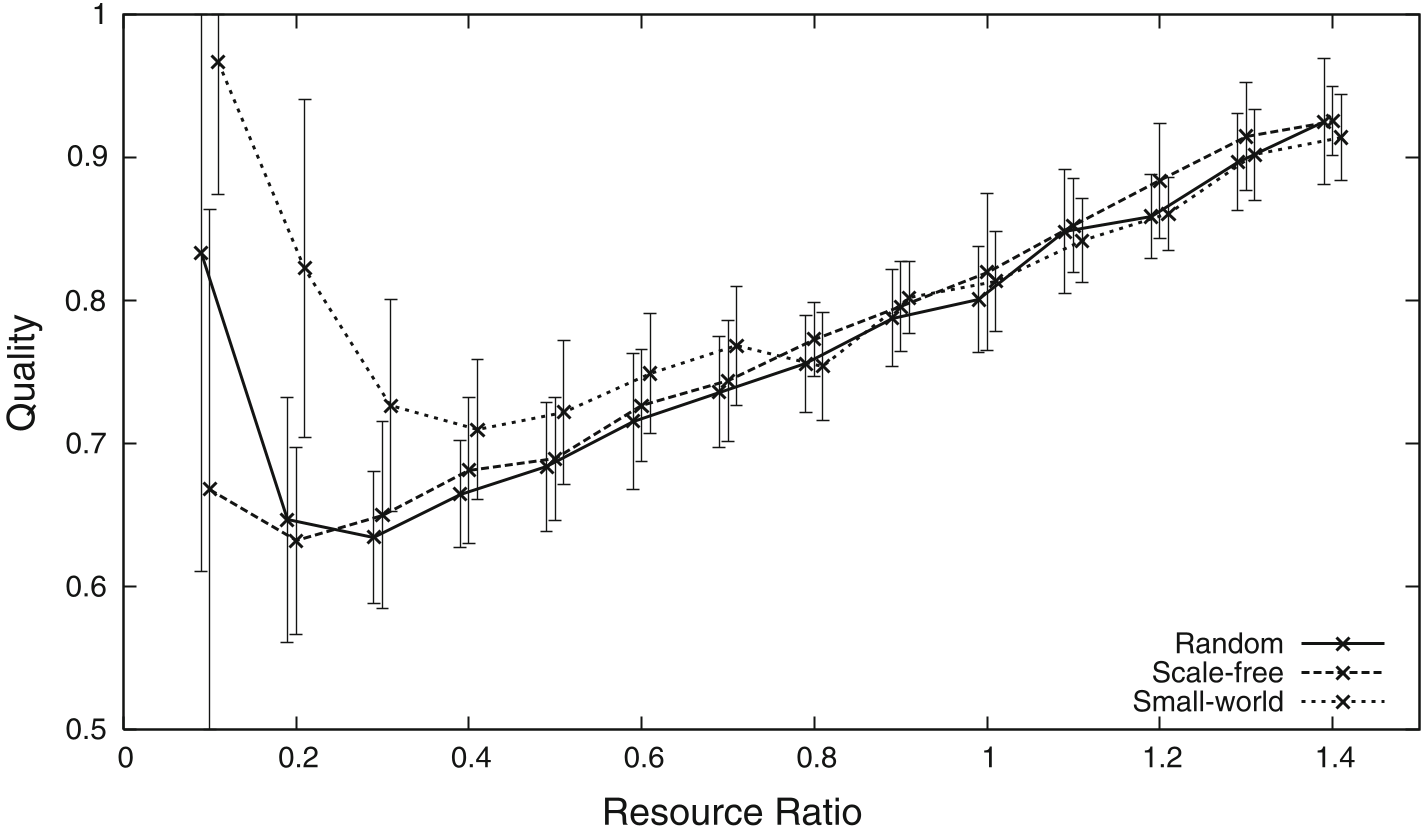 Figure 2: Performance of GDAP across different resource ratios. The "Easy-Hard-Easy" pattern is clearly visible.
Critical Insight & Conclusion
The core contribution of this paper is the bridge it builds between distributed algorithm design and mechanism design. It acknowledges that while we want efficient global outcomes, we are limited by local connectivity and individual greed.
Takeaway: If your network is naturally clustered (like a Small-World network), you can achieve both truthfulness and high efficiency by "breaking" the problem along those natural fault lines. For more chaotic networks (Scale-Free), the trade-off between truthfulness and performance remains a primary challenge for future research.