
Integrating Multicriteria Decision Aid and System Dynamics: A Framework for Real-Time Socio-Economic Control
Combining multicriteria decision aid and system dynamics for the control of socio-economic processes. An iterative real-time procedure
This paper introduces an iterative real-time methodology for controlling "hypercomplex" socio-economic systems by integrating System Dynamics (SD) for structural simulation with the PROMETHEE Multicriteria Decision Aid (MCDA) for strategy selection. The framework enables decision-makers to manage long-term strategic goals alongside short-term tactical adjustments through a multi-stage feedback process.
TL;DR
The paper presents a robust, iterative methodology to manage "hypercomplex" socio-economic systems. By combining System Dynamics (SD) for modeling causality and PROMETHEE (MCDA) for multi-objective ranking, it provides a "Control of Structure" to help decision-makers navigate long-term goals while reacting to real-time "watchdog" alerts.
The "Hypercomplexity" Challenge: Why Intuition Fails
Socio-economic systems are not just complex; they are often hypercomplex. In these systems, small changes in one variable (like social security expenses) can trigger exponential feedback loops (positive feedback) that result in "snowballing" effects such as soaring public debt.
The authors argue that traditional econometrics—which look at the past through regression—are inadequate for predicting or controlling the future because the underlying structures of our society change too fast. When structures change, old correlations die.
Methodology: The 11-Step Iterative Cycle
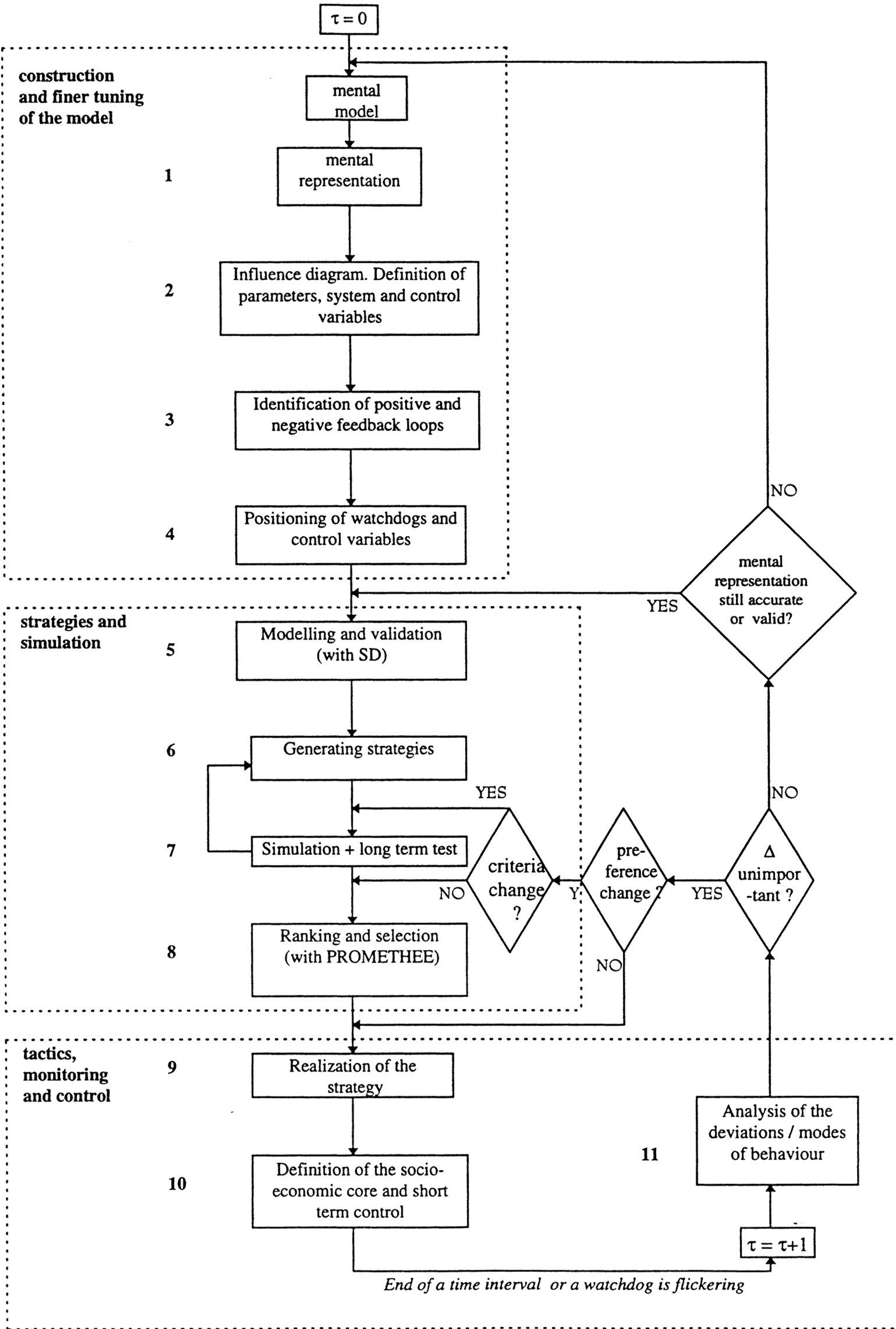
The core of this work is a systematic 11-step process designed to bridge the gap between human intuition and rigorous mathematical modeling.
1. Structural Mapping (The Logic)
Before running any simulation, decision-makers must align their "mental models" into an Influence Diagram.
- (+) Feedback Loops: These are "vicious cycles" that amplify perturbations.
- (-) Feedback Loops: These are "goal-seeking" loops used for control.

2. Strategy Ranking via PROMETHEE
Once the System Dynamics model (built in tools like STELLA or VENSIM) generates potential scenarios, the decision-maker faces a conflict: Strategy A might be great for the GNP but terrible for unemployment.
The PROMETHEE-GAIA methodology is used here to calculate a "Net Flow" () for each strategy, allowing for a transparent ranking of options based on weighted criteria.
3. Real-Time Control and "Watchdogs"
A unique contribution of this paper is the concept of Watchdogs. These are critical variables monitored in real-time. If a watchdog variable crosses a threshold, it signals that the system is sliding into an "unfavourable attractor basin"—a state of instability that might soon become irreversible.
Collaborative Decision Making: The Socio-Economic Core
Decision-makers are often overwhelmed by data. This methodology proposes the Socio-Economic Core: a minimum set of critical variables (Active and Critical) that are sufficient to describe the system's health. By monitoring only the Core, leaders can focus on high-leverage interventions without getting lost in "inert" data points.
Critical Insight & Conclusion
Takeaway
The genius of this work lies in its Iterative Nature. It acknowledges that no model is perfect. By comparing planned results against actual evolution at the end of each iteration (Step 11), the methodology forces a refinement of the mental representation itself. It is a learning system for policy-makers.
Limitations
- Cognitive Load: Despite the "Core" variables, the initial setup of hypercomplex models requires significant expert intervention.
- Subjectivity: The weighting in PROMETHEE remains subjective, though the authors argue that this makes political values transparent rather than hidden.
Ultimately, this work provides a precursor to what we now call "Adaptive Policy Making", proving that the only way to control a complex future is to build systems that learn as fast as the environment changes.