
Beyond Topicality: Quantifying the Hidden Dimensions of Relevance via Psychometrics
Multidimensional relevance modeling via psychometrics and crowdsourcing
This paper introduces a refined psychometric framework for multidimensional relevance modeling in Information Retrieval (IR). By utilizing Structural Equation Modeling (SEM) and crowdsourcing, the authors empirically validate how factors like topicality, reliability, and understandability contribute to the latent construct of "relevance," achieving a statistically significant model fit (RMSEA 0.065).
TL;DR
Relevance is the "Holy Grail" of Information Retrieval (IR), yet for 80 years, we have struggled to define it beyond simple "aboutness." This paper revitalizes a psychometric framework to measure relevance as a multidimensional latent construct. By scaling the study through crowdsourcing and applying Structural Equation Modeling (SEM), the researchers provide a positivist method to prove—not just guess—how factors like Reliability and Understandability weigh into a user's final decision.
The "Subjectivity" Trap in IR
In the systems-centered IR world (like TREC), relevance is often treated as a binary or graded "Topicality" score. However, human-centered IR knows better: a document can be perfectly on-topic but useless if it is outdated, too technical, or untrustworthy.
The challenge? Prior models were exploratory. They listed dozens of factors (utility, novelty, etc.) but couldn't explain how they interacted. A previous attempt by Xu and Chen (2006) introduced psychometrics but was hindered by small student samples and statistical shortcuts (using PCA instead of Factor Analysis). This paper sets the record straight.
Methodology: The Science of Surveying the Crowd
The authors didn't just ask "Is this relevant?" They treated relevance as a Latent Variable—something that cannot be measured directly but can be inferred from other observable behaviors.
1. Hardening Crowdsourcing
Crowdsourcing subjective judgments is notoriously difficult because "Golden Sets" don't exist for opinions. To solve this, the authors used:
- Opposite-Keyed Items: Asking "This is easy to understand" and "This is difficult to understand" at different points. If a worker agrees with both, they are flagged as a "spammer."
- Kenny’s Rule: Using 3-4 specific questions (items) per factor to ensure the latent trait is fully captured.
2. The Statistical Rigor: EFA and CFA
The authors split their 384 clean responses into two groups:
- Exploratory Factor Analysis (EFA): To see if the data naturally clustered into the five hypothesized dimensions (Topicality, Novelty, Understandability, Scope, and Reliability).
- Confirmatory Factor Analysis (CFA): To prove that their hierarchical model (where Relevance is the "parent" of these factors) actually fit the observed data.
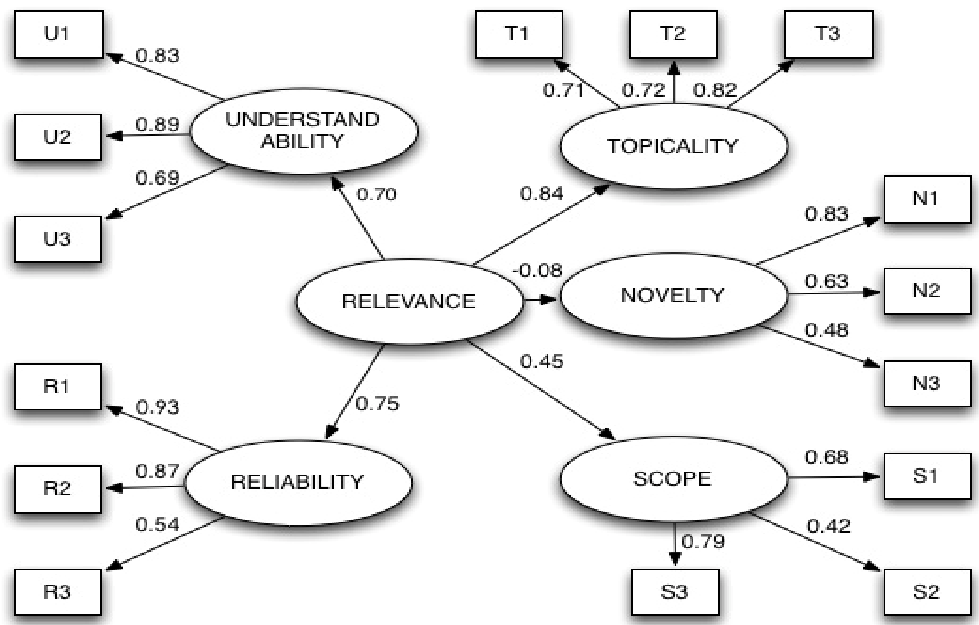 Figure 1: The hierarchical SEM where Relevance "causes" the specific dimensions, which in turn "cause" the survey responses.
Key Results: What Drives Relevance?
Through their SEM analysis, the authors derived standardized loadings (essentially importance weights) for each dimension:
- Topicality (0.71-0.82): Remains the strongest pillar, but not the only one.
- Understandability: Crucial for the user to extract value.
- Reliability: Accuracy and trust are significant moderators.
- Novelty: Interestingly, in this specific study, novelty contributed very little—suggesting its importance may be highly task-dependent (e.g., news vs. general health research).
 Table 1: Fitness indices showing the "Proposed Model" achieves an RMSEA of 0.065, significantly better than the First-order baseline (0.166).
Deep Insights & Future Outlook
The core takeaway is that Relevance is a measurable psychological property.
- Industry Value: For those building Search or Recommender systems, this framework suggests we should evaluate systems across multiple, weighted dimensions. A system that summarizes medical info for a layperson should weight "Understandability" higher than a system for doctors.
- Limitations: The study found that "Novelty" was negligible, which contradicts some prior theories. This highlights that multidimensional relevance is likely situational—the weights of the factors change depending on the search scenario.
- The Path Forward: By combining psychometric quality control with crowdsourcing, we can finally move away from the "Cranfield paradox" (where automated systems are evaluated against overly simplistic human labels) and toward a more nuanced, human-aligned IR.
Summary of the "Takeaway"
This work provides the "calibration tool" the IR community needed to turn subjective relevance into a positivist, quantifiable science.