
Robust Malware Detection: Why Neighborhood-Based Logic Outperforms Hyperplanes in Generalization
Multifamily malware models
This paper investigates the tradeoff between classification accuracy and dataset diversity in malware detection using byte n-gram features across 20 distinct families. By comparing several machine learning techniques, the authors demonstrate that neighborhood-based algorithms like Random Forest and k-Nearest Neighbors (k-NN) maintain high accuracy (over 90%) even as models generalize to detect multiple diverse malware families.
TL;DR
In the world of malware detection, there is a constant tension between specializing a model for a single family (high precision) and generalizing it for a "catch-all" detection (high efficiency). This research proves that byte bigrams are not only effective but, when paired with neighborhood-based algorithms like Random Forest and k-NN, can maintain over 90% accuracy across 20 different malware families. In contrast, Support Vector Machines (SVM) collapse under the weight of diverse data.
The Generalization Trap: Why Diverse Data Breaks Models
Most malware detectors are built to find "patterns." If you train a model on a single family (e.g., Zbot), it becomes an expert at identifying Zbot. However, in a real-world scenario, checking a file against 500 individual models is computationally expensive. We want one model to find everything.
The problem is that as you add more malware families to a training set, the "malware" class becomes increasingly fragmented and diverse. For many algorithms, this noise makes it impossible to draw a clear line between benign and malicious code.
Methodology: Testing the Limits of N-Grams
The authors leveraged a massive dataset of over 500,000 samples (~0.5 TB) and extracted byte n-gram frequencies. They tested four pillars of Machine Learning:
- k-Nearest Neighbors (k-NN): A "lazy learner" that classifies samples based on proximity.
- Random Forest (RF): An ensemble technique that creates complex neighborhood structures via decision trees.
- Support Vector Machine (SVM): A method that tries to draw a maximum-margin hyperplane between classes.
- Multilayer Perceptron (MLP): A neural network that learns a non-linear decision boundary.
The Experiment Pipeline
 The workflow: from raw malware samples to multi-level family combination and final classification.
The Core Insight: Proximity Over Boundaries
The most striking finding was the massive performance gap between algorithm types.
1. The Superiority of Neighborhoods
The authors argue that k-NN and Random Forest are both "neighborhood-based" algorithms. While an SVM tries to find a global formula to separate "good" from "bad," neighborhood algorithms essentially ask: "Is this sample close to something I already know is bad?"
This approach is far more robust. As shown in the comparison below, RF and k-NN remained remarkably stable even as the malware class became highly generic.
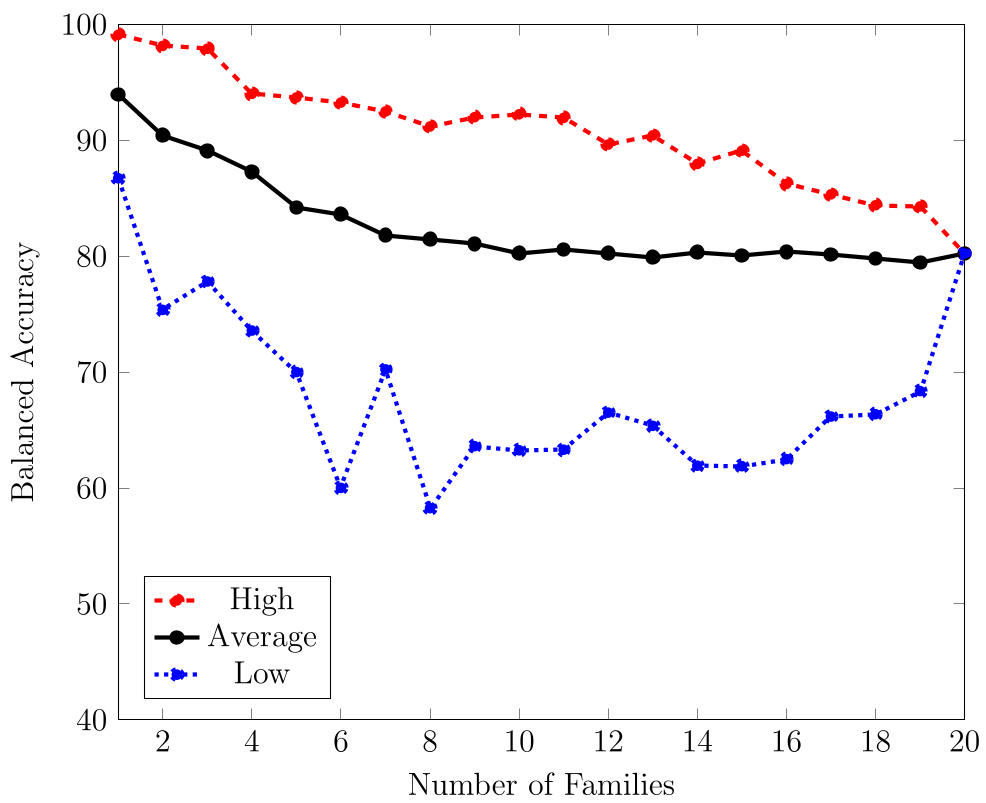 Figure: Average balanced accuracy as the number of families increases. Note the dramatic collapse of SVM (bottom line) versus the stability of RF and k-NN (top lines).
2. The N-Gram Paradox
Contrary to some industry claims that n-grams lead to overfitting, this paper shows that bigrams (n=2) are effectively the sweet spot. Higher-order n-grams (n=4, n=6) did not provide significant accuracy gains and are more computationally expensive to extract.
Experimental Analysis
The researchers performed "Level 1" to "Level 20" experiments. At Level 20, the model had to distinguish 1,000 benign files from 20,000 malware samples spanning 20 families.
- SVM Performance: Fell from 88.8% to 51.9% (essentially random guessing).
- MLP Performance: Better than SVM, but high variability (minimum scores dropped significantly).
- Random Forest: The undisputed champion, maintaining 92.87% accuracy even at Level 20.
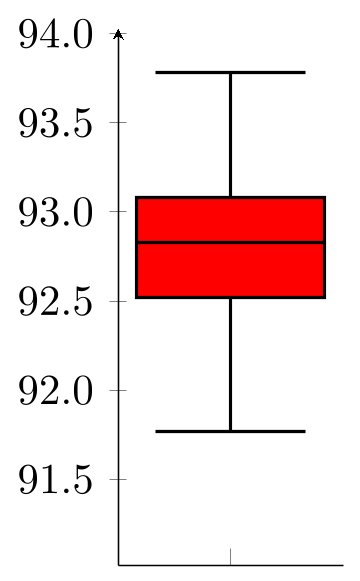 Boxplots showing the variability of accuracy with 19 families. RF and k-NN exhibit much tighter clusters at higher accuracy levels.
Conclusion & Taking it Further
The takeaway for security practitioners is clear: In feature spaces as complex and fragmented as malware bytes, neighborhood-based logic provides a more reliable inductive bias than hyperplane-based separators.
Limitations: The study focuses on binary classification (Malware vs. Benign). Future work could explore multi-class classification to see if these neighborhood models can also accurately label the specific family of a detected sample.
Future Outlook: While byte-level n-grams are strong, combining them with static features (API calls) or dynamic behavior logs using these same neighborhood algorithms could lead to an even more resilient "universal" malware detector.