
MLP: Unmasking Deceptive Cryptocurrencies via Market Fingerprinting
A Multilayer Perceptron Architecture for Detecting Deceptive Cryptocurrencies in Coin Market Capitalization Data
2019-10-14
Summary
Problem
Method
Results
Takeaways
Abstract
This paper presents a Multilayer Perceptron (MLP) architecture designed to detect deceptive cryptocurrencies by analyzing data from Coin Market Capitalization (CMC). The authors introduce 24 novel features spanning market performance and social presence, achieving a state-of-the-art accuracy of 98% in identifying "inactive" or scam-related assets.
## TL;DR
In the "Wild West" of digital assets, distinguishing a moonshot from a scam is increasingly difficult. This paper introduces a specialized **Multilayer Perceptron (MLP)** architecture that utilizes 24 newly defined features—ranging from market cap dominance to social media presence—to identify deceptive cryptocurrencies. Testing against 1,000 real-world samples, the model achieved a **98% accuracy**, significantly outperforming traditional machine learning methods.
## The Motivation: A Market of Shadows
As the number of cryptocurrencies skyrocketed (reaching over 2,200 by 2019), so did the complexity of **identity forgery**. Scammers exploit the lack of regulation to launch "ghost" coins or abandoned ICOs. The authors argue that while these projects mimic legitimate ones, their underlying data—specifically their **Trade Volume**, **Supply dynamics**, and **Social Media footprints**—betray their deceptive nature.
The core challenge is that deception is a deliberate act of transferring false beliefs. In crypto, this manifests as "Identity Forgery" (creating a fictional value proposition). Prior work lacked a comprehensive feature set to catch these nuances; this paper fills that gap.
## Methodology: The 24-Feature Anatomy
The authors curated a balanced dataset of 1,000 cryptocurrencies (500 active, 500 inactive) from Coin Market Capitalization (CMC). To feed the neural network, they extracted features across 7 dimensions:
1. **Type**: Distinguishing between independent Coins and platform-based Tokens.
2. **Trade Volume**: Measuring Market Cap Dominance and Average Volume.
3. **Rank**: Using Intra-class (local) and Inter-class (global) ranking metrics.
4. **Supply**: Analyzing circulation vs. maximum supply limits.
5. **Age**: Calculating the "Life-span" and "Market Cap Age."
6. **Trade Junction**: Counting available exchanges and market pairs.
7. **Social Media**: Verifying the presence of whitepapers, source code, and Reddit/Twitter activity.
### Neural Architecture
The proposed MLP uses a deep structure to handle the non-linearities of market behavior:
* **Input Layer**: 24 nodes (one per feature).
* **Hidden Layers**: Three layers with 500 nodes each, utilizing **ReLU** activation for faster convergence.
* **Output Layer**: A **Sigmoid** activation function to classify the asset as 0 (Deceptive) or 1 (Legitimate).
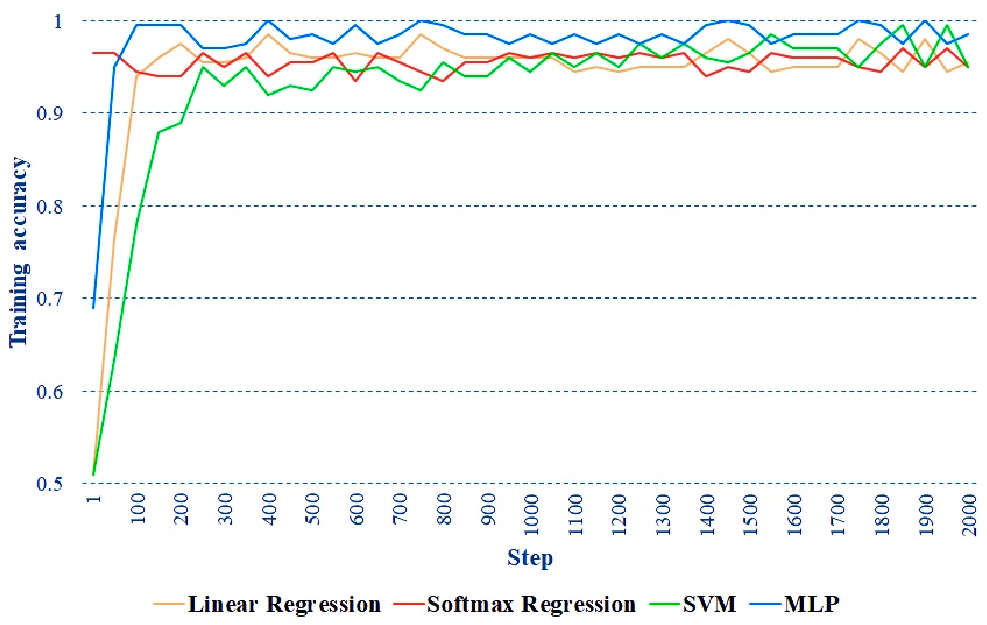
*Figure 1: Comparison of training accuracy across different iterations for MLP and traditional ML algorithms.*
## Experimental Results: Precision vs. Noise
The MLP was compared against Linear Regression, Softmax Regression, and Support Vector Machines (SVM).
| Metric | Linear Reg. | Softmax Reg. | SVM | **MLP (Ours)** |
| :--- | :--- | :--- | :--- | :--- |
| **Accuracy** | 93.00% | 94.00% | 95.00% | **98.00%** |
| **Precision** | 91.35% | 93.14% | 93.27% | **98.98%** |
| **FPR (False Positive Rate)** | 9.00% | 7.00% | 7.00% | **1.00%** |
The results are striking. The MLP's **False Positive Rate of just 1%** is crucial; in financial applications, mislabeling a legitimate project as a scam (False Positive) is as damaging as missing a scam entirely. The MLP demonstrates a superior ability to find the "signal" in the highly volatile crypto "noise."
## Critical Insights & Future Outlook
The value of this paper lies in its **feature engineering**. By quantifying "Age" and "Social Media Presence" alongside raw financial data, the authors capture the *effort* behind a project. Legitimate projects maintain source code and active community channels, whereas deceptive projects often show "stagnation" in these non-financial metrics even if their price is manipulated.
**Limitations**: The study relies on "inactive" tags as a proxy for deception. However, some projects fail due to incompetence rather than malice. Future work could benefit from a more granular taxonomy of scams (e.g., distinguishing "Rug Pulls" from "Slow Rugs").
**Conclusion**: This research provides a robust framework for automated crypto-auditing. As we move toward a more decentralized future, these MLP-based forensic tools will be vital for protecting retail investors from sophisticated financial deception.