
Unmasking the Invisible: How Tensor Analysis Reveals the Social Fabric of Immigrant Communities
Understanding Multilingual Social Networks in Online Immigrant Communities
Understanding Multilingual Social Networks in Online Immigrant Communities introduces a Tensor Analysis framework (PARAFAC) to uncover latent sub-communities and communication patterns in a large-scale Turkish-Dutch immigrant forum. Utilizing automatic language identification and high-dimensional data modeling, it successfully identifies seasonal and persistent bilingual clusters over a 15-year span.
TL;DR
This study leverages Tensor Analysis and Unsupervised Learning to map the hidden social structures within an online forum for Turkish immigrants in the Netherlands. By moving beyond static forum categories, the researchers automatically discovered latent bilingual sub-communities and tracked their evolution over seven years, providing a scalable blueprint for sociolinguistic research.
Problem & Motivation: The Limits of Top-Down Analysis
In the study of immigrant communities, researchers often face a "top-down" bias. Online forums are usually divided into rigid categories (e.g., "Politics," "Fashion"), but these don't necessarily reflect how people actually interact. Furthermore, traditional sociolinguistic research is often limited to small-scale interviews or short snippets from platforms like Twitter.
The authors argue that to truly understand an immigrant community—its needs, language shifts (Code-switching), and social health—we need to look at the bottom-up data. The challenge? The data is massive (4.5 million posts) and extremely sparse, especially when you factor in time.
Methodology: The Power of Tensors
Instead of using standard graphs, the authors represent the forum as a Tensor (a multi-dimensional matrix).
- Modeling: They construct a 3-mode tensor: (User × Sub-forum × Token).
- PARAFAC Decomposition: They decompose this "data cube" into a sum of triplets. Each triplet represents a latent sub-community—a group of users who consistently use specific words in specific forums.
- Language Profiling: By analyzing the "Token" vector within a triplet, the system automatically labels the community as Turkish-dominant, Dutch-dominant, or Bilingual.
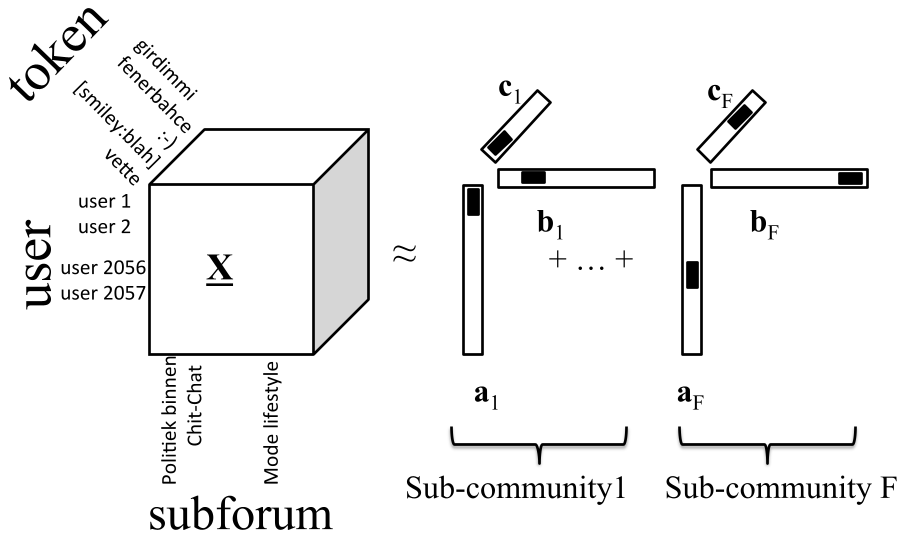
Figure 1: The framework for decomposing forum data into latent sub-communities.
Experimental Results: From Soccer to Ramadan
The analysis yielded fascinating results regarding the "Bilingual" nature of the community. In sub-communities centered around sports (like Soccer), users switched between Turkish and Dutch almost equally.
The Hidden Network
By multiplying the user embeddings (), the authors inferred a "Secret Social Network." The resulting Spy-Plot (Figure 4) shows a dense core of highly active individuals surrounded by a "long tail" of less engaged users—a classic power-law distribution in social dynamics.
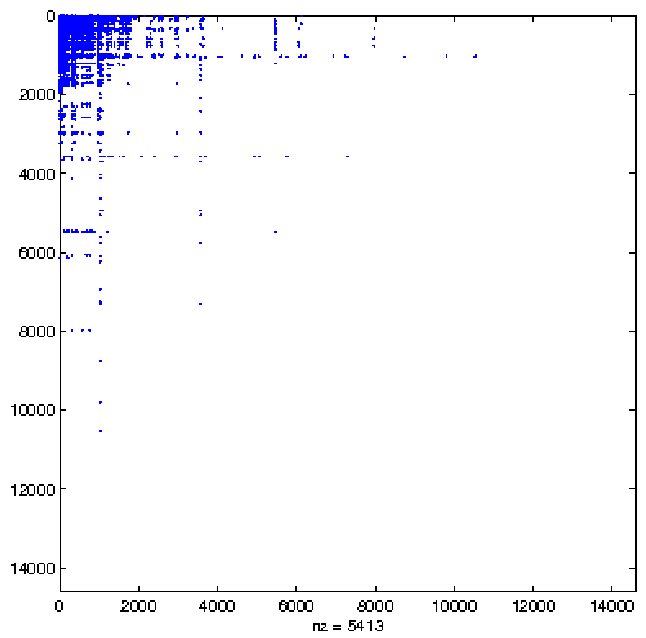
Figure 2: The inferred communication ties showing dense interconnection among the core 2,000 users.
Temporal Evolution
Adding a fourth dimension—Time—allowed the authors to see the "heartbeat" of the community. One bilingual sub-community showed massive spikes in activity every year corresponding to the month of Ramadan, proving that these digital spaces serve as vital cultural and religious touchstones.
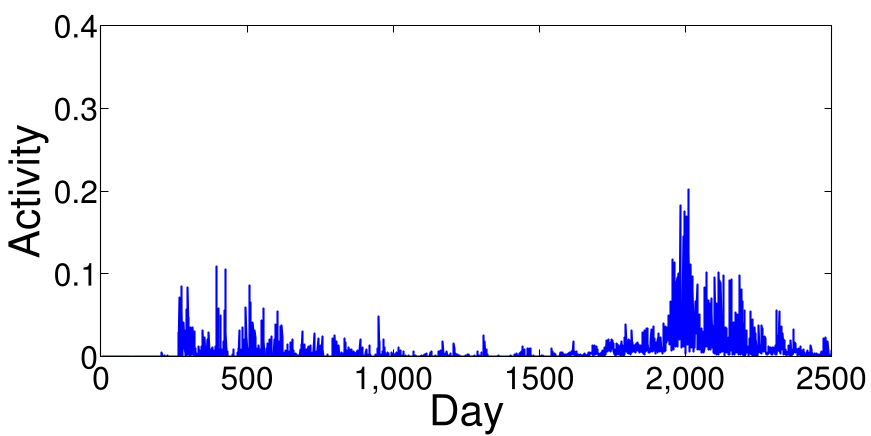
Figure 3: Periodic activity spikes indicating seasonal community engagement.
Critical Insight: Why This Matters
This work demonstrates that Tensor Analysis handles the "Vanishment of Meaning" caused by sparsity better than traditional methods. While a simple word-count might miss the context, tensor decomposition preserves the relationship between the who (users), the where (sub-forums), the what (tokens), and the when (time).
Future Outlook: While the accuracy is high, the authors note that as tensors become more multi-dimensional (sparser), the computational cost rises. Future research could integrate more modern SOTA word embeddings (like BERT or LLM-based vectors) into the "Token" mode to capture even deeper semantic nuances in code-switching.
Takeaway
For technology and policy, this research suggests that targeted recommendations (health, jobs, education) should not be based on a user's static profile, but on their membership in these fluid, latent sub-communities.