
Beyond Keywords: Enhancing Multimedia Recommendations through Synonymous Mood Vectors
Multimedia content recommendation in social networks using mood tags and synonyms
This paper introduces a mood-based multimedia recommendation method that utilizes the Arousal-Valence (AV) model and folksonomy data. By mapping internal mood tags and their synonyms to a 2D vector space, the system achieves superior recommendation accuracy compared to traditional keyword-based methods on the Last.fm dataset.
TL;DR
This research moves beyond simple keyword matching in Social Network Services (SNS) by leveraging the psychological Arousal-Valence (AV) model. By transforming ambiguous user tags and their synonyms into quantifiable 2D vectors, the method achieves a significantly higher "cost-satisfaction" for users searching for content that matches their emotional state.
Problem & Motivation: The "Happy" Synonym Trap
In modern folksonomy-based platforms like Last.fm or Instagram, users tag content with varied terminology. One user might tag a song as "cheerful," while another uses "joyful" or "bright." Traditional Query-by-Text systems often fail to link these synonyms, leading to sparse search results.
The authors argue that the industry is shifting from cost-effectiveness (price/performance) to cost-satisfaction (psychological fulfillment). To achieve this, recommendation engines must understand the latent mood of content rather than just the literal text of the tags.
Methodology: Vectorizing Emotion
The core of the paper lies in its 4-phase pipeline that translates subjective tags into objective coordinates:
- Tag Collection: Scraping multimedia metadata (titles, artists, and tag counts) via APIs.
- Synonym Mapping: Using a pre-defined table (based on the Thayer model) to group words like delight, satisfy, and amused under the core mood "Pleased."
- Vector Calculation: Each item's mood is calculated as a point in the AV space using weighted averages of its tags.
- Similarity Search: Recommendations are generated by calculating the Cosine Similarity between the user's query tag vector and the content's AV vector.
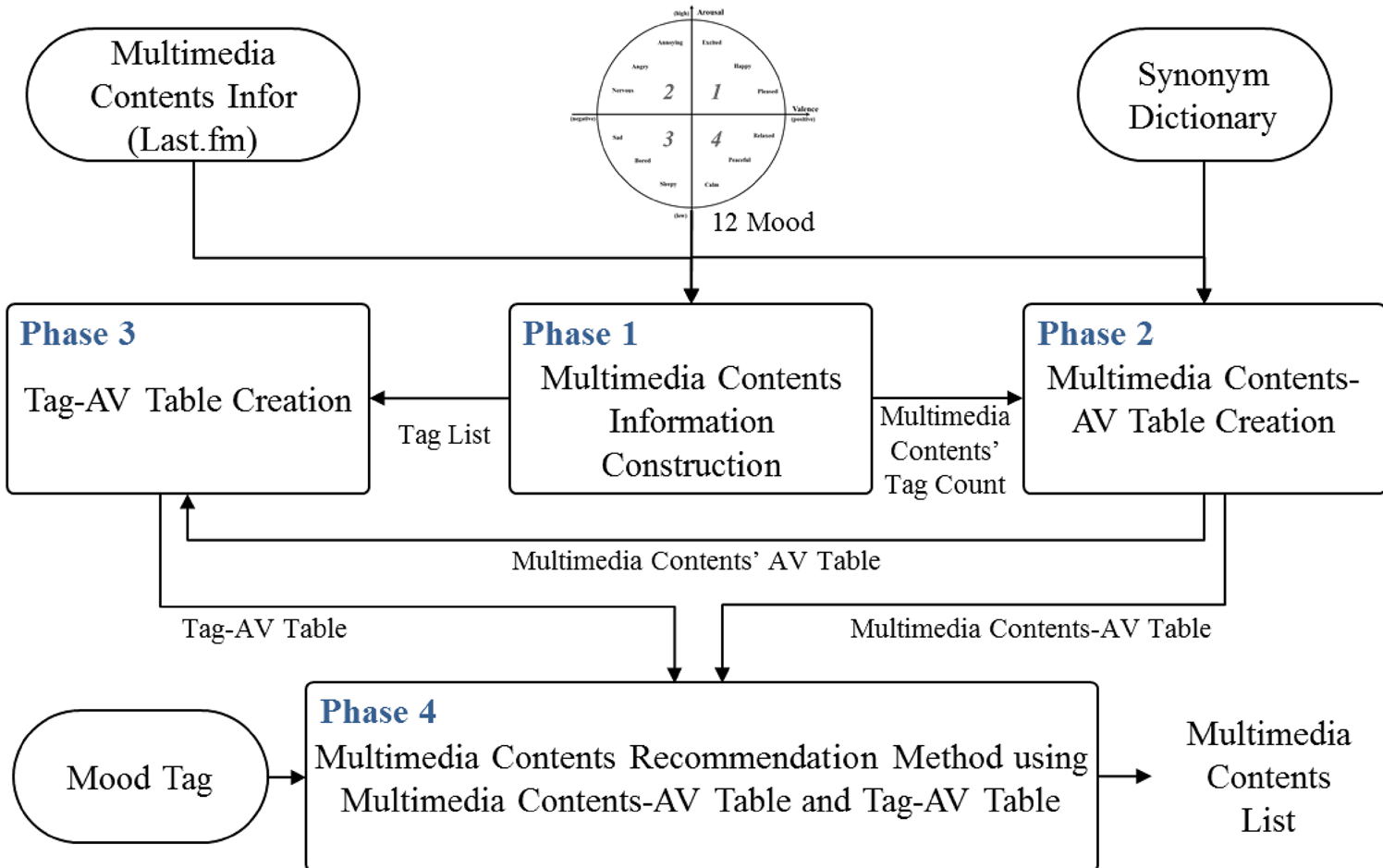 Figure: The end-to-end architecture of the mood-based recommendation engine.
The paper emphasizes the use of the Thayer Model, which divides emotions into four quadrants based on:
- Arousal: The strength of stimulation (High vs. Low energy).
- Valence: The degree of stability or pleasure (Positive vs. Negative).
Experiments: Quantifying Satisfaction
Using a dataset of 50,000 items from Last.fm, the authors conducted a rigorous analysis of how AV values were distributed.
- Verification: Statistics (ANOVA and Levene tests) confirmed that the 12 mood groups occupied distinct, non-overlapping regions in the AV space, proving the mathematical validity of the model.
- Performance: The comparison between the proposed method and the standard keyword-based approach was striking. While keyword searches have perfect precision at very low recall (finding exactly what is typed), they fall off rapidly. The proposed AV method maintained high precision even as more items were retrieved.
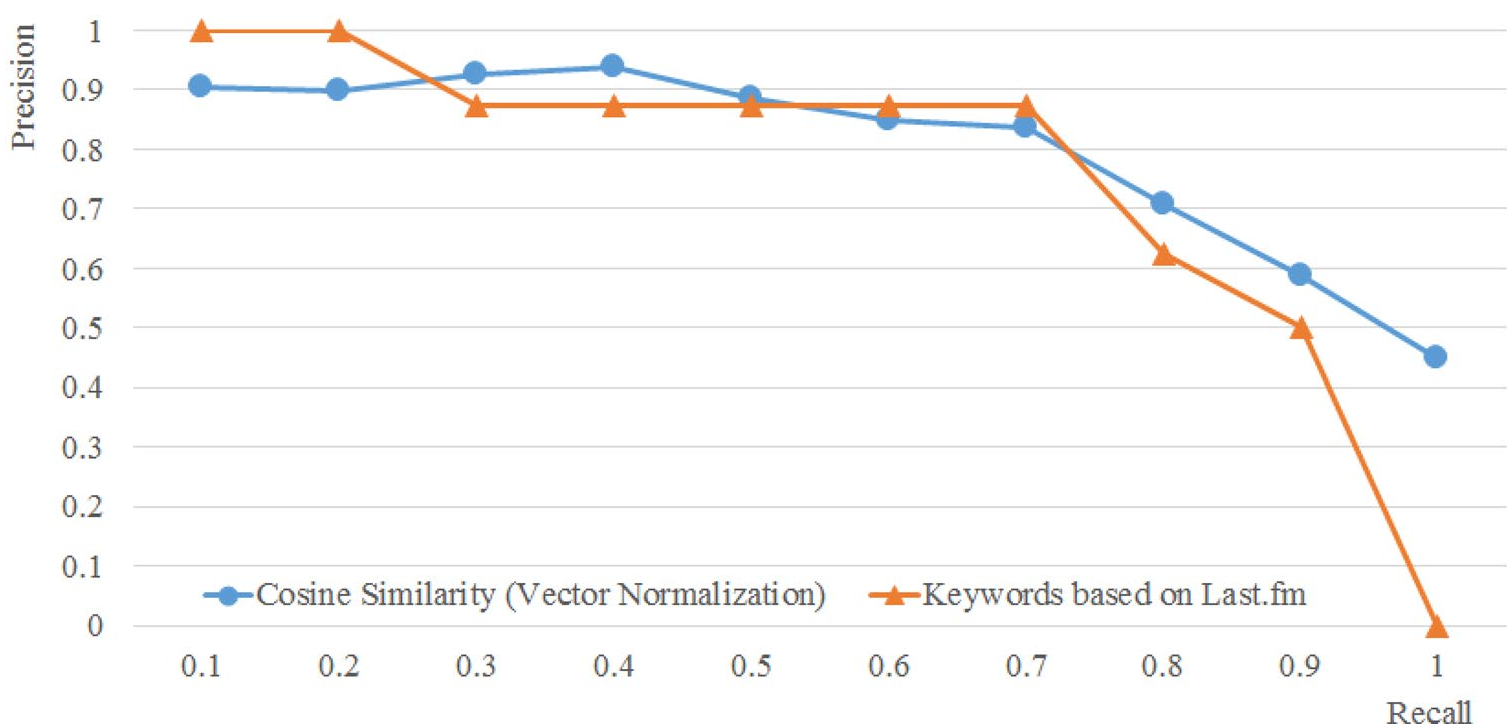 Figure: Average precision across different recall levels. The proposed method (using vector normalization) consistently outperforms traditional keyword methods as recall increases.
Critical Analysis & Conclusion
The beauty of this approach is its modality-agnostic nature. Unlike systems that require complex signal processing of audio or video, this method relies on the "wisdom of the crowd" (tags), making it easily deployable across different types of media (images, videos, or text).
Key Takeaways:
- Cosine > Distance: The study found that the angle (direction of mood) is a more accurate predictor of similarity than the absolute distance in the AV plane.
- Data Density Matters: Moods with more than 1,000 associated items (like "Happy" and "Sad") showed significantly better recommendation performance than sparse moods (like "Pleased").
- Versatility: This framework provides a bridge between psychological theory and scalable recommendation algorithms.
Future Outlook: The authors suggest expanding this to purely visual content, exploring how to auto-generate AV values for images without requiring existing tags—aiming to solve the "cold start" problem for new multimedia uploads.