
Hypergraph Dynamics: Revolutionizing Multimedia Summarization in Social Networks
Multimedia summarization using social media content
This paper introduces a novel multimedia summarization framework for Online Social Networks (OSNs). It leverages an hypergraph-based model to represent complex social entities and relationships, employing a biologically-inspired Artificial Bee Colony (ABC) algorithm for influence maximization to identify key multimedia objects for topic-centered summaries.
TL;DR
In the era of "Big Social Data," traditional text-based summaries are no longer sufficient. This paper presents a sophisticated framework that treats a Multimedia Social Network (MSN) as a weighted hypergraph. By utilizing a bio-inspired Artificial Bee Colony (ABC) algorithm and a specialized PCVR heuristic, the authors successfully distill high-impact, diverse, and continuous multimedia summaries from platforms like Flickr, outperforming baseline semantic filters.
Background & Motivation: Why Current Summarizers Fail
The explosion of multimedia data on platforms like Instagram and YouTube has created a "Visual Big Data" problem. Modern users don't just want a list of images; they want a "story" that is:
- Relevant (Priority to their keywords)
- Diverse (Variety across different users)
- Non-redundant (Low Repetitiveness)
- Coherent (Topical and temporal Continuity)
Existing techniques often treat images as isolated entities. This paper argues that images are embedded in a rich web of social interactions—likes, tags, and friendships—that must be exploited to determine an object's true "influence" and relevance.
Methodology: The Hypergraph Advantage
The core innovation lies in the data structure. While traditional graphs represent pairwise relationships, Hypergraphs allow an edge to connect any number of vertices simultaneously.
1. Modeling the MSN
The network is defined as , where vertices include Users, Objects (Photos/Videos), and Topics. An hyperedge can represent a complex action, such as "User A tagging User B in Photo C under Topic D."
2. The Bee's Wisdom: Influence Maximization
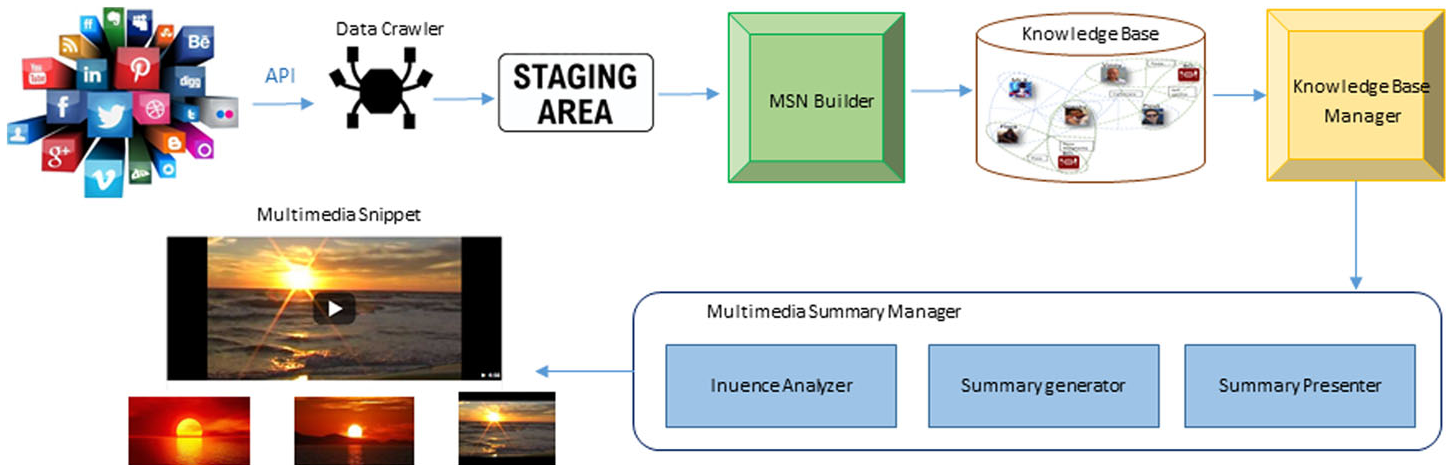
To find the best candidate objects, the authors use an Artificial Bee Colony (ABC) algorithm. They transform the hypergraph into a "Summarization Graph" where edges represent "recommending paths." The algorithm mimics bees foraging for food:
- Employer Bees: Rank the top-k most influential objects.
- Scout Bees: Explore neighboring nodes to avoid local maxima.
- Waggle Dance: Communicates the "profitability" (relevance) of a multimedia object.
3. The PCVR Optimization
Once the influential candidates are selected, a greedy strategy optimizes for the PCVR score: This ensures the final output isn't just a collection of popular photos, but a curated snippet that respects user preferences and structural variety.
Experimental Insights
The team tested their system on the Yahoo Flickr Creative Commons 100M (YFCC100M) dataset. They specifically looked at topics like landscapes and animals.
Key Metrics:
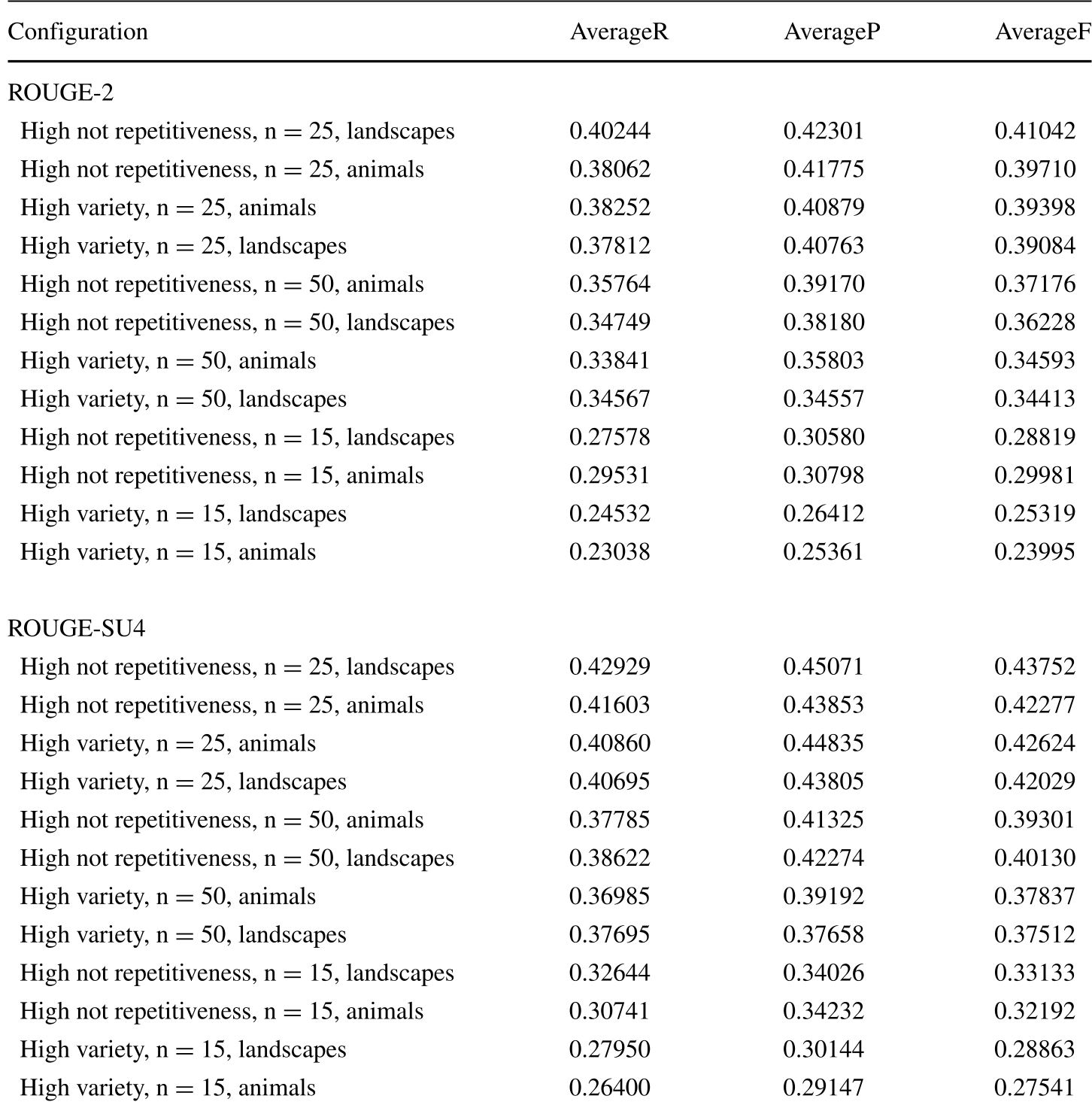
- Human Alignment: Using ROUGE metrics (standard in NLP), the system showed high alignment with human-curated summaries, particularly for medium-length summaries (25 items).
- The Variety vs. Repetition Trade-off: The configuration focusing on "High Not Repetitiveness" yielded the highest F-measures, suggesting that users value the exclusion of redundant content over extreme variety.
Critical Analysis & Conclusion
Takeaway
The shift from simple graph modeling to hypergraph analysis is a major step forward for OSN analytics. By treating influence as a "diffusion" process through these complex edges, the authors provide a more accurate proxy for what makes an image "relevant" to a community.
Limitations
While powerful, hypergraph building is computationally expensive. Although the authors used Apache Spark and GraphX to manage Big Data, the "Topic Learning" phase via LDA and high-level similarity computations remains a bottleneck for real-time applications.
Future Outlook
The next frontier for this research is likely the integration of Deep Hypergraph Manifold Learning, which could automate the feature extraction process even further, potentially allowing this framework to work across multiple fragmented social platforms simultaneously.
Keywords: Multimedia Social Networks (MSN), Hypergraph Modeling, Artificial Bee Colony, Visual Analytics, PCVR Model.