
Beyond the Word: Decoding the Media Aesthetics of Social Networks
Specifics of multimedia texts in the context of social networks media aesthetics
The paper explores "Multimedia Texts" as the primary communicative units in social networks, specifically within the Russian platform VKontakte. It defines these texts through the lens of Media Aesthetics, demonstrating how the integration of verbal and non-verbal signs facilitates social activity through irony and deconstruction.
TL;DR
In the digital age, a simple text post is no longer enough to capture attention. This paper argues that Multimedia Texts—complex hybrids of text, images, and memes—are the new currency of social networks. By leveraging irony, "handmade" aesthetics, and the deconstruction of official norms, these texts transform passive readers into active participants, achieving engagement rates dozens of times higher than traditional reporting.
The Shift to "Total Mediation"
Why do we feel more compelled to share a meme than a well-written news summary? The authors point to a phenomenon called "Total Mediation," where digital media influences the very consciousness of the user. Communication has shifted from information delivery to performance. On platforms like VKontakte, users aren't just reading; they are performing their social identity.
The core problem is that traditional "text" definitions are becoming obsolete. In social networks, a text isn't a static message; it is a "polycode unit" that includes the original post, the image, and the subsequent "endless chain of comments" and reposts.
Methodology: The Power of Deconstruction
The study utilizes Media Aesthetics as its primary framework, focusing on how users employ Deconstruction (a term from Derrida) to challenge official culture. This isn't just "protest" in the political sense, but an aesthetic one where the "high" culture is pulled down to the "low" through:
- Language Play: Breaking linguistic norms to create new meanings.
- Irony: Using humor to destroy the "official" gravity of an event.
- Collage: The intentional clashing of "beautiful" and "ugly" elements.
Case Study: One Event, Two Realities
The authors analyzed two news reports about traveler Fedor Konyukhov asking President Putin for help with a Mariana Trench expedition.
- Medusa (Formal): A verbal message on a black background.
- Lentach (Multimedia): A "handmade" style image with a biting ironic comment: "To find the bottom of the Russian economy."
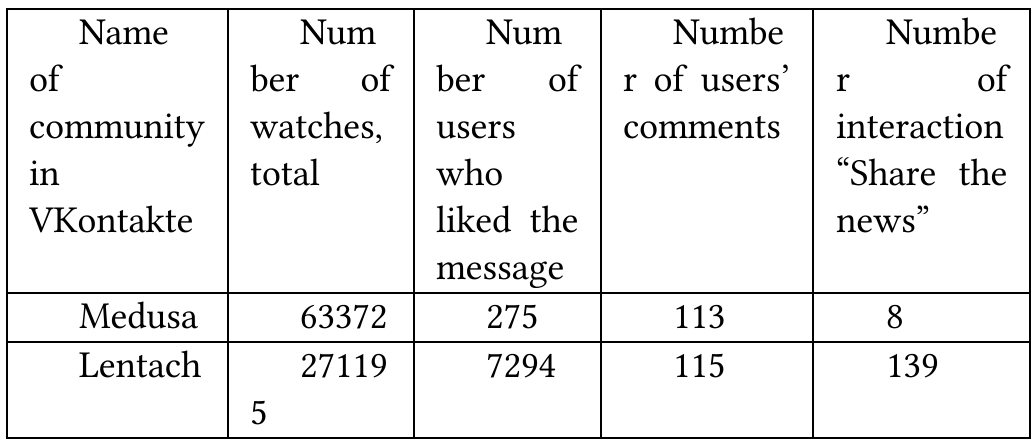
The results (as seen in Table 1 above) were categorical. While both posts had similar comment counts, the multimedia version from Lentach saw a massive surge in Likes and Shares. This proves that the multimedia text functions as a "marker of axiological deconstruction"—it gives the audience a "ready sample" for expressing their own emotions and protests.
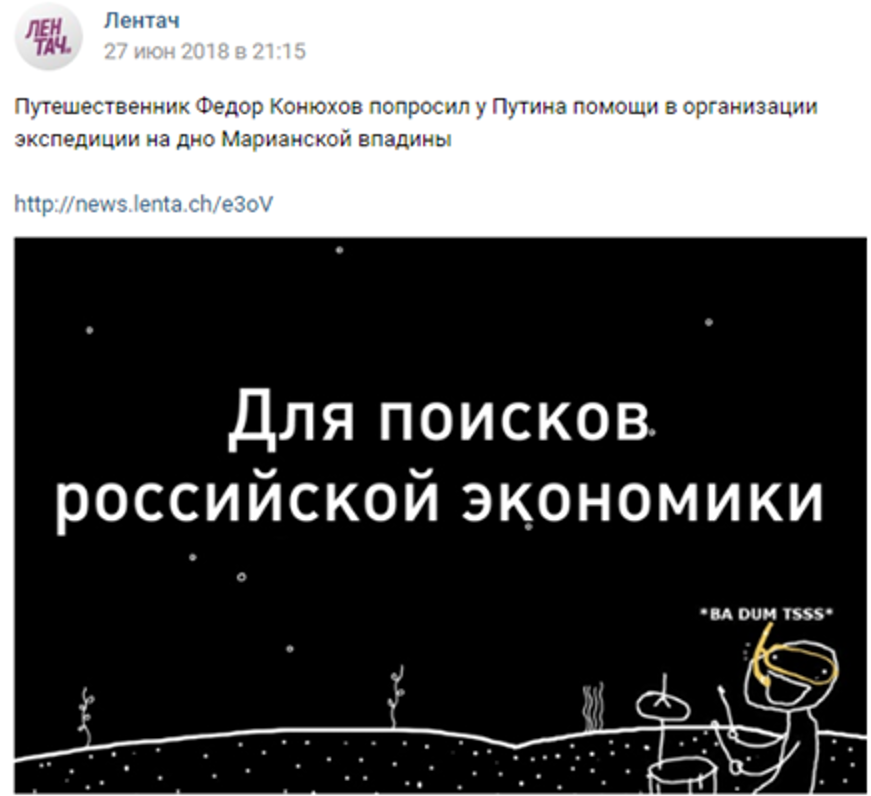 Figure: The Lentach post using simple graphics and irony to drive viral engagement.
Critical Insight: The "Handmade" Aesthetic
Perhaps the most intriguing finding is the rise of the "handmade" style. Young audiences prefer content that looks non-professional. This "conscious simplification" serves as a signal of authenticity and emotional materialization, contrasting sharply with the polished, sterile look of state-controlled media.
Conclusion & Future Outlook
The paper confirms that the "Industry of News" on social networks is no longer about journalism alone; it is about Media Aesthetics. The "repost" is the ultimate sign of success, indicating that a message has successfully materialized the user's sense perception.
Limitations: The study is localized to the Russian platform VKontakte and specific independent media outlets. However, the principles of deconstruction and the dominance of the audiovisual over the verbal are universal trends across the global digital landscape.