
Beyond Keywords: Decoding Image Search Intent via Multimodal Behavior Analysis
Multimodal Analysis of Image Search Intent: Intent Recognition in Image Search from User Behavior and Visual Content
This paper presents a multimodal framework for automatically recognizing user search intent in image retrieval systems. By leveraging a combination of implicit user interactions (mouse/keystrokes), eye gaze, physiological signals, and visual content features, the authors achieved an F-1 score of 0.722 in classifying three distinct intent categories: finding, re-finding, and entertainment.
TL;DR
Why do we search for images? Sometimes we need a specific file (finding), sometimes we want to see a photo we've seen before (re-finding), and often we are just bored (entertainment). This paper introduces a system that identifies these motivations within the first 30 seconds of a session by watching how you move your mouse, where your eyes linger, and what kind of images you click on, achieving a high 0.722 F-1 score in user-independent tests.
The "Why" Behind the Click: A Missing Dimension
Most search engines are "intent-blind." They treat a query for "Geneva" the same way whether you are a tourist looking for a specific landmark or a bored student looking for pretty landscapes. The authors argue that since the motivation dictates the interaction, understanding the "why" allows the system to change its ranking strategy—shuffling specific matches to the top for "re-finding" tasks or offering a diverse, aesthetic gallery for "entertainment."
Methodology: Listening to the Unconscious
The researchers didn't just ask users what they wanted; they monitored their physiological and behavioral "leakage."
1. The Interaction Pipeline
The study captured four distinct data streams:
- Implicit Interactions: Mouse movements, clicks, and keystroke dynamics.
- Eye Gaze: Fixation counts and scan paths using a Tobii tracker.
- Spontaneous Reactions: Facial Action Units (FAUs) and Galvanic Skin Response (GSR).
- Visual Content: Features like JCD (texture/color) and Visual Sentiment (adjective-noun pairs) of the images the user interacted with.
2. Experimental Setup
51 participants performed 7 tasks across the three intent categories. The authors custom-built an image retrieval tool powered by the Flickr API to log every micro-interaction.
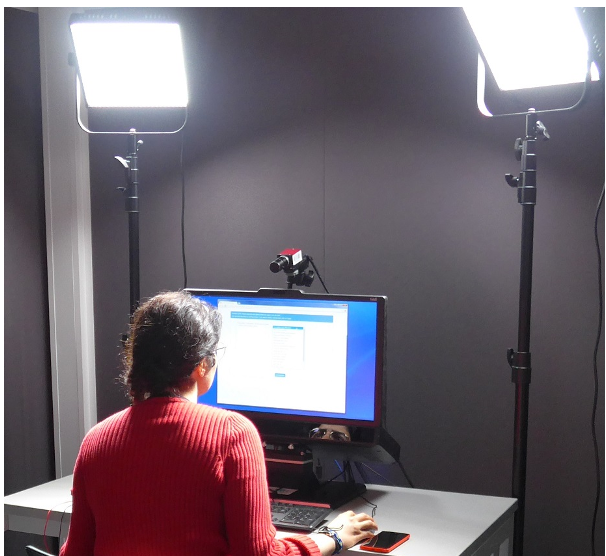 Figure 1: The custom search interface used to collect synchronized multimodal data.
Key Insights: What Truly Signals Intent?
The study’s statistical analysis yielded fascinating "behavioral signatures" for each intent:
- Entertainment: Users move the mouse faster, browse more images, but use shorter, simpler queries. They spend more time looking at the enlarged "hero" image.
- Re-finding: This is the most "cognitive" task. Users use complex, specific queries (high semantic complexity) and spend more time looking at thumbnails to spot the target.
- The Surprise: Despite the theory that emotions drive search, Facial Expressions and GSR were the weakest predictors. The most "unobtrusive" features—mouse movements and eye gaze—were the most informative.
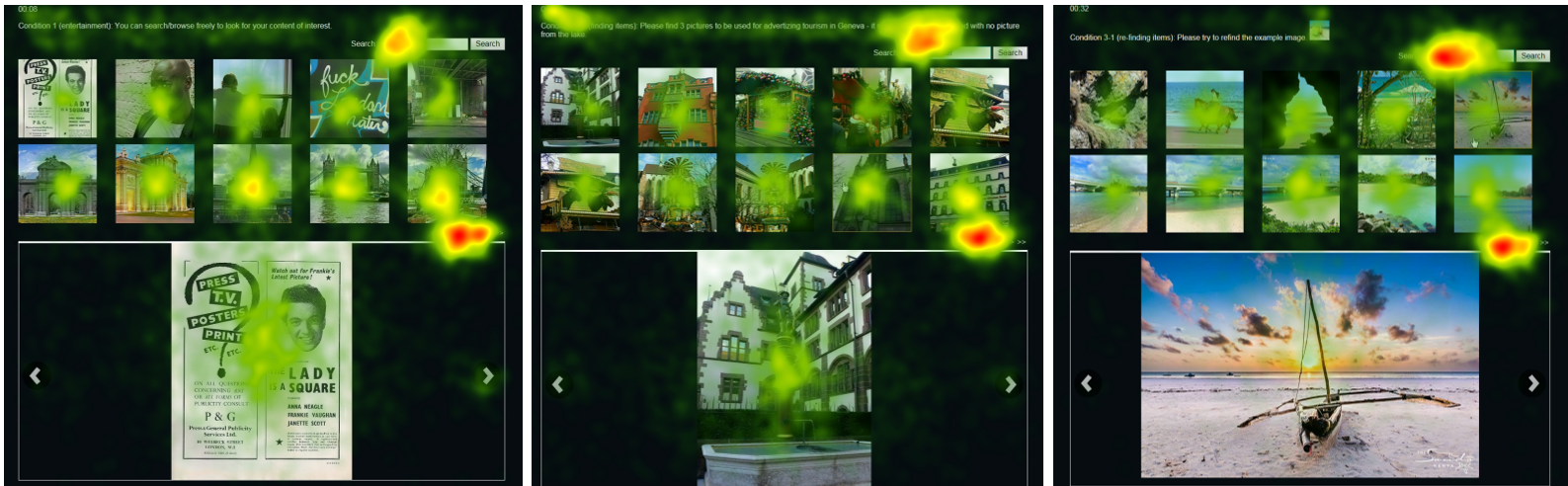 Figure 2: Heatmaps showing distinct gaze patterns for Entertainment (focus on central image) vs. Re-finding (scanning thumbnails).
Results & Fusion
The researchers tested Early Fusion (combining features) vs. Late Fusion (combining classifier decisions). Late Fusion of Interaction and Visual Content proved superior.
| Modality | 30s Window (F-1) |
|---|---|
| Implicit Interaction | 0.637 |
| Visual Content (VSO) | 0.612 |
| Late Multimodal Fusion | 0.722 |
| Baseline (ZeroR) | 0.264 |
Note: Performance improves as the interaction window increases from 10s to 30s, highlighting the temporal nature of intent manifestion.
Critical Perspective: Is it Intent or just Task Difficulty?
The authors candidly discuss a major challenge in this field: Cognitive Load Confounding. Is the user showing "re-finding" behavior, or are they simply showing "difficult task" behavior? Because re-finding is inherently harder than browsing, the behavioral signals might be capturing stress/effort rather than the intent itself. Future work must disentangle task difficulty from the underlying motivation.
Conclusion: Toward Intent-Aware AI
This research moves us closer to search engines that "feel" our needs. By proving that intent can be recognized through standard peripherals (mouse/camera) in near real-time, it opens the door for adaptive UX where the interface itself morphs based on the user's psychological state.
Takeaway: In the future of IR, the way you move your cursor might be just as important as the keywords you type.