
Decoding the Searcher's Mind: Multimodal Intent Recognition in Image Retrieval
Multimodal analysis of user behavior and browsed content under different image search intents
The paper presents a multimodal framework for the automatic recognition of image search intent (Finding, Re-finding, and Entertainment). By fusing implicit user interactions, eye gaze, physiological responses, and visual content features, the authors achieved a user-independent F-1 score of 0.722, demonstrating that intent can be predicted within the first 30 seconds of a session.
TL;DR
Why are you searching for an image? Whether you are looking for a specific photo you've seen before (Re-finding), searching for a new asset for a project (Finding), or simply browsing to kill time (Entertainment), your behavior tells a story. This paper demonstrates a system that can predict these intents with over 72% accuracy by analyzing your mouse movements, eye gaze, and the very images you click on—all within the first 30 seconds of your session.
Contextualizing Intent: Beyond Keywords
In the world of Information Retrieval (IR), the "Query" is only the tip of the iceberg. A user typing "Geneva" might want a specific landmark (transactional) or might just be bored and looking for beautiful scenery (entertainment). Traditional systems that treat these users identically are sub-optimal. The authors argue that by understanding the Why behind the search, systems can provide better-ranked results and a more tailored user experience.
The "Digital Breadcrumbs" Methodology
The researchers built a custom image search interface powered by the Flickr API and monitored 51 participants through a rigorous experimental setup. Unlike previous studies that relied on a single data source, this work looks at:
- Implicit Interactions: Clicks, keystrokes, and the "fluidity" of mouse movements.
- Physiological Signals: Galvanic Skin Response (GSR) and facial expressions to capture the "knowledge emotions" like confusion or interest.
- Eye Gaze: Where you look—and for how long—reveals cognitive load and focus.
- Visual Content: Features like color (JCD), texture (Tamura), and sentiment (VSO) of the images the user chooses to view.
 Figure 1: The experimental setup used to capture synchronized multimodal data during search tasks. Note the integration of eye tracking and physiological sensors.
Key Insights: What Truly Matters?
One of the paper's most significant findings is the hierarchy of features. Surprisingly, while emotions are theoretically central to the search process, facial expressions and physiological responses (GSR) were the weakest predictors.
Instead, mouse movements and eye gaze patterns were the MVP (Most Valuable Predictors).
- Entertainment seekers moved the mouse faster but across shorter distances, spending more time looking at enlarged images.
- Re-finders (looking for a specific mental image) were more focused on thumbnails and spent significantly more time on complex query formulation.
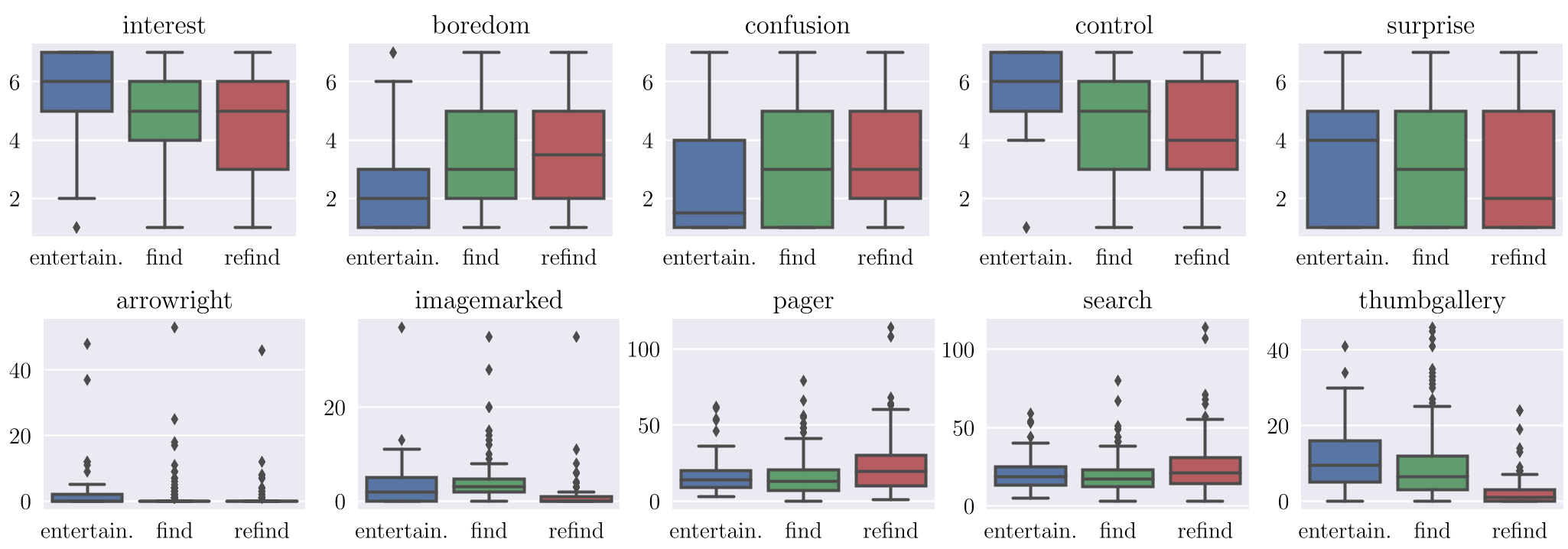 Figure 2: Statistical breakdown of reported emotions and interaction patterns across different intents. Note the clear distinction in click behavior between Finding and Entertainment.
Performance and Multi-modal Synergy
The authors compared Early Fusion (concatenating all data into one giant vector) vs. Late Fusion (letting each modality "vote" on the result). Late Fusion was the clear winner.
Combining user behavior with visual content features achieved an F-1 score of 0.722. This is particularly impressive because the model is user-independent—it doesn't need to know you personally to guess your intent; it only needs to see how someone like you behaves.
| Feature Group | Precision (30s) | Recall (30s) | F-1 Score (30s) |
|---|---|---|---|
| Implicit Interaction | 0.619 | 0.682 | 0.637 |
| Eye Gaze | 0.562 | 0.572 | 0.536 |
| Late Fusion (Best) | 0.743 | 0.748 | 0.722 |
Critical Perspective: The Road Ahead
While the results are promising, the study highlights the "vagueness" of the Entertainment intent, which was frequently confused with other categories. Furthermore, the absence of significant facial expressions during tasks suggests that "lab-induced" search tasks might not elicit the same emotional intensity as real-world information needs.
Future Outlook: The ability to capture these signals unobtrusively (without bulky sensors) via standard webcams and mouse logs makes this highly deployable. Imagine a search engine that realizes you are struggling to "re-find" a specific image and automatically shifts its UI to emphasize thumbnails and visual similarity tools, or one that detects you are "browsing for fun" and offers more aesthetically pleasing, diverse content.
Conclusion
This work moves us closer to "empathetic" retrieval systems. By looking beyond the search bar and observing the user's behavioral "body language," we can bridge the gap between what a user types and what they truly desire.