
MDDA: Unmasking Social Media Rumors via Disentangled Representation and Domain Adaptation
18849_Multimodal Disentangled Domain Adaption for Social Media Event Rumor Detection.
The paper proposes Multimodal Disentangled Domain Adaptation (MDDA), a novel framework for detecting rumors in emerging social media events. By combining multimodal VAEs and adversarial learning, MDDA achieves SOTA performance on Twitter benchmarks by transferring knowledge from labeled source events to unlabeled target events.
TL;DR
The battle against online rumors is a cat-and-mouse game where new "events" (topics) emerge daily without labeled data for training. Most AI models fail because they learn the topic of the rumor rather than the essence of the deception. This paper introduces MDDA (Multimodal Disentangled Domain Adaptation), a framework that strips away the event-specific context to isolate the "rumor style," allowing models to detect lies in never-before-seen events with unprecedented accuracy.
Background: The Entanglement Problem
When we train a model to detect rumors about a "Terrorist Attack," the model often mistakenly learns that the word "Attack" or images of "Police Cars" are indicators of a rumor. However, in a new event—say, a "Pop Star Scandal"—those features are useless.
The authors identify two fundamental challenges:
- Entanglement: Rumor indicators (style) are buried within event topics (content).
- Domain Gap: New events have zero labels, and the distribution of information differs significantly from past data.
Methodology: The "Style vs. Content" Split
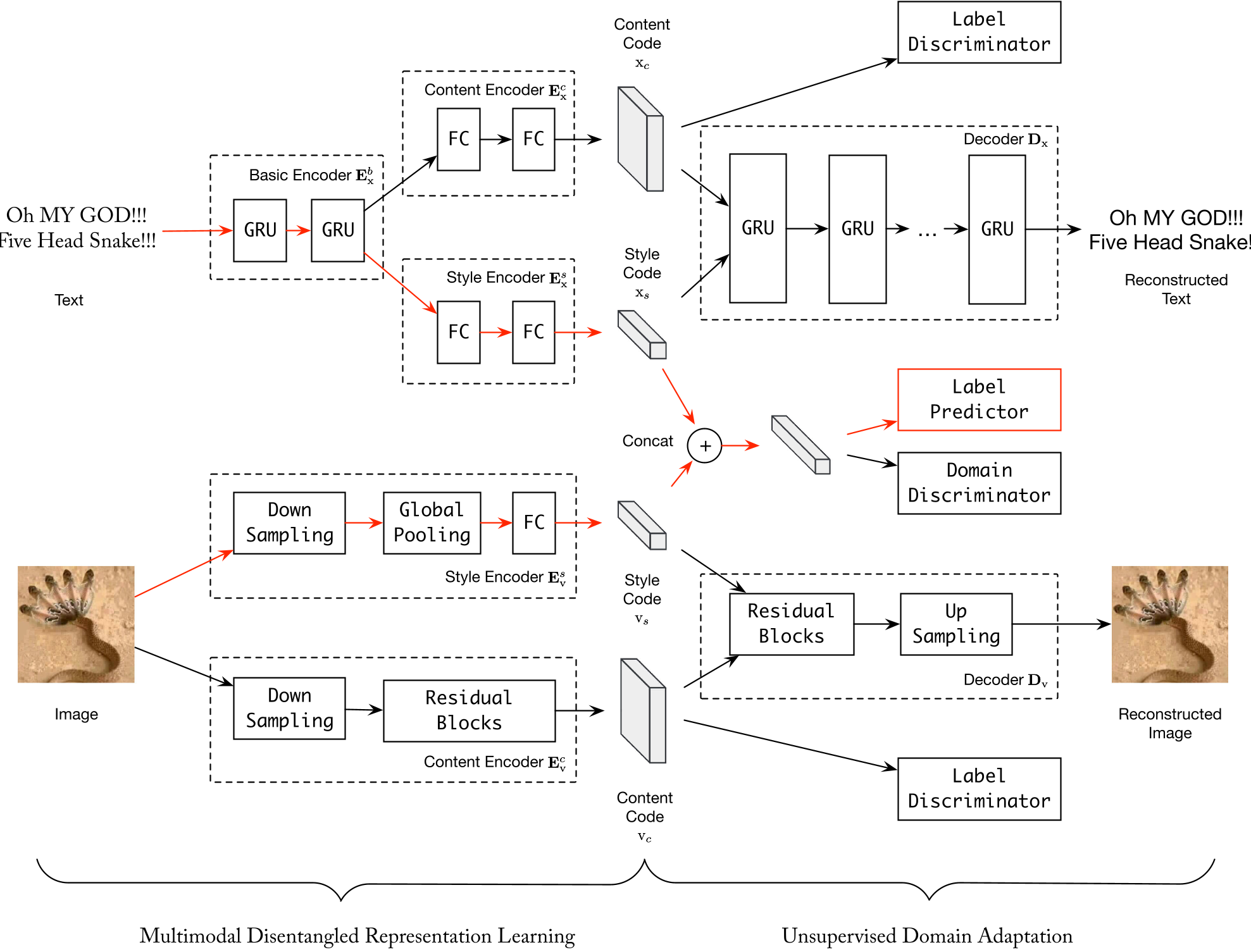
The core innovation of MDDA is its ability to decompose a multimedia post into two distinct latent spaces.
1. Multimodal Disentangled Learning
For both text and images, MDDA uses a specialized architecture to separate features:
- Text (VAE-based): Uses a basic encoder to get a hidden state, followed by two separate heads: a
Content Encoderand aStyle Encoder. - Image (CNN + AdaIN): Uses strided convolutions and Instance Normalization. Content is captured through residual blocks, while style is extracted via global average pooling.
- Adversarial Filtering: To ensure the "Content" space doesn't "leak" rumor information, a discriminator tries to predict the label from the content code. The encoder is then trained to "fool" this discriminator, effectively purging rumor-related signals from the content branch.
2. Domain Adversarial Alignment
To solve the "New Event" problem, MDDA employs a Domain Discriminator. It looks at the "Style" features and tries to guess which event they came from. By using a Gradient Reversal Layer (GRL), the style encoders are forced to generate features that are identical across all events. If the model can't tell which event the style belongs to, it has successfully learned event-invariant rumor indicators.
Experiments: Dominating the Twitter PHEME Benchmark
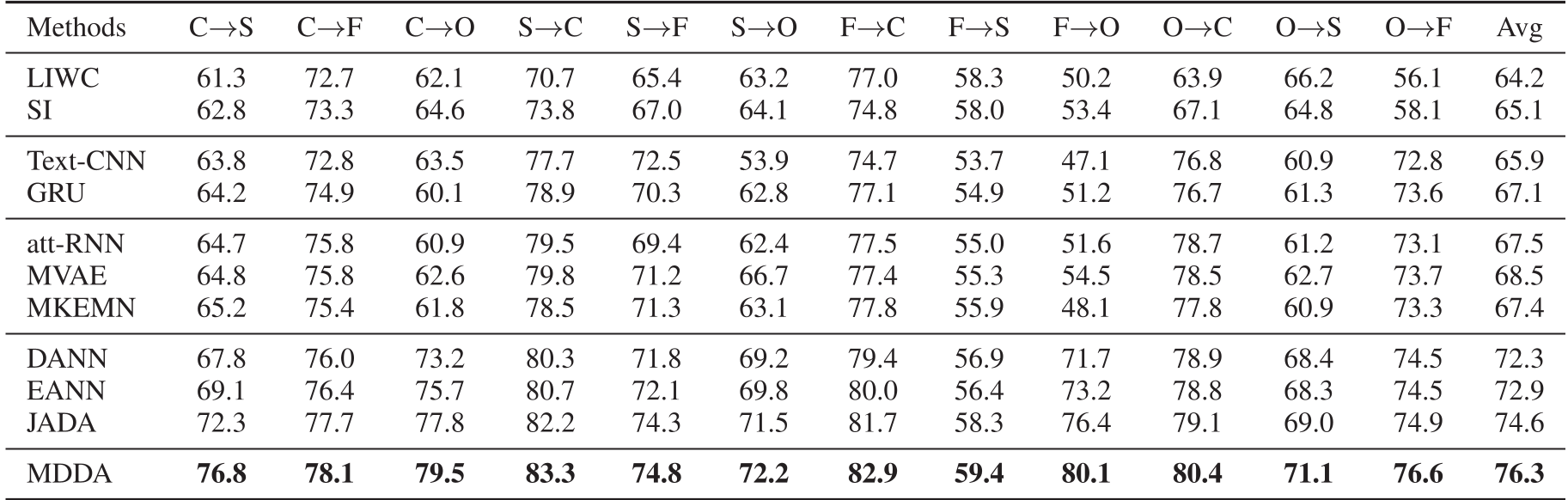
The researchers tested MDDA on nine prominent Twitter events (e.g., Charlie Hebdo, Sydney Siege, Ferguson Unrest).
Key Findings:
- Standard Deep Learning Fails: Models like Text-CNN and GRU perform poorly on "Target" events because they overfit to the vocabulary of the "Source" events.
- The Power of Disentanglement: Even MDDA without images (MDDA w/o V) outperformed many multimodal baselines, proving that how you represent data is more important than how much data you have.
- SOTA Achievement: MDDA reached an average accuracy of 76.3% in Experiment One and 68.4% in the significantly harder Experiment Two (transferring to very small, niche events), beating previous leaders like JADA and EANN.
Visualizing the Disentanglement
The efficacy of the model is best seen in the t-SNE visualizations below. In the "Style Space" (a & c), rumors (blue) and non-rumors (red) are clearly separated. However, in the "Content Space" (b & d), the two classes are mixed. This proves the model successfully isolated the "rumor DNA" from the "event body."
Conclusion & Insights
MDDA shifts the paradigm from "Topic Detection" to "Style Analysis." By treating rumor detection as a domain adaptation problem and leveraging disentangled representations, the authors provide a robust solution for real-world social media moderation where labeled data is a luxury we rarely have in time to prevent a rumor from going viral.
Future Outlook: While MDDA is powerful, its visual style space is currently less discriminative than the text space. Future work combining this disentanglement with Large Vision-Language Models (LVLMs) could provide even deeper semantic understanding of deceptive imagery.