
Beyond Single Labels: Mastering User Interests via Multimodal Joint Representations
Multimodal Joint Representation for User Interest Analysis on Content Curation Social Networks
This paper introduces a multimodal joint representation framework for "pins" on Content Curation Social Networks (CCSNs) like Pinterest and Huaban. It combines image features from a fine-tuned multilabel CNN and text features from Word2Vec using a Deep Boltzmann Machine (DBM) to capture consistent and complementary user interest patterns.
TL;DR
Understanding user interests on Content Curation Social Networks (CCSNs) like Pinterest is challenging due to the noisy and multifaceted nature of user-generated content. This paper presents a framework that moves away from "one-size-fits-all" labels. By analyzing "re-pin trees," the authors generate category distributions that reflect diverse user perspectives, then fuse visual and textual features using a Multimodal Deep Boltzmann Machine (DBM) to create a unified interest vector.
The Problem: The Noise in Curation
On platforms like Huaban or Pinterest, a "pin" consists of an image and a snippet of text. Previous research suffered from two main bottlenecks:
- Semantic Ambiguity: An image of a cute puppy in a garden could be categorized as "Pets," "Photography," or "Nature." Forcing a model to pick just one (Multiclass) ignores the underlying distribution of human interest.
- Fragmented Fusion: Most systems use "Late Fusion," where image and text are processed entirely separately and only combined at the very last step, missing out on the "interplay" between the two.
Methodology: The Power of the Re-pin Tree
The authors' core insight is that the social behavior of the crowd acts as a natural annotator.
1. Automatic Annotation via Re-pin Trees
When a user "re-pins" an image into their own board, they assign it a category. By tracing the entire "re-pin tree" (the history of everyone who saved that image), the authors calculate an Interest Distribution. If 60% of people saved an image under "Architecture" and 40% under "Design," the label becomes a vector [0.6, 0.4] rather than a single choice.
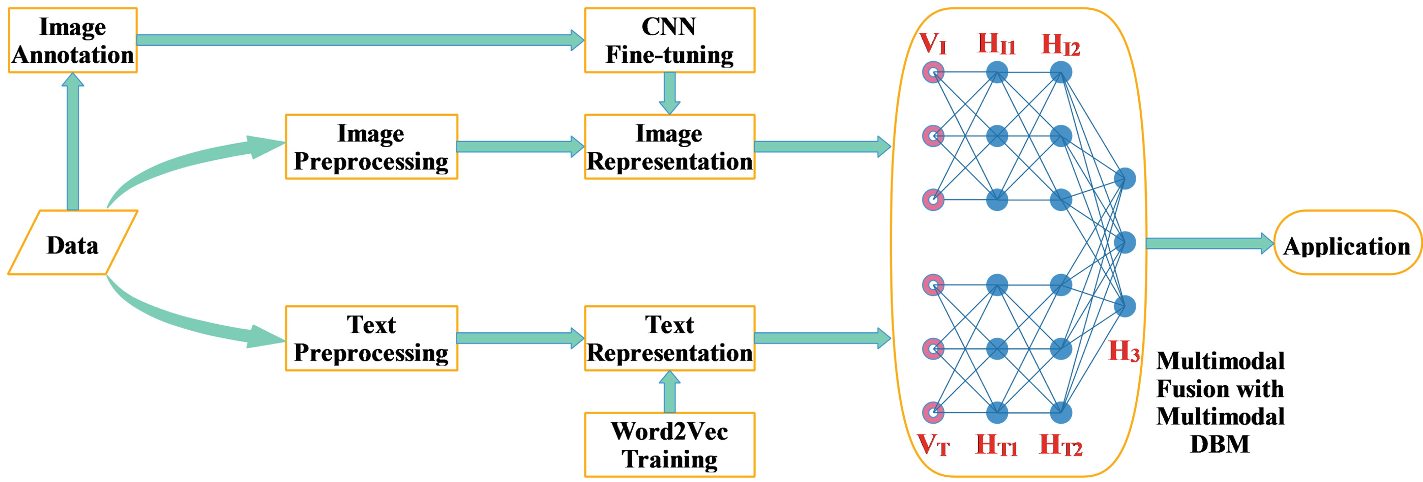
2. The Multimodal Architecture
The framework utilizes a three-stage pipeline:
- Visual Branch: An AlexNet architecture modified into a multilabel regressor using a sigmoid cross-entropy loss to predict the interest distribution.
- Textual Branch: Descriptions are processed via Word2Vec and averaged into a mean vector to capture semantic intent.
- Fusion Layer: A Multimodal DBM sits atop both branches. Because DBMs are probabilistic and generative, they can "imagine" or reconstruct missing text if a user uploads an image without a description.
Experiments & Key Results
The authors tested their approach on data from Huaban, a major Chinese CCSN.
Significant Accuracy Boost
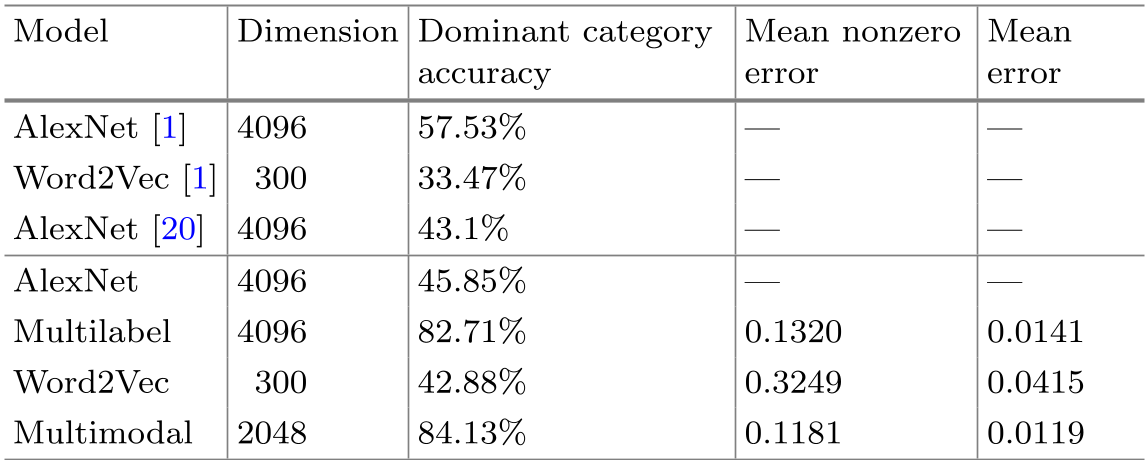
By switching from a standard multiclass AlexNet to their Multilabel distribution-based approach, the accuracy of predicting the dominant category skyrocketed from 45.85% to 82.71%. This proves that teaching a model about the "relatedness" of categories (e.g., Art and Illustration) makes it much smarter.
Performance in Recommendation
The framework was evaluated on "Board Category Recommendation." In cases where users haven't categorized their boards, the multimodal representation achieved a Top-1 MRR of 62.35%, outperforming both purely visual and purely textual models.
Critical Insight: Why This Matters
The real value of this work lies in its Inductive Bias. It acknowledges that user interest is not a point, but a manifold. By using DBMs, the authors provide a robust solution for real-world social media data, which is notoriously "incomplete" (missing descriptions).
Looking Ahead
While this paper uses AlexNet and Word2Vec (standard for its time), the Methodology of distribution-based labeling is perfectly suited for modern Transformers and Contrastive Learning (like CLIP). The transition from "what is in this image" to "why are users interested in this image" marks a pivotal shift toward more human-centric AI in recommendation systems.
Conclusion
This research establishes that multimodal joint representations, powered by crowd-sourced interest distributions, are essential for capturing the nuance of social curation. It provides a blueprint for building recommendation engines that truly understand the "why" behind the "click."