
MDBN: Bridging Social Structure and User Sentiment through Multimodal Deep Learning
Multimodal Learning Based Approaches for Link Prediction in Social Networks
This paper introduces a Multimodal Deep Belief Network (MDBN) for predicting link sign values (positive/negative) in social networks by fusing network structural features with user comment text. The proposed model achieves state-of-the-art performance, reaching 88.50% accuracy on the Wikipedia RfA dataset.
TL;DR
Predicting whether a social interaction is positive or negative (link prediction) is a complex task that goes beyond simple graph topology. This paper proposes a Multimodal Deep Belief Network (MDBN) that combines 26 structural features with textual comments. By using a deep stacking strategy, the model achieves a SOTA accuracy of 88.50%, proving that the synergy between "how users are connected" and "what users say" is key to understanding social dynamics.
Problem & Motivation: The Silo Effect in Social Computing
In the context of social networks like Wikipedia’s Request for Adminship (RfA), a "link" isn't just a connection—it's a vote of confidence or a sign of opposition. Prior works typically tackled this from two isolated angles:
- Structural Analysis: Looking at in-degrees, out-degrees, and common neighbors.
- Opinion Mining: Analyzing the sentiment of comments.
However, these features exist in vastly different mathematical spaces. A simple concatenation (feature fusion) often fails to capture the non-linear correlations between a user's structural position and their verbal expression. The authors argue that a joint representation, learned through deep abstraction, is necessary to map these different modalities into a shared "concept" space.
Methodology: The Architecture of Fusion
The research explores two primary ways to fuse data: Shallow MDBN and Deep MDBN.
1. Structural and Textual Feature Extraction
- Network Features: The authors use 26 features, including degree statistics and 18 diverse "triadic" relationship types (neighbor features).
- Textual Features: A Bag-of-Words (BOW) model is applied to comments, refined by selecting the top 2000 most frequent words to manage dimensionality.
2. Deep MDBN (The Winning Architecture)
Instead of concatenating raw data, the Deep MDBN follows a hierarchical strategy:
- M-DBN Part A: A dedicated DBN abstracts the 26 structural features.
- M-DBN Part B: A separate DBN abstracts the sparse BOW vectors.
- The Joint Layer: The top hidden layers of both DBNs are concatenated and fed into higher-level RBMs to learn "cross-modal" features.
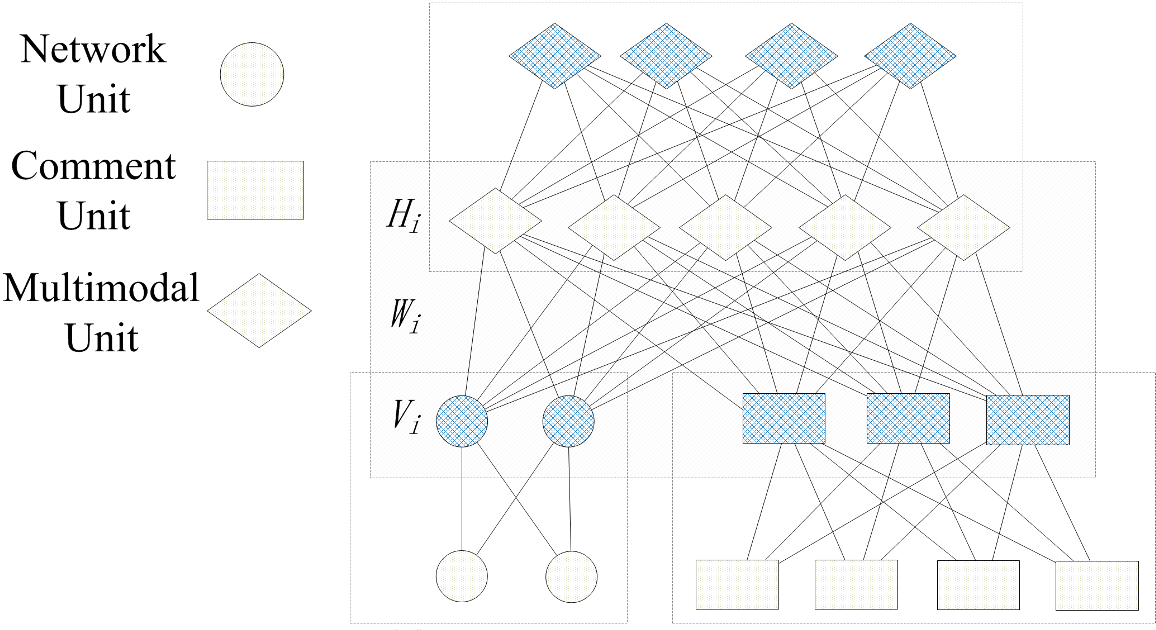 Fig 1: The Deep Multimodal DBN structure showing the fusion of hidden representations.
Experiments & Results
The model was evaluated on the Wikipedia RfA dataset, consisting of 50,000 balanced samples.
Performance Gains
The Deep MDBN outperformed all baselines, including Support Vector Classifiers (SVC) and single-modality DBNs.
| Method | Features Used | Accuracy (%) |
|---|---|---|
| SVC (Basline) | Link Structure | 81.17 |
| SVC | Link + Text | 85.96 |
| MDBN (Shallow) | Link + Text | 87.75 |
| MDBN (Deep) | Link + Text | 88.50 |
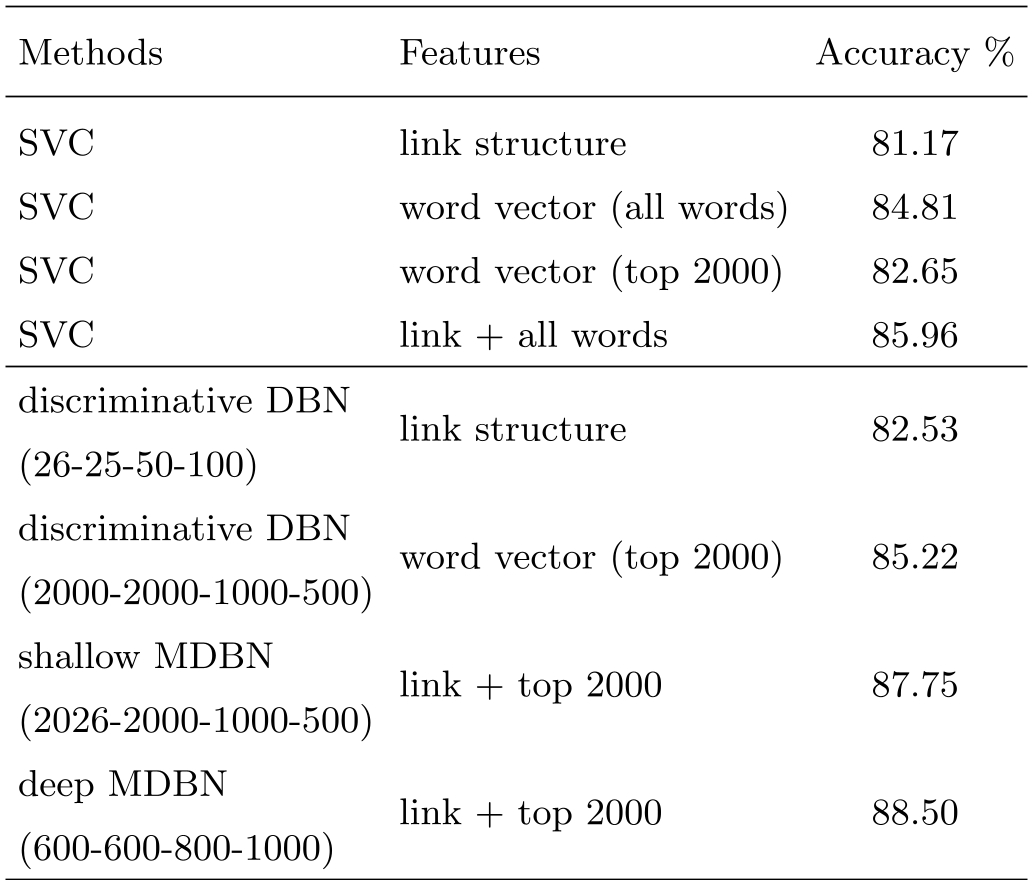 Fig 2: Comparative analysis of different models showing the superiority of Deep MDBN.
Key Insights from Ablation
- Abstraction Matters: Even a single-modality DBN outperformed the SVC on the same features, indicating that the non-linear transformations in DBNs create more "linearly separable" feature spaces.
- Deep vs. Shallow: The 0.75% advantage of Deep MDBN over Shallow MDBN confirms that aligning modalities at a higher level of abstraction is more effective than merging them at the raw input level.
Critical Analysis & Conclusion
Takeaway
The paper successfully demonstrates that link prediction is inherently a multimodal problem. By employing Restricted Boltzmann Machines (RBMs) as building blocks, the authors created a robust framework for capturing the latent "link value" that resides at the intersection of network topology and natural language.
Limitations & Future Outlook
While powerful, the model is computationally expensive (requiring 40 hours of training in the reported setup). Furthermore, the use of Bag-of-Words is somewhat dated by modern standards; replacing the text DBN with a Transformer-based encoder (like BERT) or using Graph Neural Networks (GNNs) for the structural side could likely push these results even further.
The transition from "feature engineering" to "deep representation learning" in social link prediction is clearly validated here, paving the way for more sophisticated multimodal AI in social computing.