
MMDB: Refined Personality Mining via Multimodal Mixture Density Boosting
Multimodal Mixture Density Boosting Network for Personality Mining
This paper introduces the Multimodal Mixture Density Boosting Network (MMDB), a novel deep learning framework for automated personality mining from video data. By integrating visual, auditory, and textual features using a unique cascaded architecture, MMDB achieves state-of-the-art performance in predicting Big Five personality traits, particularly excelling in small-sample scenarios common in psychological research.
Executive Summary
TL;DR: The Multimodal Mixture Density Boosting Network (MMDB) is a specialized deep learning architecture designed to infer "Big Five" personality traits from video, audio, and text. By combining Mixture Density Networks (MDN) with Dynamic Cascade Boosting, it successfully overcomes the chronic "small-data" problem in psychology, outperforming traditional SVR and standard Deep Learning models in predictive accuracy.
Academic Positioning: This work bridges the gap between traditional psychological assessment and modern computer vision. It represents one of the first successful applications of a hybrid probabilistic-cascaded boosting architecture to the domain of Multimodal Personality Recognition.
The Challenge: Why Personality Mining is "Hard"
Personality mining (predicting traits like Openness or Neuroticism) faces two major hurdles:
- The Modal Gap: Text alone (what people say) is insufficient. Facial expressions (visual) and tone (auditory) carry crucial signals that are often lost in unimodal models.
- The "Data Desert": Unlike ImageNet, psychological datasets (like the YouTube Personality dataset) are often small (N < 500) due to the high cost of expert labeling. Standard Deep Learning models tend to overfit these small samples, while simple regressions lack the capacity to model complex human behaviors.
Methodology: The MMDB Architecture
The authors propose a pipeline that balances feature fusion with a robust regression backend.
1. DCA Feature Fusion
Instead of simple concatenation, the model uses Discriminant Correlation Analysis (DCA). This technique maximizes correlations across corresponding features (e.g., video and audio) while decorrelating features of different classes, effectively mitigating the Small Sample Size (SSS) problem where features outnumber observations.
2. Mixture Density Network (MDN)
Rather than predicting a single point value (which is prone to noise), the MDN predicts a Gaussian Mixture Distribution.
- Intuition: It models the probability of a personality score, allowing the network to capture the inherent uncertainty and variance in human impressions.
3. Dynamic Cascade Boosting
Inspired by the gcForest (Deep Forest) concept, this layer passes the data through multiple levels of gradient boosting estimators.
- How it works: Each layer evaluates the Mean Accuracy (MA). If the performance improves, it adds a new layer. This "adaptive depth" acts as a powerful regularizer for small datasets.
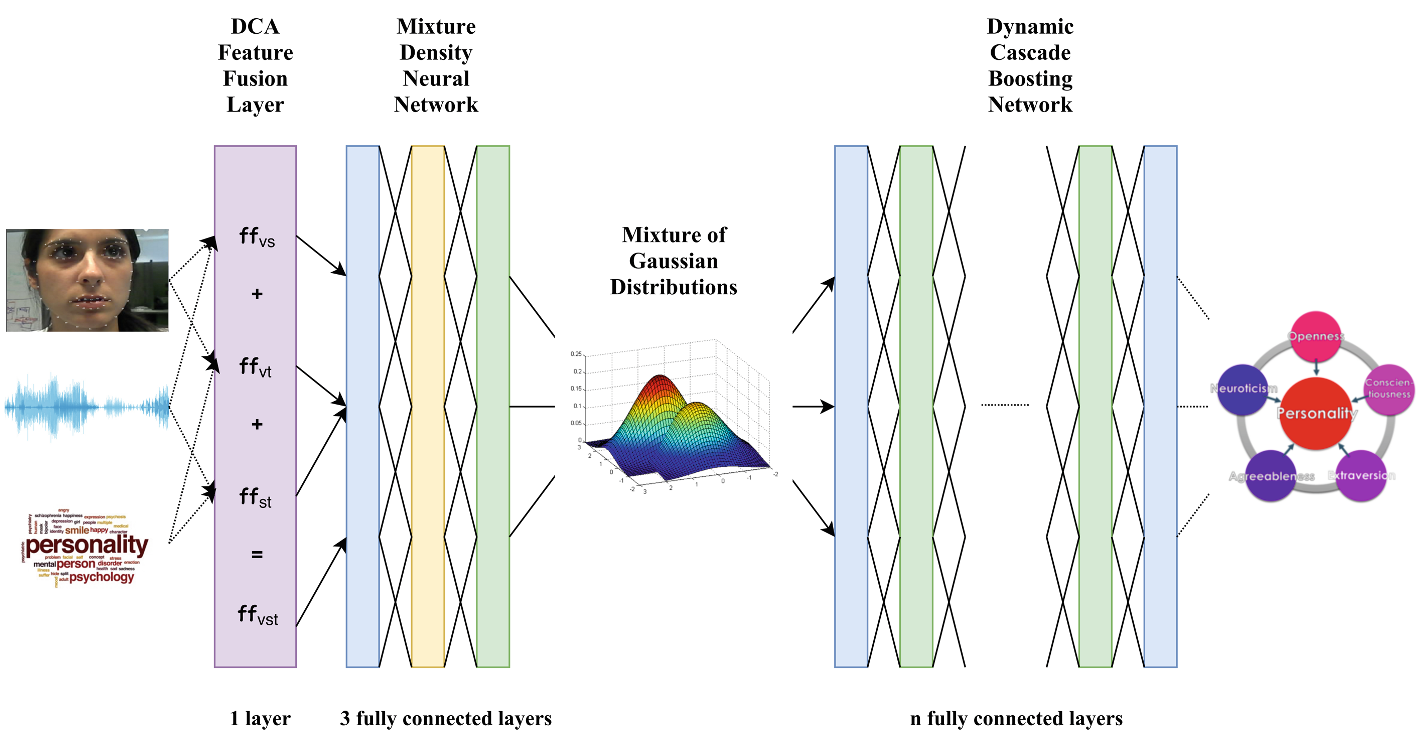 Figure 1: The Cascaded Structure of the MMDB Network, showing the flow from MDN to the Boosting layers.
Experiments & SOTA Performance
The authors tested MMDB on the First Impressions (FI) and YouTube (YT) datasets.
- Small Data Superiority: On the YT dataset (only 404 clips), the MMDB model significantly outperformed standard Neural Networks (NN) and Support Vector Regression (SVR).
- Rank Correlation: The model's Spearman’s rho (a measure of how well it ranks individuals by trait) was substantially higher than baselines, proving that the model "understands" the relative differences between personalities better than traditional tools.
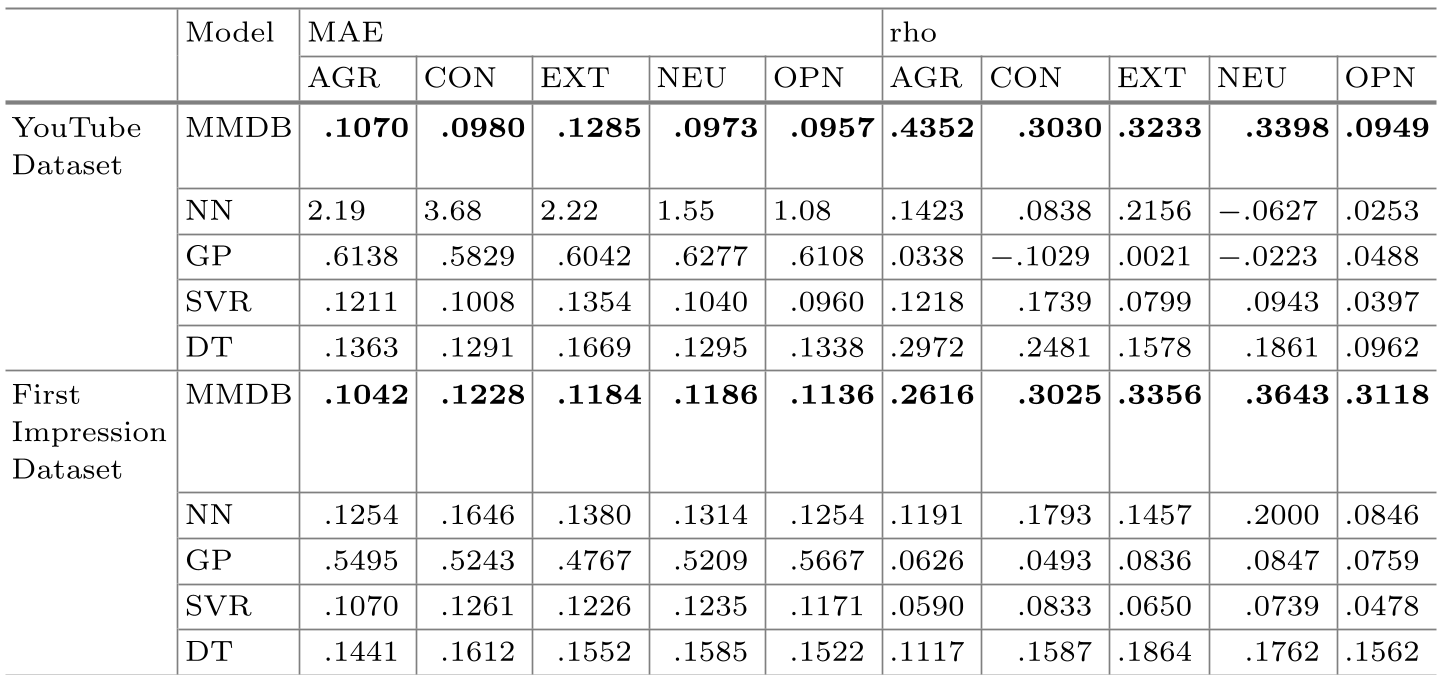 Table 1: Performance comparison across Big Five traits. MMDB shows a clear edge in MAE and Rho.
Component Insight: Does Boosting Help?
The authors performed an ablation study by comparing the full MMDB with a version lacking the boosting layers (MMD). The inclusion of Dynamic Cascade Boosting consistently lowered the Root Mean Squared Error (RMSE), confirming that the iterative refinement of boosting is key to high-precision regression.
Critical Analysis & Future Outlook
Takeaway: MMDB proves that 1,000-layer Transformers aren't always the answer. For specialized domains like psychology, structural priors (like MDN for uncertainty and Boosting for small-sample efficiency) are more effective.
Limitations:
- The model still relies on manual feature extraction (OpenCV, LIWC).
- Transfer learning across datasets (e.g., using FI results to predict YT) remains challenging, likely due to the subjective nature of ground-truth labeling across different research groups.
Future Work: The authors aim to evolve this into an End-to-End system that processes raw video pixels directly while maintaining the robust statistical properties of the mixture density approach.
Senior Editor's Note: This paper is a masterclass in "Architecture Engineering" for small data. It acknowledges that when you can't have "Big Data," you must have "Smart Layers."