
Integrating IoT and AI: A Multimodal Blueprint for the Future of Precision Agriculture
Towards a Multimodal System for Precision Agriculture using IoT and Machine Learning
This paper presents a multimodal precision agriculture system integrating IoT for real-time environmental monitoring and Machine/Deep Learning for predictive analytics. The system combines smart irrigation, fertilizer recommendation, crop disease detection using CNNs (reaching 99.6% accuracy on specific crops), and damage prediction via ensemble learning.
TL;DR
This study proposes a comprehensive multimodal framework for precision agriculture, bridging the gap between hardware and software. By combining IoT-based sensor networks for irrigation and fertilization with Deep Learning (DenseNet/ResNet) for disease detection and Gradient Boosting for damage prediction, the system achieves diagnostic accuracies as high as 99.6%.
Background: Why the "Siloed" Approach Fails
Agriculture is entering its 4.0 era, yet many regions still suffer from low efficiency and resource waste. The core problem identified by the authors is the "disconnect" in research: IoT papers often ignore the advanced predictive power of Deep Learning, while ML papers often use curated datasets without considering real-world sensor constraints. This paper attempts to synthesize these domains into a single, beginner-friendly multimodal pipeline.
Methodology: The Multimodal Architecture
The proposed system is divided into four functional pillars:
1. The IoT Backbone (Irrigation & Fertilizers)
The hardware layer utilizes NodeMCU (ESP8266) to interface with soil moisture sensors and N-P-K (Nitrogen, Phosphorus, Potassium) sensors.
- Smart Irrigation: Uses a threshold-based logic implemented via Arduino IDE to trigger relay modules for water pumps.
- Smart Fertilization: Involves a Modbus-interfaced N-P-K sensor. The system doesn't just report values; it calculates specific fertilizer dosages (e.g., Urea, MOP, DOP) required to reach optimal growth targets for crops like wheat.
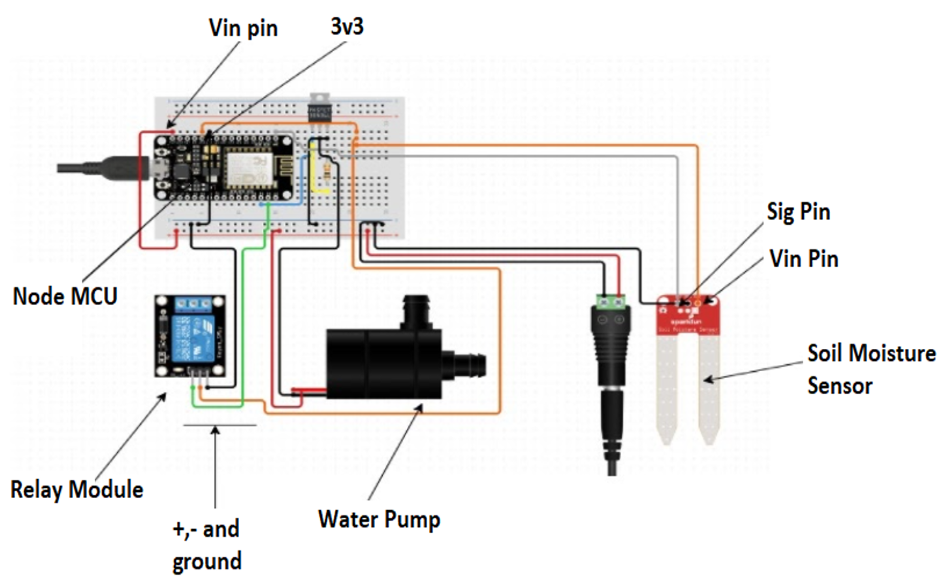 Fig 1. Logical flow and circuit design for the smart irrigation and fertilizer modules.
2. Deep Learning for Disease Detection
The authors leveraged the PlantVillage dataset (38 classes) and employed Transfer Learning. By taking pre-trained weights from ImageNet, they fine-tuned three SOTA architectures:
- VGG16: Robust for smaller datasets.
- ResNet50: Utilizes residual connections to prevent gradient vanishing.
- DenseNet121: Exploits dense blocks to maximize feature reuse.
The modification phase included a unique Concat Layer that merges features from MaxPooling2D and Flatten layers before passing them to a Dense layer with a 0.5 Dropout rate to prevent overfitting.
3. Machine Learning for Damage Prediction
For predicting damage tiers (Alive, Damage due to other causes, Damage due to pesticides), the team utilized a dataset of 88,858 records. They performed intensive feature engineering, such as using rolling windows to calculate moving averages for "Estimated Insect Counts," a critical Inductive Bias for temporal data.
Experimental Results & Critical Insights
The experimental evaluation highlights the superiority of modern ensemble and dense architectures:
- Vision Performance: DenseNet121 proved superior in complexity-heavy tasks, achieving 97.3% accuracy on Tomatoes and 99.6% on Peach.
- Tabular Performance: LightGBM (LGBM) outperformed XGBoost and Random Forest with a 94% accuracy. The authors noted that LGBM's Gradient-based One-Side Sampling (GOSS) provided better computational efficiency and accuracy than XGBoost's histogram-based filters.
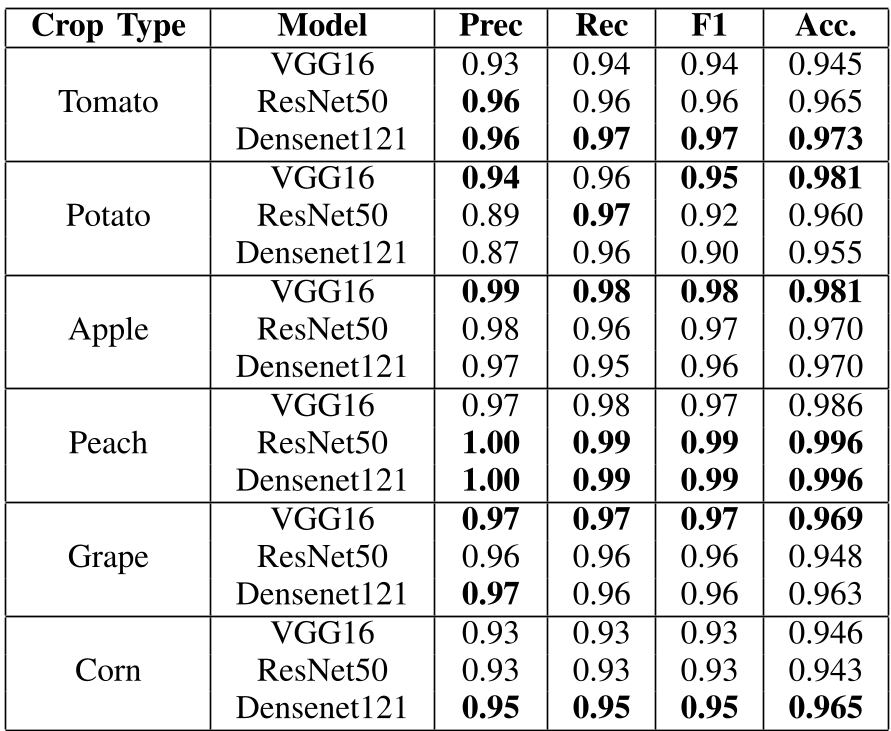 Table 1. Evaluation of Pre-trained CNN models across various crop categories.
Critical Analysis & Conclusion
While the system presents a robust end-to-end vision, there are two primary areas for future optimization:
- Class Imbalance: The ML models struggled with "minority classes" (rare causes of damage). The precision for Class 2 damage was significantly lower than Class 0.
- On-Device Deployment: While the CNN models are accurate, their computational weight suggests a need for Quantization or the use of MobileNetV3 for actual deployment on the NodeMCU-linked edge devices.
The Takeaway: Precision agriculture is no longer just about "measuring"; it’s about "prescribing." By linking N-P-K sensors directly to a chemical-balance calculation and images to a SOTA classifier, this multimodal approach provides a practical roadmap for reducing resource waste and improving food security.