
Multimodal Teaching & Learning Analytics: Bridging the Gap Between Teacher Delivery and Student Engagement
Multimodal Teaching and Learning Analytics for Classroom and Online Educational Settings
This paper presents a multimodal analysis framework to evaluate teaching effectiveness and student engagement in both traditional classrooms and online settings. By leveraging automated audio-visual feature extraction (OpenFace, OpenPose) and machine learning classifiers, it predicts student attention levels and correlates speaker delivery styles with audience response.
TL;DR
This paper introduces a comprehensive multimodal framework designed to solve a critical challenge in modern education: How can we objectively and automatically measure teaching effectiveness? By analyzing synchronized audio-visual data from both teachers and students, the research utilizes computer vision and speech processing to predict engagement levels with up to 89% accuracy, paving the way for real-time pedagogical feedback.
The Motivation: Moving Beyond Subjective Observation
In traditional settings, a teacher's "success" is often judged by end-of-semester surveys or sporadic peer observations—methods that are inherently biased and delayed. In the booming world of online learning (MOOCs), teachers often feel like they are "speaking into a void."
The author's insight is that engagement is a two-way street. To truly understand a learning environment, we must measure the speaker's delivery (prosody, gestures, posture) and the audience's reception (eye gaze, head pose, facial expressions) concurrently.
Methodology: The Multimodal Pipeline
The research employs a sophisticated pipeline to transform raw video into actionable educational insights.
1. Data Collection & Feature Extraction
The study utilizes two distinct datasets:
- Dataset-1 (Audience Focus): Students watching motivational clips.
- Dataset-2 (Dual Perspective): Seminar sessions with cameras facing both the speaker and the audience.
The framework integrates several state-of-the-art toolkits:
- OpenFace: Extracts 2D/3D facial landmarks, eye gaze vectors, and Facial Action Units (FAUs).
- OpenPose: Tracks body skeletal movements to analyze teacher gestures.
- OpenSMILE & Praat: Process acoustic features like pitch, intensity, and rhythm to characterize "liveliness."
2. Prediction Pipeline
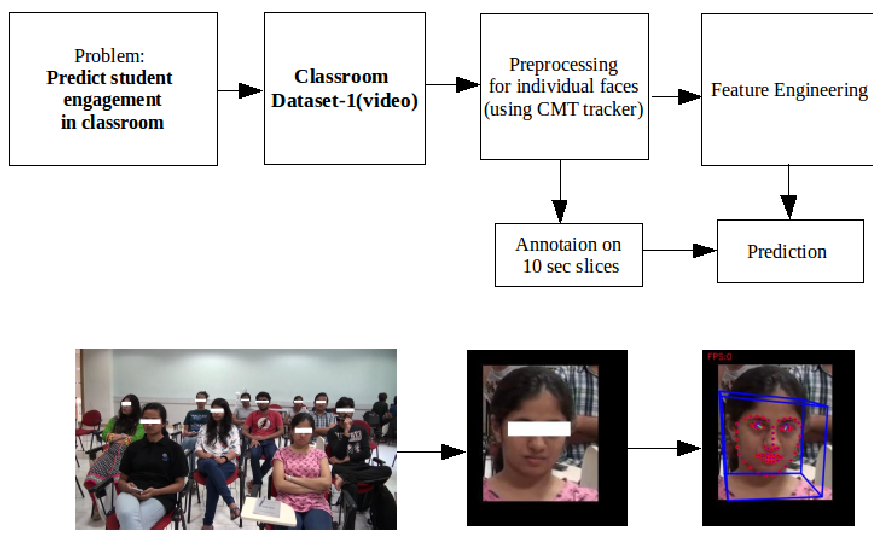
The architecture for student engagement prediction follows a structured flow: Face detection -> Feature Extraction -> Feature Engineering (Mean/Std Dev) -> Classification.
Experimental Evidence of Success
The paper proves that a combination of head pose and eye gaze is more predictive than either feature alone. Interestingly, while Gaze alone reaches 85% accuracy, the "Best Combination" (using a subset of 8 optimized features) pushes the performance to 89%.
| Metric | Gaze Only | Pose Only | Best Combination |
|---|---|---|---|
| Accuracy | 0.85 | 0.82 | 0.89 |
| F1 Score | 0.90 | 0.89 | 0.93 |
| AUC | 0.70 | 0.74 | 0.83 |
Table: Performance comparison across different feature sets using Linear SVM.
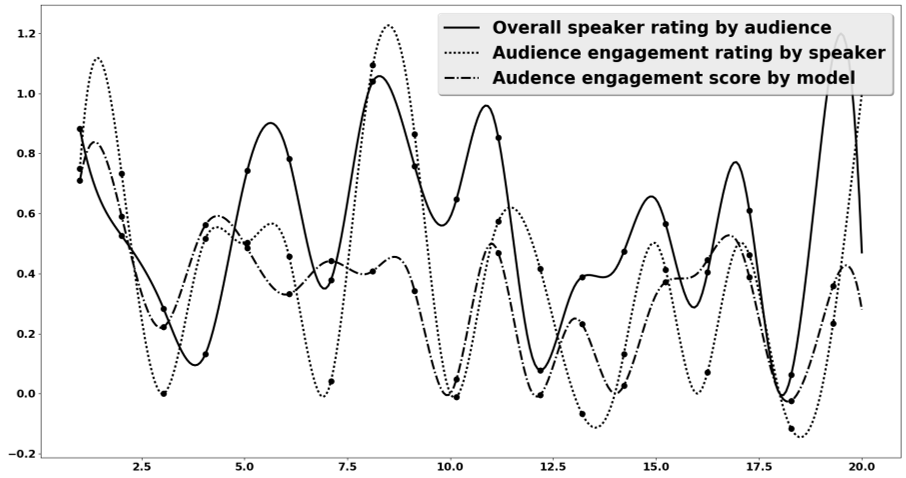
Furthermore, the study validated that automatic engagement models correlate highly with manual student ratings. This means the AI can "sense" the room similarly to how human students do.
Deep Insight: Why Does This Matter?
The core value of this work lies in its scalability. By proving that automated tools like OpenFace can reach parity with human evaluators (Cohen's kappa 0.51), the research suggests that we can provide automated "rehearsal" tools for teachers or real-time "boredom alerts" in online classrooms.
Limitations & Future Work
While the results are promising, the dataset size (10-29 subjects) is relatively small. The author notes that future work will involve:
- Transfer Learning: Applying models trained on TED talks to classroom settings.
- Deep Learning: Moving beyond SVMs to more complex temporal models (like LSTMs or Transformers) to capture the "rhythm" of a lecture.
Final Summary
As education becomes increasingly hybrid, the ability to quantify the "unquantifiable"—interest, enthusiasm, and focus—is essential. This paper provides a robust blueprint for how multimodal AI can transform educational data into better learning outcomes.