
MODdEA: Mastering the Fragmented Landscape of Disconnected Pareto Optimization
A Multiobjective Evolutionary Algorithm That Diversifies Population by Its Density
The paper introduces MODdEA (Multiobjective Density Driven Evolutionary Algorithm), a novel MOEA engineered specifically for Truly Disconnected Pareto Fronts (TYD-MOPs). By utilizing a Binary Space Partitioning (BSP) tree to estimate solution density in the decision space rather than the objective space, it achieves SOTA coverage on complex, fragmented Pareto sets.
TL;DR
In the realm of Multiobjective Optimization Problems (MOPs), "Truly Disconnected" Pareto Fronts (TYD-MOPs) represent a significant challenge where the optimal solutions aren't just one continuous curve, but several isolated islands. MODdEA (Multiobjective Density Driven Evolutionary Algorithm) breaks the limitations of traditional MOEAs by ditching objective-space heuristics in favor of a Binary Space Partitioning (BSP) tree-based density estimation in the decision space. This allows it to "see" the gaps in the search space and successfully navigate fragmented optimal regions where other SOTA models get lost.
The "Imaginary Gap" Problem in Traditional MOEAs
Most existing algorithms, like the famous NSGA-II, utilize a "crowding distance" metric to ensure population diversity. However, this metric is almost exclusively calculated in the objective space.
For problems where the true Pareto Front (PF) is disconnected, these algorithms often try to maintain a uniform distribution by placing individuals in the "empty" space between segments. This is a fundamental mistake: by assuming the front is a connected segment (the "Neighborhood Assumption"), they waste search effort on "phantom" solutions that don't exist. The result? They fail to discover isolated islands of optimality, leaving the Pareto set incomplete.
Methodology: The Architecture of MODdEA
The core innovation of MODdEA lies in its ability to remember and learn from the entire search history, rather than just the current generation.
1. The BSP Tree Archive
MODdEA stores every evaluated solution in a BSP Tree. This choice isn't just for storage; it's a computational shortcut. The tree naturally partitions the n-dimensional decision space into hyper-rectannels. The size of these rectangles provides an immediate, "parameter-less" estimate of solution density: regions with larger rectangles are sparsely explored and deserve more search effort.
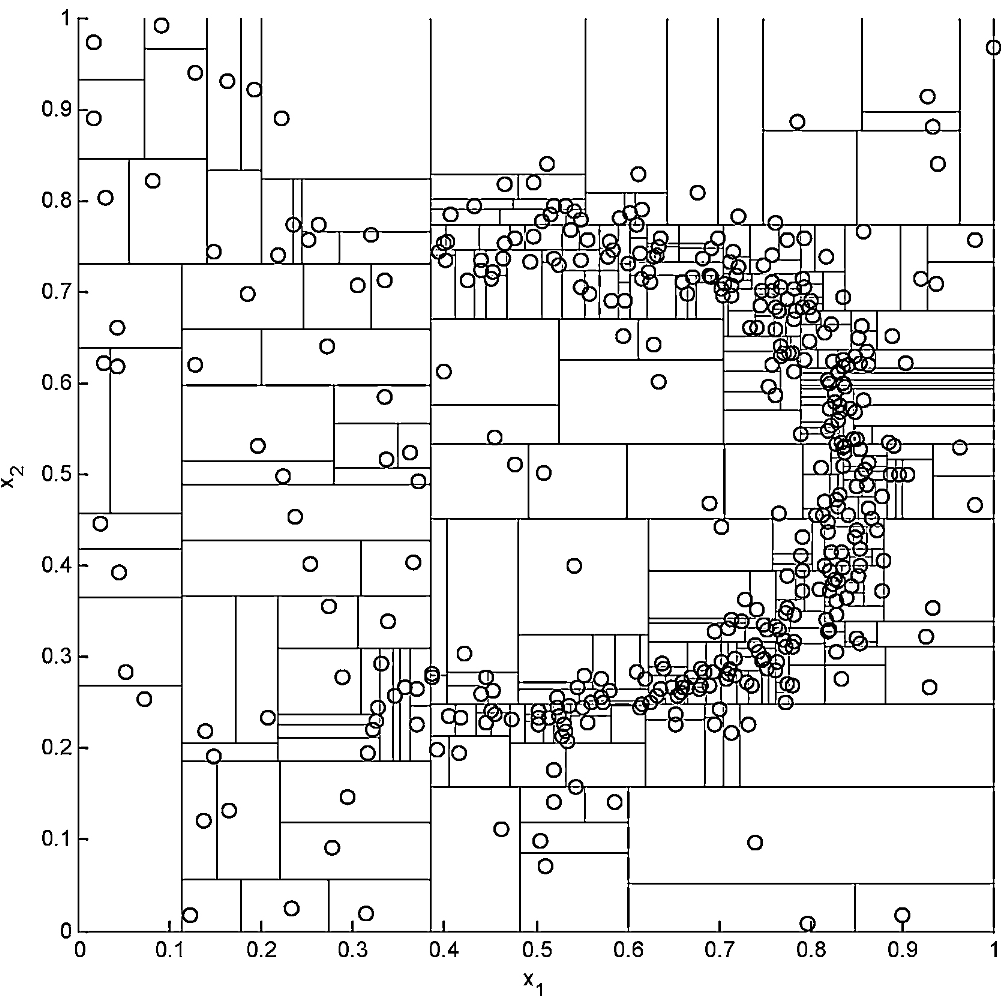 Figure 1: Comparison of solution distribution and the resulting BSP tree partitioning.
2. Diversified Operators (EAX & DM)
To prevent premature convergence, the authors introduced:
- Extended Arithmetic Crossover (EAX): Unlike Conventional Arithmetic Crossover (CAX) which "contracts" offspring towards the center of parents, EAX can "expand" the search slightly beyond the parent bounds, pushing the population to explore new territory.
- Diversified Mutation (DM): A Gaussian-based mutation that avoids the "trapping" effect of local optima by maintaining a consistent level of exploration throughout the entire evolutionary run.
Experimental Showdown
The authors tested MODdEA against 14 top-tier MOEAs (including SPEA2, MOEA/D, and AMGA) across two major test sets.
Breaking the Disconnected Challenge (TYD-MOPs)
On the "Truly Disconnected" test suite (TYD1-TYD6), the superiority was clear. While most algorithms failed to find all disjoint segments of the Pareto Front, MODdEA achieved 100% segment coverage consistently.
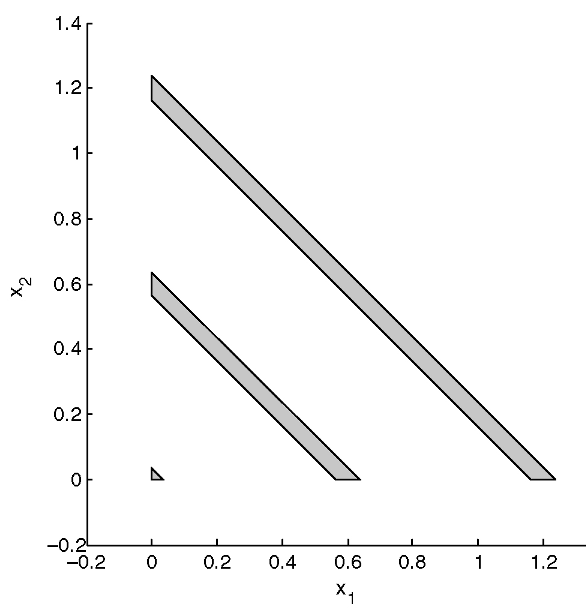 Figure 2: Visual comparison of Pareto Fronts found by different algorithms on disconnected problems.
In the quantitative IGD (Inverted Generational Distance) metric, which measures both convergence and diversity, MODdEA ranked 1st in 5 out of 6 cases with extremely high statistical confidence (99.95%).
Robustness on Standard Benchmarks
Even on standard continuous benchmarks (ZDT and DTLZ suites), MODdEA remained a top contender. What stands out is its stability. In a comparison of average ranks, MODdEA had the smallest standard deviation, meaning it is less sensitive to specific problem types or parameter settings compared to its peers.
Critical Insight & Conclusion
The true value of MODdEA is the philosophical shift from Objective-Space Diversity to Decision-Space Density. By using the BSP tree as an "evolutionary memory," the algorithm avoids the trap of the neighborhood assumption.
Takeaway: If your optimization problem involves complex, non-linear constraints that might break the Pareto Set into disjoint pieces, traditional "crowding distance" metrics will fail you. MODdEA provides a robust, nearly parameter-less blueprint for exploring these fragmented landscapes without losing the "islands" of optimality.
Limitations: While powerful, the storage of the entire search history in a BSP tree can lead to increased memory consumption in extremely long runs (though the authors argue it's well within the limits of modern PCs).