
AI-NSGA-II: Mastering Community Detection in the Era of Expanding Social Networks
Multiobjective evolutionary algorithms for dynamic social network clustering
This paper introduces AI-NSGA-II, an Adaptive Immigrant-based Multi-Objective Evolutionary Algorithm designed for clustering dynamic social networks. By optimizing both Min-Max Cut and Global Silhouette Index, the method automatically determines the optimal number of clusters as the network expands over time.
TL;DR
Social networks never sleep—they grow, merge, and evolve. This paper tackles the challenge of Dynamic Social Network Clustering by treating it as a multi-objective optimization problem. The authors introduce AI-NSGA-II, an algorithm that adaptively balances exploration and exploitation using a novel "immigrant" strategy, allowing it to find high-quality community structures even as the underlying graph data changes in real-time.
Background: The Static Trap
Most traditional clustering algorithms (like K-means or standard Spectral Clustering) suffer from two major flaws when applied to the modern web:
- The "K" Problem: They require you to specify the number of clusters upfront.
- Static Bias: They assume the graph is a frozen snapshot.
In reality, a social network like YouTube or Twitter is a living organism. New users (nodes) and interactions (edges) are added every second. To find meaningful communities, we need an algorithm that can decide "how many groups exist" and "where they shifted" simultaneously.
Methodology: Adaptive Evolution
The core of the paper is the transition from static Multi-Objective Evolutionary Algorithms (MOEAs) to dynamic ones.
1. Dual-Objective Optimization
Instead of focusing on just one metric, the authors use two conflicting goals:
- Min-Max Cut (f1): Minimizes inter-cluster similarity (making clusters distinct).
- Global Silhouette Index (f2): Maximizes intra-cluster cohesion (making clusters tight).
2. The Adaptive Immigrant Mechanism
The breakthrough lies in AI-NSGA-II. In genetic algorithms, "over-convergence" is a death sentence in dynamic environments—the population gets stuck in an old optimum and fails to see the new one. The authors propose three types of child generation:
- Crossover/Mutation: Exploiting known good solutions.
- Elite Immigrants: Refining the current Pareto front.
- Random Immigrants: Exploring entirely new regions of the graph.
The Logical "How": AI-NSGA-II observes the distance between parents. If parents are too close, it triggers a "random immigrant" to force exploration. If they are outside the Pareto front, it focuses on "elite" refinement.
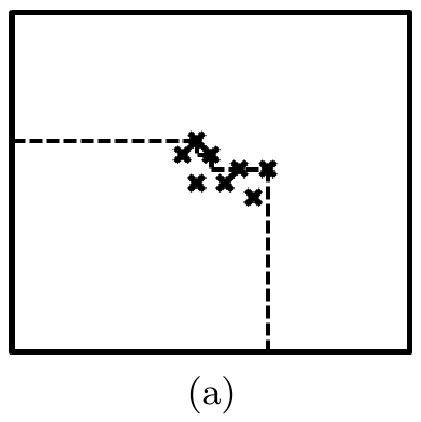 In the figure above, (a) shows over-convergence, while (b) shows wide but low-quality diversity. AI-NSGA-II seeks the "Goldilocks" zone.
Experiments: Real-World YouTube Data
The authors tested their framework on a dataset of YouTube video relations, simulating 20 temporal changes.
Key Findings:
- Pareto Dominance: AI-NSGA-II didn't just find one solution; it found a better set of trade-offs than any other variant.
- Efficiency: By using a Locus-based adjacency representation, the chromosome length adjusts naturally as nodes are added, and the number of clusters is decoded automatically via connected components.
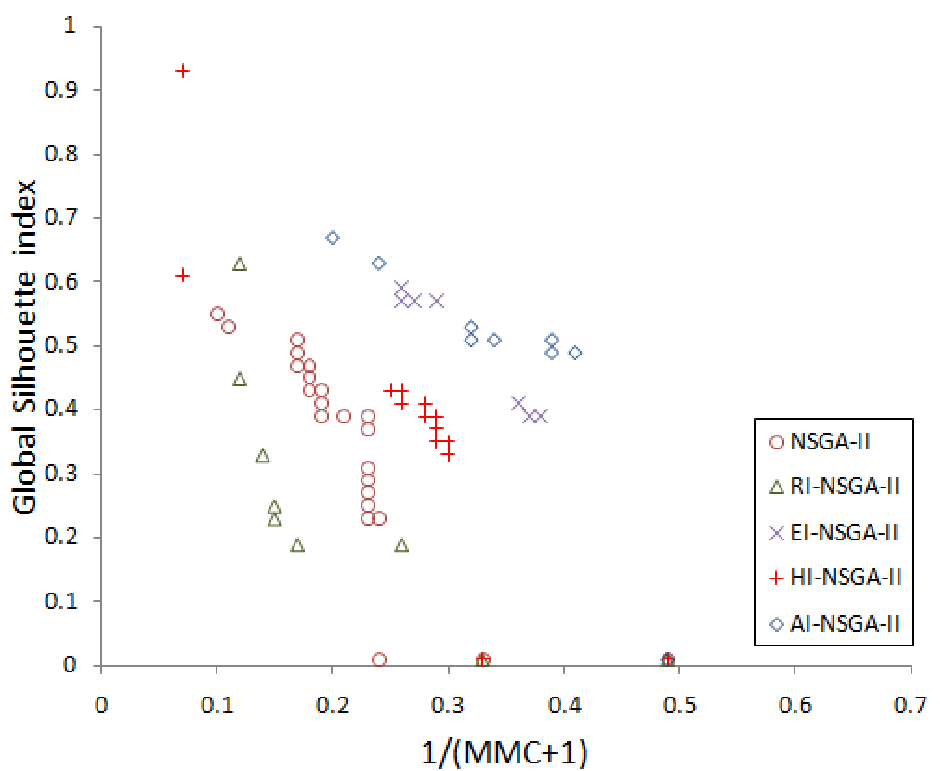 Comparison of Pareto approximation sets: AI-NSGA-II (red) consistently pushes the frontier further than static models.
Critical Insight & Conclusion
While this paper focuses on network expansion (adding nodes), its real value is the Adaptive Strategy. The meta-rule—deciding when to explore vs. exploit based on the current population's spread—is a powerful inductive bias for any dynamic optimization problem.
Limitations: The study assumes nodes/edges are only added, not deleted. Future work must address "network decay" or "unfriending" to fully model social dynamics. However, for 2010-era research, this work laid a crucial foundation for modern dynamic community detection.
Table: Summary of Dominance Rankings
| Approach | Performance Rank | Insight |
|---|---|---|
| AI-NSGA-II | 1st | Best balance through adaptation |
| EI-NSGA-II | 2nd | High quality but lacks diversity |
| RI-NSGA-II | 5th | Too much noise, low quality |
If you are building a recommendation engine or a community detection tool for a platform that grows daily, the adaptive immigrant scheme is a mechanism you cannot afford to ignore.