
Beyond Unimodal Recognition: Boosting Emotional Intelligence with Multi-Classifier Systems
Multiple Classifier Systems for the Recogonition of Human Emotions
The paper presents a Multi-Classifier System (MCS) architecture for multimodal human emotion recognition, specifically focusing on Hidden Markov Models (HMMs) for facial expressions and Echo State Networks (ESNs) for audio-visual laughter detection. The proposed ensemble approach achieves a peak facial expression detection rate of 86.1% and a laughter detection rate of 91% using decision-level fusion.
TL;DR
Recognizing human emotion is a complex task where single-modality sensors often fail. This paper introduces a sophisticated Multiple Classifier System (MCS) that leverages Hidden Markov Models (HMMs) and Echo State Networks (ESNs). By fusing diverse features from facial regions and audio-visual cues, the authors achieved an 86.1% accuracy in facial expression recognition and a 91% success rate in laughter detection, proving that "the whole is greater than the sum of its parts."
The Problem: The Bias of Single Models
In affective computing, researchers typically face a trade-off. A model optimized to recognize "Joy" via mouth movement might be completely blind to "Anger," which is often expressed through the eyebrows. Furthermore, unimodal systems (audio-only or video-only) are notoriously fragile in noisy environments. The authors argue that for a system to be truly "emotionally intelligent," it must integrate diverse feature views to ensure diversity—a state where classifiers do not agree on the same mistakes.
Methodology: Fusing Geometry, Texture, and Time
The paper breaks down the recognition process into two distinct but related experimental setups:
1. Facial Expression via HMM Fusion
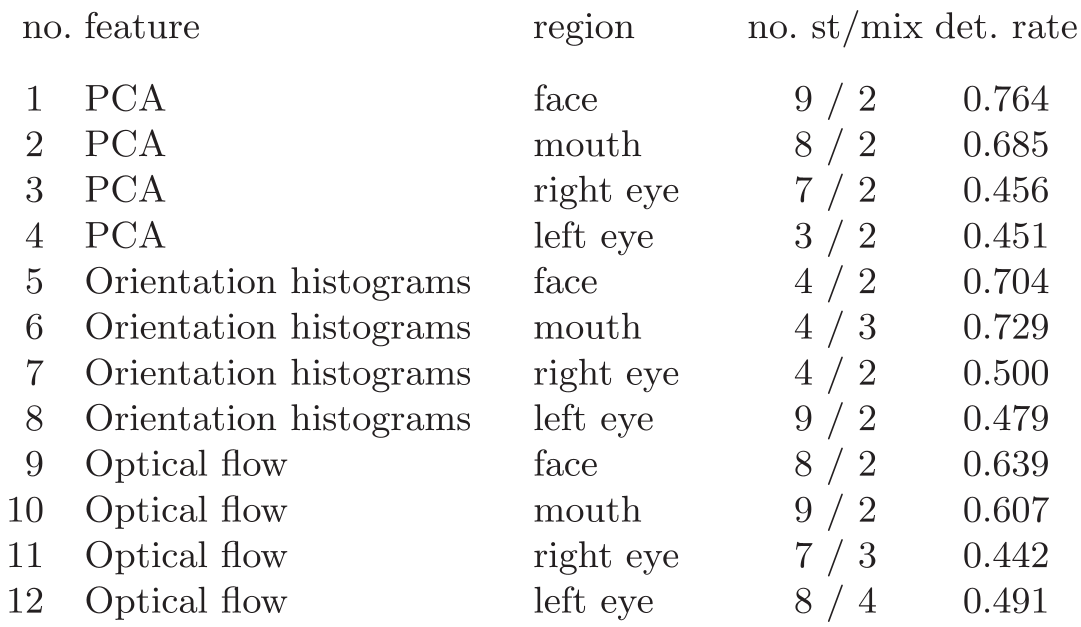
The researchers didn't just look at the face as a whole; they subdivided it into the mouth, left eye, and right eye. They then applied three distinct feature extraction techniques to these regions:
- PCA (Eigenfaces): Captures global geometry.
- Orientation Histograms: Captures local texture and edge orientation.
- Optical Flow: Captures temporal motion between frames.
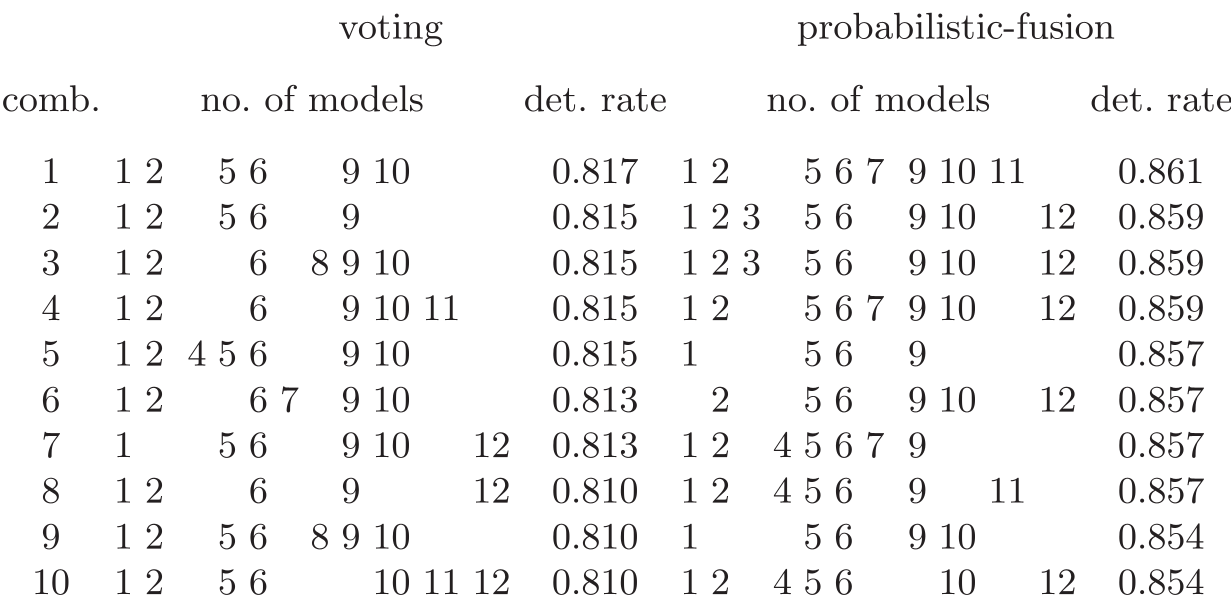
Rather than using a simple majority vote (Voting Fusion), they found that Probabilistic Fusion (multiplying the posterior probabilities of the models) was superior. This prevents "early hardening" of decisions, allowing subtle probabilistic evidence from one region (like the mouth) to correct an error in another (like the eyes).
2. Laughter Detection via Echo State Networks (ESN)
Laughter is highly dynamic and acoustically variable (snorts, giggles, chuckles). To handle this, the authors used Echo State Networks.
- The Reservoir: Unlike standard RNNs where every weight is trained, ESNs use a large, sparsely connected "reservoir" of neurons with fixed, random weights.
- The Dynamics: Only the output weights are trained using a simple pseudo-inverse method, making it computationally efficient and excellent at capturing temporal dynamics.
Experiments and Results
The results confirm the power of multimodal fusion:
- Facial Recognition: The best single model managed 76.4%. By combining the face and mouth regions through probabilistic fusion, the accuracy jumped to 86.1%.
- Laughter Detection: Moving from unimodal video (82%) or audio (87%) to a multimodal approach yielded 91%.
Interestingly, the researchers noted that eye regions, when used alone, were significantly less accurate than the mouth or the full face. However, when fused correctly, they still contributed to the overall robustness of the system.
Critical Insight: Why This Matters
The core takeaway from this work is that Inductive Bias management matters more than model size. By forcing different HMMs to look at different sections of the face and different types of features (motion vs. static texture), the authors created a "jury" of experts.
The transition to Echo State Networks for laughter also highlights a shift toward "Reservoir Computing," which is far more efficient for real-time applications than traditional Backpropagation Through Time (BPTT). This led to the development of the pepr framework, a Java-based engine designed to handle these multi-sensor fusion tasks in real-time.
Conclusion & Future Outlook
While this paper uses established tools like HMMs and ESNs, its focus on multi-classifier diversity remains a cornerstone of modern AI. The primary limitation is the reliance on lab-controlled datasets (Cohn-Kanade). Future work in this area has since moved toward Transformer-based cross-modal attention, but the fundamental principle—that different emotional "views" must be reconciled probabilistically—remains the gold standard for robust HCI.