
CoXCS: Scaling Learning Classifier Systems via Feature Space Partitioning
A multiple population XCS: Evolving condition-action rules based on feature space partitions
The paper introduces CoXCS, a multi-population parallel version of the accuracy-based XCS learning classifier system. It leverages feature space partitioning and cooperative coevolution to solve high-dimensional classification tasks, achieving 100% accuracy on complex Boolean multiplexer problems significantly faster than standard XCS.
TL;DR
The paper presents CoXCS, a multi-population evolution strategy that solves the scalability bottleneck of the XCS (Accuracy-based Learning Classifier System). By partitioning the input feature space and evolving rules in isolated "islands," CoXCS achieves 100% accuracy on the complex Multiplexer-70 benchmark nearly 50x faster than a single-population XCS.
Context & Positioning
In the landscape of Evolutionary Computation, XCS stands as the gold standard for Michigan-style Learning Classifier Systems. It combines Reinforcement Learning (RL) with Genetic Algorithms (GA) to evolve a set of condition-action rules. However, as problem dimensionality increases, XCS often suffers from a "search explosion." This work positions itself as a structural remedy, borrowing "divide-and-conquer" principles from large-scale optimization to make XCS viable for high-dimensional tasks.
The Problem: The Scalability Wall
Standard XCS maintains a single population of classifiers. When the number of input features (bits) grows, the number of possible schemata grows exponentially.
- Prior Work Limitation: Standard XCS tries to learn all feature dependencies simultaneously, which dilutes the "fitness pressure" needed to find specific, accurate rules.
- The Challenge: How do we maintain the accuracy-based fitness of XCS while reducing the search space for the genetic operators?
Methodology: CoXCS Architecture
The core innovation is the Coevolutionary Parallel Learning Classifier. Instead of one large population, the system is split into sub-populations.
1. Feature Partitioning
Each sub-population only sees a subset of features. For the features it doesn't "own," it treats them as "don't care" (denoted as #). This essentially shrinks the search space for each sub-population.
2. Three Specialized Strategies
- Dynamic Random Partitioning (DRP): Features are periodically reassigned, preventing sub-populations from getting stuck on local dependencies.
- Fixed Random Partitioning with Migration (FRPM): Partitions are fixed, but the "best" rules migrate between islands to share discovered building blocks.
- Dynamic Random Partitioning with Migration (DRPM): A hybrid approach combining both reassignment and migration.
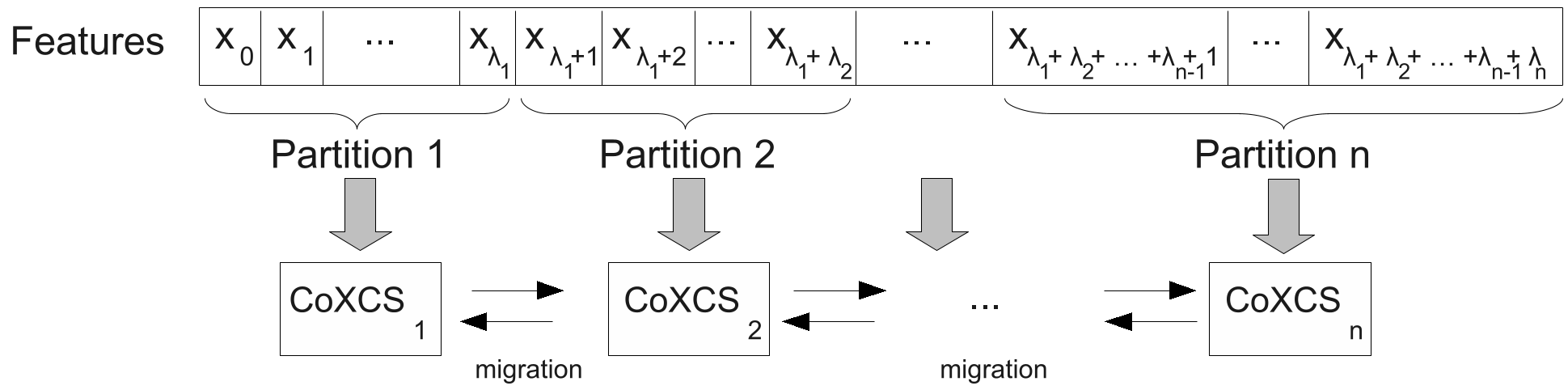 Figure 1: High-level overview of CoXCS showing isolated sub-populations evolving solutions on feature subsets.
Experiments: Breaking the Multiplexer-70
The authors tested the system on Boolean Multiplexer problems (20, 37, and 70 bits). The Multiplexer problem is a classic "needle in a haystack" task where the address bits point to specific data bits.
Key Findings:
- Speedup: For the Multiplexer-20, CoXCS reached perfect accuracy in iterations compared to standard XCS's .
- Efficiency in Complexity: In the massive Multiplexer-70 test, standard XCS flatlined (failed to reach 100% within the limit), while all CoXCS variants (DRP, FRPM, DRPM) converged rapidly.
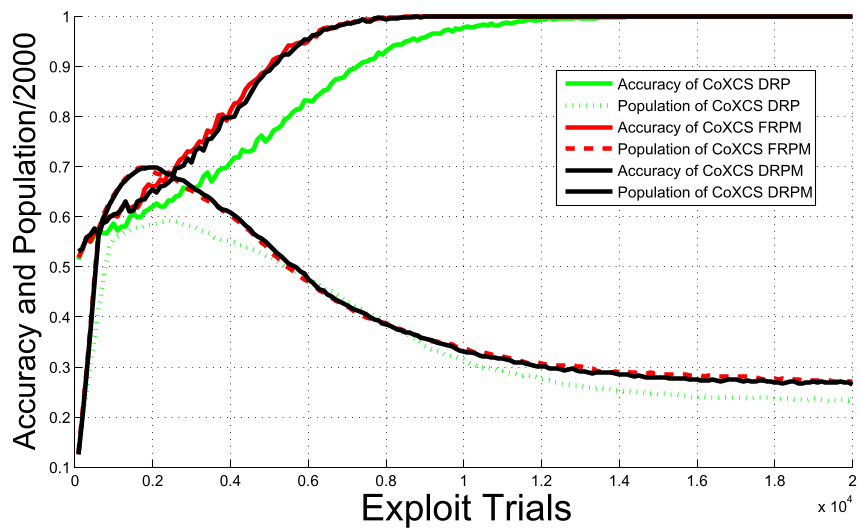 Figure 2: Performance comparison on the Multiplexer-70 problem. Note how CoXCS variants reach 1.0 accuracy while standard XCS lags behind.
Critical Insight: Why Does Migration Matter?
The paper highlights that migration episodes act as a high-level recombination operator. In FRPM/DRPM, migration allows a sub-population that has discovered a crucial dependency (a "building block") to share it with others. This "restricted mating" prevents the crossover operator from destroying good rules, a common failure mode in single-population GAs.
Conclusion & Perspective
CoXCS demonstrates that the "Michigan model" of LCS is not inherently unscalable; rather, its search mechanism needs structural guidance. By using Dynamic Random Partitioning, researchers can solve non-linear classification problems that were previously computationally prohibitive for evolutionary systems.
Limitations: The current model doesn't explicitly account for inter-feature dependencies during the partitioning phase (i.e., it doesn't know which bits should stay together). Future work involving "Linkage Learning" or automated decomposition could further enhance this framework.