
MGrank: Decoding Complex Social Layers for Superior Recommendations
Multirelational Social Recommendations via Multigraph Ranking
The paper introduces MGrank, a multigraph ranking model designed for social recommender systems. By representing diverse user relationships (friendship, trust, similarity) in a multigraph and applying a specialized ranking algorithm, it achieves SOTA performance in recommendation coverage and accuracy.
TL;DR
Collaborative Filtering (CF) is the backbone of recommendation, yet it breaks down when data is sparse. While social networks help, most systems treat all "connections" the same. MGrank changes the game by using Multigraph Ranking to preserve the unique structural patterns of different social ties—like friendship, trust, and co-tagging—simultaneously.
Context: This work addresses the "Rating Sparsity" bottleneck by shifting from single-layer graphs to a sophisticated multigraph ranking framework.
The Problem: The "Flat" Social Network Fallacy
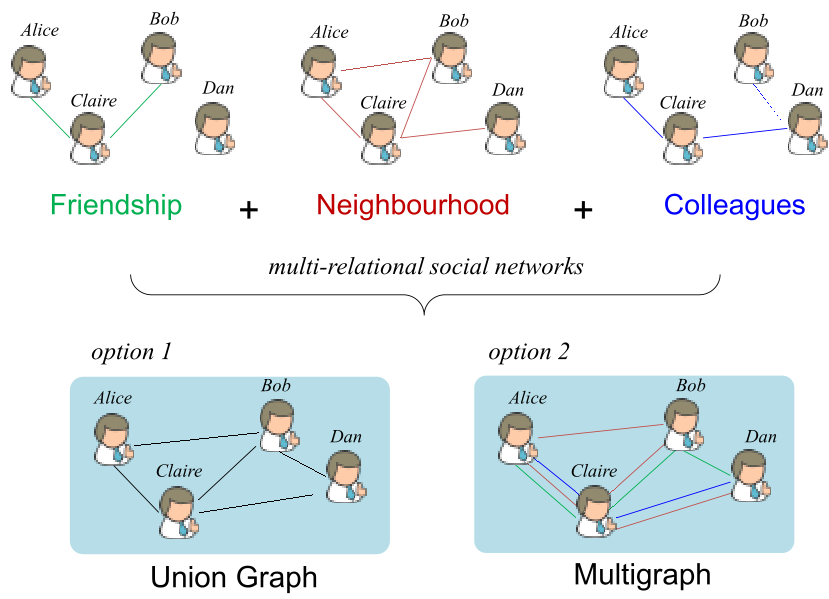
Most social recommenders suffer from a reductive approach. They take diverse relationships (e.g., "I trust your reviews" vs. "We share a colleague") and flatten them into a single average weight. This Union Graph approach loses critical structural information.
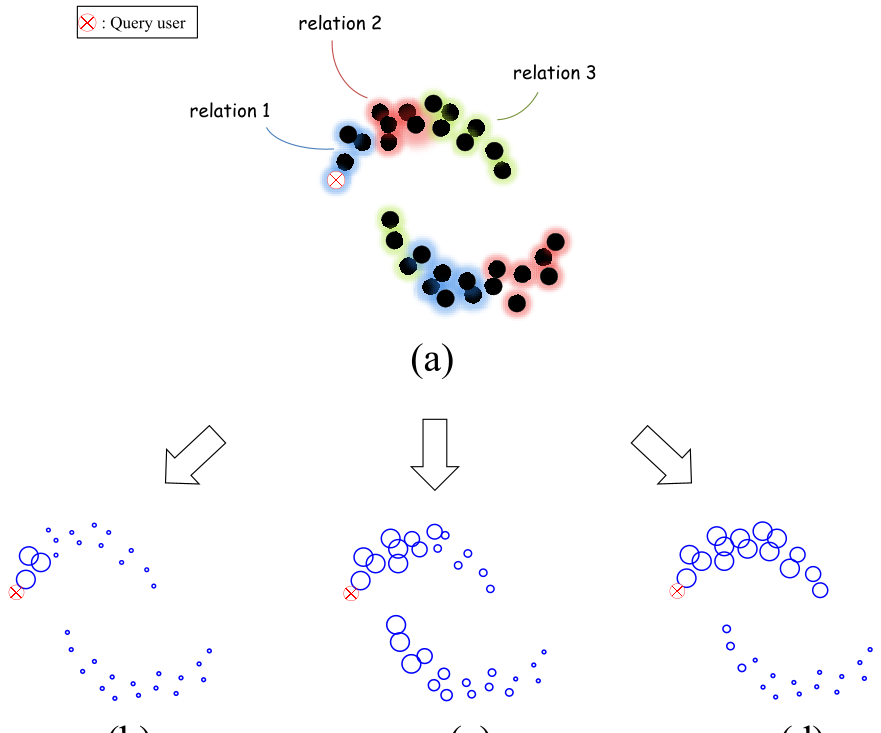
The authors identify a specific challenge: The Two-Moon Problem. As seen in the figure below, a user might be part of different clusters in different networks. A union graph often ignores the specific topology that links these clusters, failing to find the true "nearest neighbors."
Methodology: Two Steps to Precision
1. Social Network Propagation
Before ranking, the authors handle initial sparsity using a "Walk and Select" random walk.
- Walking: The algorithm traverses the graph to find "indirect" similar users.
- Selecting: It polls the opinions of reached nodes. Using the 80-20 rule, they simplify the 6-step "Six Degrees of Separation" walk into a manageable 2-step approximation to boost initial data density without massive computational overhead.
2. The Multigraph Ranking Model
The core innovation is the regularization framework adapted for multigraphs. They define a Virtual Edge Function :
This formula is ingenious because it doesn't just sum weights; it weighs them by Internetwork Diversity (). If two users are connected across two very different types of networks (high diversity), their relationship is considered much stronger than a connection in two redundant networks.
Experiments: Dominating Sparse Data
The authors tested MGrank on two distinct environments:
- Epinions: Extreme sparsity (99.99%), relying on Trust and Similarity.
- Last.fm: Higher density, involving Friendship, Similarity, and Tagging.
Key Findings:
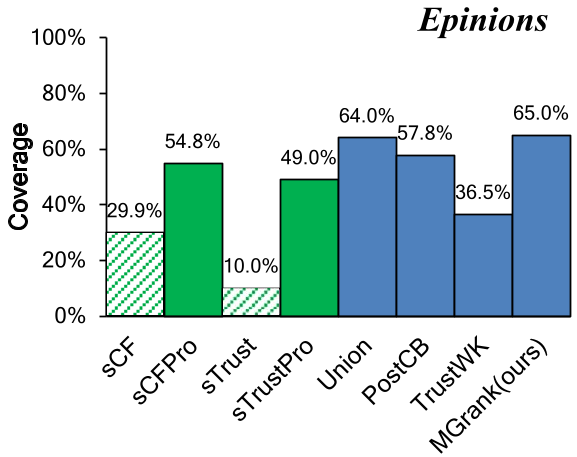
- Coverage Boost: On Epinions, MGrank moved the needle from a dismal 30% coverage (CF) to 65%.
- Error Reduction: Unlike other hybrid methods that increase error (RMSE) as they try to cover more users, MGrank successfully lowered the RMSE, proving that its "neighbors" are actually relevant.
Critical Insight: The Logic of Alpha ()
The model uses a trade-off parameter . The authors found that in sparse environments (like Epinions), a high is needed—essentially telling the model to trust the structural geometry of the graph more than the (limited) initial query data. In dense environments (Last.fm), a lower works best, as the initial preferences are already quite reliable.
Conclusion & Future Work
MGrank demonstrates that how we represent social data is just as important as what data we have. By treating social relations as layers in a multigraph rather than a soup of connections, we can navigate the sparsity problem far more effectively.
Limit: The current model focuses on positive ties. The "Final Boss" of social recommendation remains the integration of Negative Ties (Distrust), which the authors flag as the next frontier in graph-based ranking.