
Unlocking Emotional Cues: Multiscale Amplitude and Vocal Tract Enhancement
Multiscale Amplitude Feature and Significance of Enhanced Vocal Tract Information for Emotion Classification
The paper proposes a novel Multiscale Amplitude (MA) feature for speech emotion classification, utilizing Multiresolution Analysis (MRA) and a Sinusoidal Model to capture signal intensities across different frequency sub-bands. By enhancing vocal tract information via pre-emphasis (SEVTI), the method achieves a State-of-the-Art (SOTA) average recognition rate of 86.7% on the EMODB dataset.
TL;DR
This research introduces a robust framework for Speech Emotion Recognition (SER) by combining Multiresolution Analysis (MRA) with a Sinusoidal Model. By focusing on Enhanced Vocal Tract Information (SEVTI)—essentially boosting the high-frequency components that carry emotional signatures—the authors achieved a significant performance leap, reaching 86.7% accuracy on the German EMODB dataset and demonstrating superior robustness in cross-language scenarios.
Background & Motivation: Why Static Features Fall Short
Most modern SER systems rely on Mel-Frequency Cepstral Coefficients (MFCCs). While excellent for speech recognition, MFCCs smooth out the spectrum, often losing the "shimmer" and "jitter" inherent in emotional speech. The authors argue that emotional states (like anger or sadness) physically alter the speaker's vocal tract and breathing. Specifically, high-arousal emotions shift energy to higher frequencies, which are unfortunately the most susceptible to attenuation during the "lip radiation" phase of speech production.
Methodology: The MRA-Sinusoid Pipeline
The core innovation lies in a two-step process: Enhancement and Decomposition.
1. SEVTI: The Pre-emphasis Advantage
The authors use a first-order difference equation to "pre-emphasize" the signal. By setting , they effectively cancel the natural 6 dB/Oct attenuation of the vocal tract, bringing high-frequency emotional cues back to the forefront.
2. Multiscale Amplitude Feature Extraction
Using a 3-level Wavelet decomposition (db4 basis), the signal is split into four distinct frequency scales (0–1 kHz, 1–2 kHz, 2–4 kHz, and 4–8 kHz). In each scale, they don't just take energy levels; they fit a Sinusoidal Model.
- Sinusoid vs. Noise: They use Normalized Bandwidth (NBD) and Normalized Duration (NDD) descriptors to separate true vocal tract resonances (sinusoids) from turbulent noise.
- Architecture:
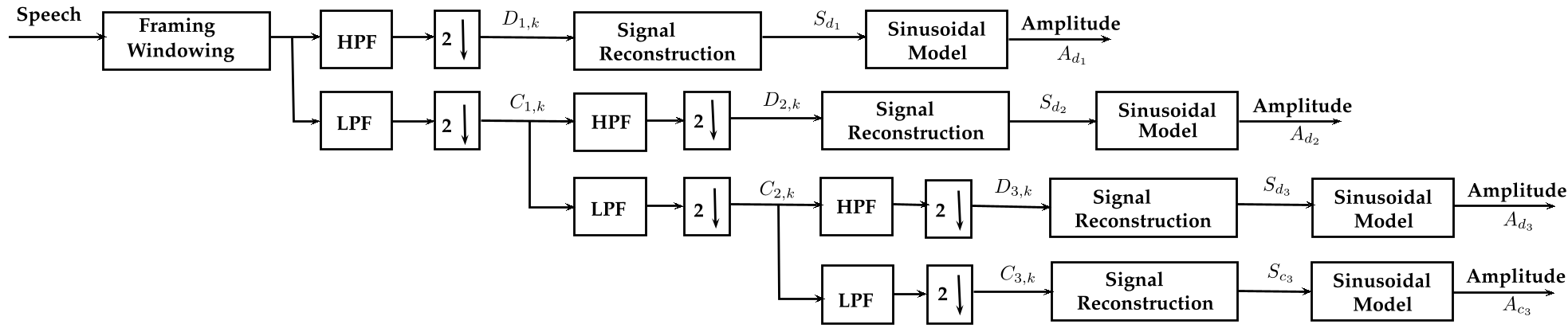 Fig 1: The 3-level MRA decomposition process to generate sub-band signals Sc3, Sd3, Sd2, and Sd1.
Experimental Battleground: SOTA Comparisons
The authors tested their feature against three heavyweights: MFCC, TEO-CB-Auto-Env, and Breathiness features.
Key Results on EMODB
The proposed MA feature alone hit 80.7%, but the real magic happened with the Comb2 feature set (MA + MFCC + TEO + Breathiness), which reached 86.7%.
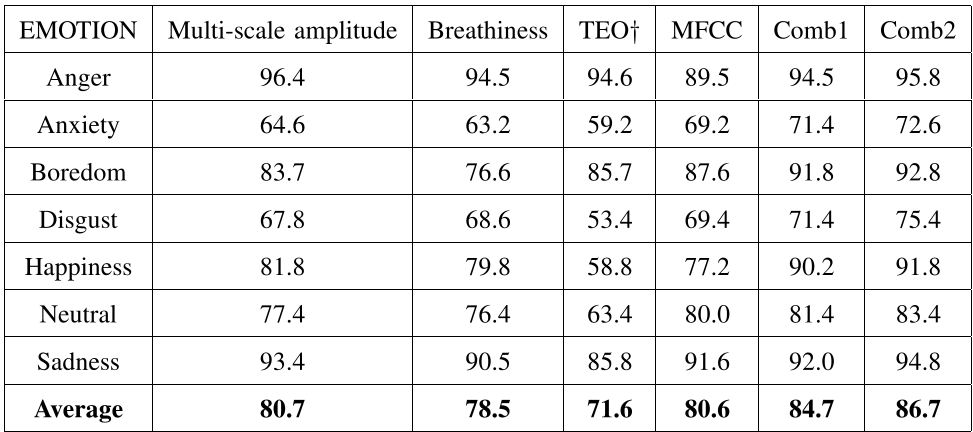 Table: Comparison of recognition rates on EMODB using SEVTI signals. Note how the Multiscale Amplitude feature consistently leads the baseline MFCC.
The Cross-Corpus Litmus Test
One of the hardest tasks in SER is training on one language (e.g., German EMODB) and testing on another (e.g., Hindi SSD). The Multiscale Amplitude feature showed remarkable resilience, maintaining accuracies around 62-67%, whereas standard features often crumble due to "feature shift" caused by different recording environments and linguistic phonemes.
Deep Insight: Why Does It Work?
The statistical analysis (Section III) reveals that the F-score (a measure of discriminative power) for the MA features increases significantly when using SEVTI compared to raw speech. By boosting the high-frequency vocal tract information, the "distance" between emotion clusters (like Anger vs. Happiness) in the feature space becomes larger, making the SVM classifier's job much easier.
Conclusion & Future Outlook
This work moves beyond "black-box" feature extraction by grounding its methodology in the physics of speech production. While the FAU AIBO (spontaneous children's speech) database remains a challenge (achieving ~45%), the research proves that multiscale resolution and high-frequency enhancement are the keys to unlocking robust, cross-cultural emotion recognition.
Future research could look into replacing the SVM with Deep Temporal models (like LSTMs or Transformers) using these same multiscale amplitude maps as a "spectrogram-plus" input.
Takeaway: Don't just analyze the sound; analyze the "instrument"—the vocal tract—that created it.