
Beyond Truth: Leveraging Novelty and Emotion to Shield Against Fake News
A Multitask Learning Approach for Fake News Detection: Novelty, Emotion, and Sentiment Lend a Helping Hand
This paper introduces a deep Multitask Learning (MTL) framework that jointly predicts Fake News Detection, Novelty Detection, Emotion Recognition, and Sentiment Prediction. By leveraging auxiliary tasks to capture the "surprise" and "emotionality" typical of misinformation, the model achieves state-of-the-art (SOTA) performance on ByteDance, FNC, and Covid-Stance datasets.
TL;DR
Fake news doesn't just spread because it's false; it spreads because it's surprising and emotional. This paper presents a Deep Multitask Learning (MTL) framework that treats fake news detection not as a isolated classification task, but as a composite phenomenon involving Novelty, Emotion, and Sentiment. By training on these four tasks simultaneously, the model achieves a record-breaking 21.76% accuracy boost on COVID-19 misinformation datasets.
Background: The Psychology of a Lie
Why is fake news so "sticky"? Research suggests that false stories are significantly more novel than true ones, hijacking our "surprise" circuitry. Furthermore, misinformation is often weaponized with high emotional charges—fear, disgust, or sudden joy—to bypass our analytical brain.
The authors of this paper argue that if we want to catch a lie, we must also identify its "emotional fingerprint" and "novelty signature." This work positions itself as a comprehensive MTL solution that bridges the gap between psychological insights and deep learning architecture.
Methodology: The Multitask Powerhouse
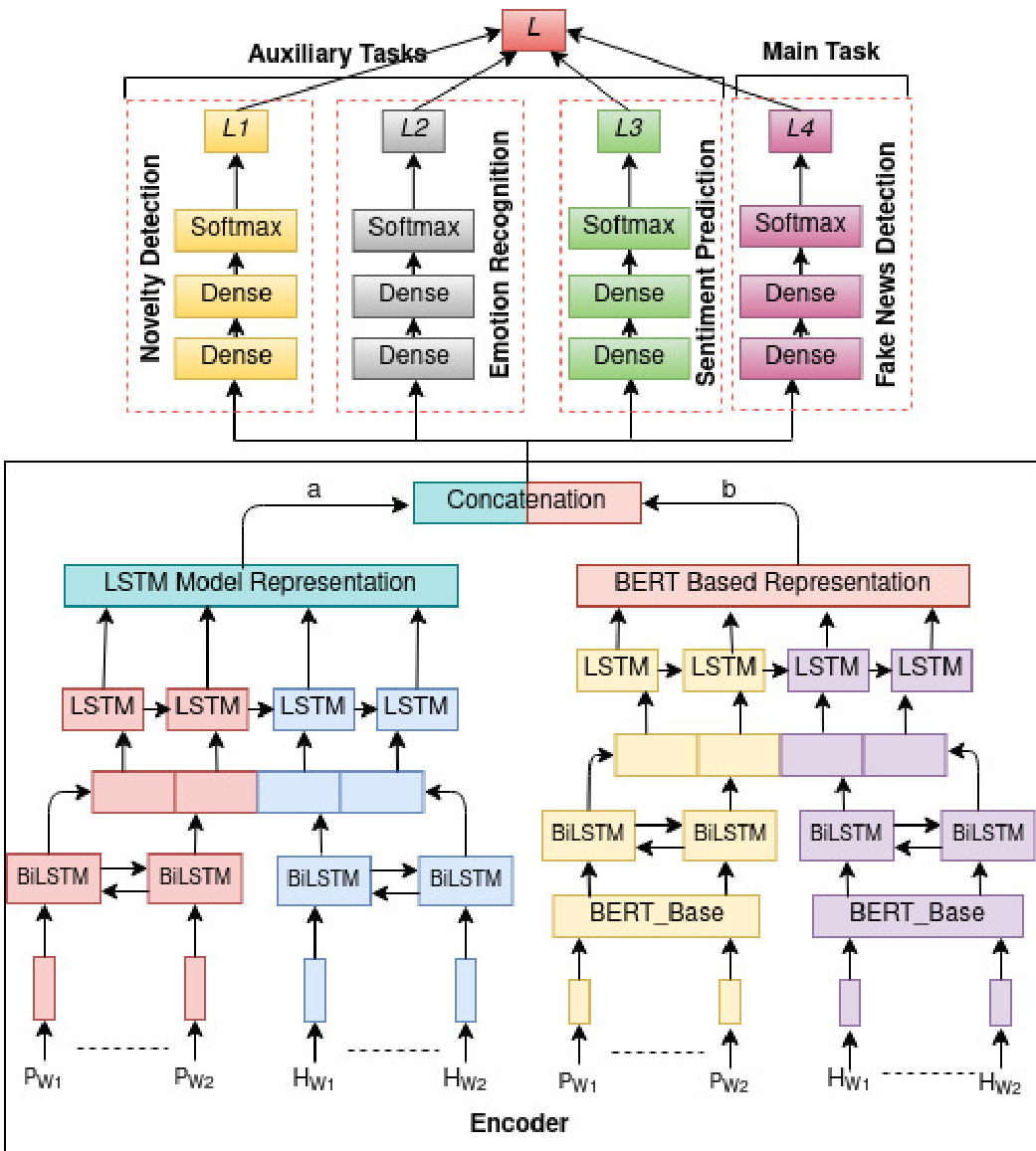
The architecture is built on the principle of Hard Parameter Sharing, where a shared encoder extracts features for all tasks, fostering a generalized representation.
1. Dual-Encoder Strategy
Instead of relying on a single embedding, the authors used:
- Glove + BiLSTM: Captures traditional linguistic patterns.
- BERT (Transformer): Captures deep contextual semantics.
2. The Two-Phase Pipeline
Since standard fake news datasets (like FNC or ByteDance) don't come with "emotion" or "novelty" labels, the researchers implemented a clever two-phase pipeline:
- Phase 1 (Labeling): Fine-tuned specialized models on Quora Question Pairs (for novelty), GoEmotions (for emotion), and Amazon Reviews (for sentiment) to "auto-label" the fake news datasets.
- Phase 2 (Multitask Training): Trained the core model to predict all four labels simultaneously.
Experimental Breakthroughs
The results across three diverse benchmarks prove that "multitasking" is the key to robustness.
- ByteDance (General News): Achieved 99.74% accuracy, outperforming the ensemble SOTA.
- FNC (Stance Detection): Reached 96.88% accuracy.
- Covid-Stance (Domain Specific): A massive jump to 98.59%, proving the model handles high-stakes medical misinformation exceptionally well.
Ablation Study: What really matters?
The authors found that removing any of the auxiliary tasks (Novelty, Emotion, or Sentiment) led to a drop in performance. For instance, in COVID-19 news, the word "apparently" often flags a "Novelty" shift that pure sentiment analysis might miss.

Critical Insight: The "Bias" Secret Sauce
One technical nuance in this paper is the use of Task-Specific Biases (). By adding 300-dimension vectors representing specific "states" (e.g., a "positive" sentiment vector) into the concatenation layer, the model navigates the optimization landscape more effectively. It doesn't just look for any pattern; it seeks the intersection where novelty and emotion meet falsehood.
Conclusion & Future Outlook
This work marks a shift from "text-only" analysis to "context-and-intent" analysis. While the model is currently SOTA for English, the authors acknowledge the need for:
- Low-resource language support: Misinformation is a global problem beyond English.
- Multimodal Integration: Future models must digest images and videos alongside text.
By proving that novelty and emotion are "helping hands" rather than noise, this research provides a blueprint for the next generation of digital fact-checkers.