
MPOL: Achieving Deterministic N-ary Polling in Reputation-Conscious Social Networks
Multivalued and Deterministic Peer-to-Peer Polling in Social Networks with Reputation Conscious Participants
The paper introduces MPOL, a decentralized, deterministic P2P polling protocol for social networks that supports n-ary (multi-valued) voting and abstentions. It leverages a simple secret-sharing scheme and participant reputation to achieve accurate results and optimal voter privacy without relying on heavy cryptography or central authorities.
TL;DR
Researchers have developed MPOL, a Peer-to-Peer (P2P) protocol that enables large-scale, private, and exact voting across social networks. Unlike previous methods that were either binary or relied on "fuzzy" randomization, MPOL provides deterministic n-ary results and allows members to abstain without breaking the system. It replaces expensive cryptography with a clever secret-sharing scheme and the social "carrot and stick" of user reputation.
Problem & Motivation
Current social platforms like Facebook often use centralized polling, which is a privacy nightmare—the server knows exactly how everyone voted. While decentralized P2P alternatives exist, they suffer from three major flaws:
- Lack of Diversity: Most reliable protocols only support "Yes/No" (binary) voting.
- The Randomization Trade-off: Previous attempts at n-ary voting used randomization to hide votes, which introduced noise and made the final count an estimate rather than an exact tally.
- Rigid Participation: Nodes were forced to vote; there was no mechanism for "active abstention."
The authors observed that in social networks, users care about their ID reputation. By designing a protocol where cheaters are exposed with a non-zero probability, the system can deter malicious behavior without requiring the computational heavy lifting of Zero-Knowledge Proofs or Fully Homomorphic Encryption.
Methodology: The Secret of the Tally
The MPOL protocol operates in four distinct phases: Voting, Counting, Broadcasting, and Calibrating.
1. The Ballot Distribution (Secret Sharing)
Instead of sending one vote, a node generated ballots. If a node votes for option , it sends ballots for that option and ballots for every other option. This ensures that a single proxy receiving a ballot learns nothing new about the voter's intent—a property termed Optimal Privacy.
2. The Calibration Math
The "magic" happens in the final phase. Because the protocol is deterministic, the system knows exactly how many "filler" ballots were added to the system to protect privacy. The global tally is calculated as: By subtracting the known noise (), the exact count of intentional votes is revealed.
 Figure 1: The MPOL Calibration formula showing how global tallies are recovered from local sums.
Experiments & Results: Robustness Against Collusion
The study analyzed what happens when malicious nodes try to "stuff the ballot box."
- The Bound: If a malicious coalition exists, their impact on any single voting option is strictly bounded by .
- Privacy Guard: The probability of a privacy breach (revealing a specific user's vote) is exponentially tied to the privacy parameter . Even with a group of dishonest nodes, the risk remains minimal: .
Scalability
The message complexity stands at . While this sounds complex, the authors note that most messages are simple array indices (integers), making it highly efficient even for networks with millions of nodes.
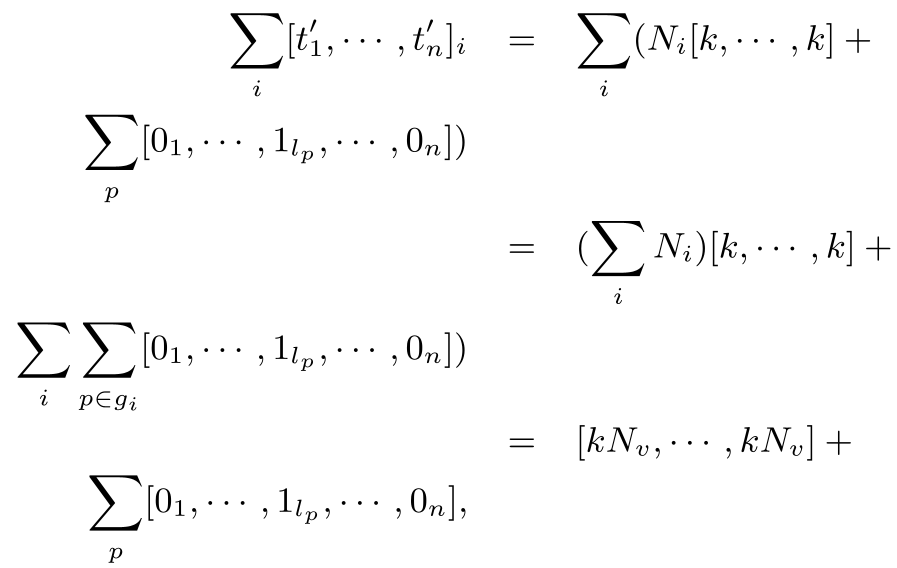 Figure 2: Mathematical proof visualization for the correctness of the aggregated global tally.
Depth Insight: Why It Works
The brilliance of MPOL is its Agnostic Abstention. By calculating a "Voting Counter" alongside the vote tally, nodes can participate in the network's relay and verification duties without actually casting a preference. This increases the total "honest mass" of the system, making it harder for malicious actors to dominate group-level decisions.
Critical Analysis & Conclusion
Takeaway
MPOL is a significant step forward for decentralized governance. It proves that we can have precise, multi-option results in a P2P environment without sacrificing privacy.
Limitations
- Static Topography: The protocol assumes a relatively stable "virtual ring." In a real-world scenario where users go offline (churn), the ring structure could break.
- Collusion Limits: The safety guarantees hold only as long as malicious nodes do not form a majority in two consecutive groups.
Future Outlook
The next frontier for MPOL is Fault Tolerance. The authors aim to adapt the protocol to survive "Byzantine" failures where nodes don't just lie, but crash or delay messages intentionally. If successful, this could become the standard for private, decentralized polling in DAOs and Web3 social layers.