
Decoding Musical Emotions: A Robust DT-CWPT Approach to EEG Classification
Classification of emotions induced by music videos and correlation with participants’ rating
This paper introduces a novel machine learning framework for music-induced emotion recognition using Dual-Tree Complex Wavelet Packet Transform (DT-CWPT) for EEG feature extraction. Combined with a hybrid SVD-QRcp and F-Ratio feature selection method and an SVM classifier, the system achieves state-of-the-art results on the DEAP dataset for Valence, Arousal, Liking, and Dominance classification.
TL;DR
This study presents a high-performance framework for classifying human emotions induced by music videos. By leveraging Dual-Tree Complex Wavelet Packet Transform (DT-CWPT) and a specialized feature selection pipeline (SVD-QRcp + F-Ratio), the researchers achieved classification accuracies of up to 71.2%, significantly outperforming traditional spectral power methods used in affective computing.
Background & Motivation: Why EEG for Emotion?
While facial expressions and speech are common modalities for emotion detection, they can be easily "masked" or faked (e.g., a polite smile masking anger). Brain signals (EEG) provide a more reliable, undisguised window into the Central Nervous System. However, EEG signals are notoriously non-stationary and noisy.
The authors identify a major gap: previous works using Discrete Wavelet Transforms (DWT) were hindered by sensitivity to signal shifts and aliasing. To solve this, they turn to Complex Wavelets, which offer better shift-invariance and directional selectivity.
Methodology: The DT-CWPT Advantage
The core of the methodology lies in the decomposition of EEG signals into precise time-frequency subbands.
1. Feature Extraction via DT-CWPT
Unlike standard wavelets, DT-CWPT employs two parallel trees (Real and Imaginary) to create an analytic signal. This structure ensures that the energy calculated from the subbands is stable and not affected by the phase shifts of the input signal.
 Note: The decomposition provides 16 subbands, allowing for granular analysis of Theta, Alpha, Beta, and Gamma rhythms.
2. Radical Dimensionality Reduction
Starting with 552 features (including hemispheric asymmetry pairs), the authors used a triple-stage filter:
- SVD: Retains 99.5% of the signal's information variance.
- QRcp: Selects the most linearly independent and representative features.
- F-Ratio: Prioritizes features that maximize the distance between emotional classes (e.g., High vs. Low Arousal).
Experimental Results & Insights
Testing on the DEAP database (32 participants), the results showed a clear dominance over the baseline Naive Bayes approach.

Key Discoveries:
- Asymmetry Matters: Features representing the energy difference between the right and left hemispheres were vital for Valence (pleasure) and Arousal (intensity).
- Frequency Specificity: The 0–4 Hz (Delta) and 4–8 Hz (Theta) bands showed significant negative correlations with Arousal and Dominance.
- Localization: The Frontal and Parietal lobes remained the most active regions for emotional processing, while Occipital activity was likely linked to the visual stimuli of the music videos.
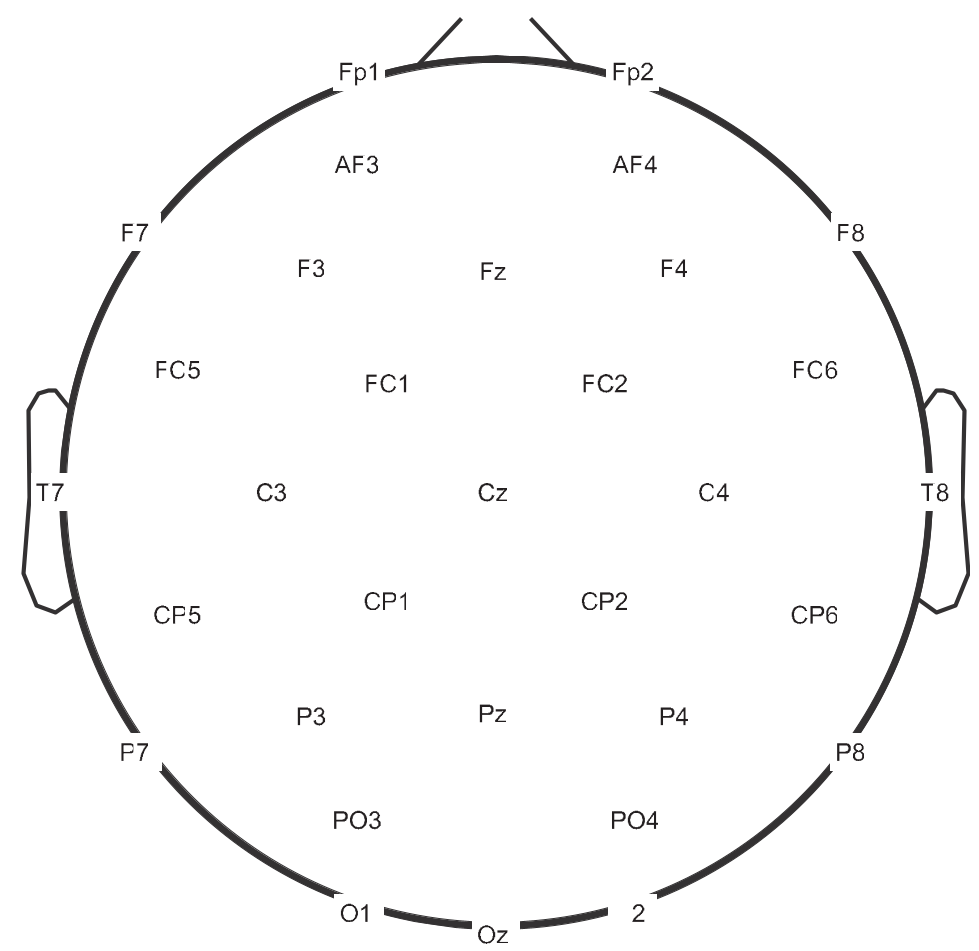 Electrode placement following the 10-20 system used to map emotional responses.
Critical Analysis & Conclusion
The beauty of this work is its efficiency. Reducing a massive EEG feature set to just 7-19 key indicators without losing predictive power is a major step toward real-time BCI (Brain-Computer Interface) applications like Neuromarketing or Implicit Multimedia Tagging.
Limitations: The study utilizes a leave-one-out cross-validation within the same dataset. Future research should explore cross-dataset generalization to see if these DT-CWPT features hold up across different recording environments.
Takeaway: If you want to capture the nuances of the "emotional brain," look beyond simple power spectra—complex wavelets provide the mathematical depth required to handle the brain's non-stationary nature.