
MyNet: Reclaiming the Personal Cloud through Secure P2P Networking
MyNet: A Platform for Secure P2P Personal and Social Networking Services
This paper introduces MyNet, a middleware platform designed for secure Peer-to-Peer (P2P) personal and social networking. Built on the Unmanaged Internet Architecture (UIA), it enables non-expert users to securely share devices, services, and content directly across a decentralized overlay network using intuitive interaction metaphors like "Passlets" and "TAPing."
TL;DR
MyNet is a research project from Nokia Research Center and MIT that challenges the centralized "upload-to-cloud" status quo. It provides a P2P middleware allowing users to turn their private devices (phones, laptops, home servers) into a seamless, secure social network. By using NFC-based "TAPing" and a digital ticket metaphor called "Passlets," it makes complex network security accessible to everyday users.
Background: The Centralization Trap
In the mid-2000s, the "Web 2.0" revolution democratized the internet but forced a trade-off: to share anything, you had to upload it. This created a bottleneck for "live" data. If you wanted to share a real-time feed from your home security camera with a friend, the technical hurdles (firewalls, NAT traversal, SSL certificates) were insurmountable for non-technical users. MyNet was designed to break this bottleneck by allowing direct device-to-device interaction without the "middle-man" of a central web server.
The Core Insight: Social Relationships as Routing Logic
The researchers recognized that technical addresses (IPs) mean nothing to users, but social relationships mean everything. MyNet leverages the Unmanaged Internet Architecture (UIA) to provide permanent, location-independent device identifiers. The system's brilliance lies in how it maps these technical identifiers to human actions:
- Imprinting: Claiming ownership of a device via a simple PIN.
- Personal Device Clusters (PDC): Automatically linking all your own devices so they trust each other by default.
- Social Introductions: Establishing trust with a friend's device via a physical gesture (NFC TAPing).
Methodology: Under the Hood of MyNet
The MyNet architecture is composed of several sophisticated layers that translate "intended" social actions into "enforced" network policies.
1. The Secure Resource Discovery (SRD)
Unlike traditional discovery protocols (like Bonjour) that stop at the local router, MyNet’s SRD works across the global P2P overlay. It allows you to see your home laptop's files from your mobile phone while at a coffee shop, or see a friend's shared photos as if they were local.
2. MyNetSec & Passlets
Instead of complex configuration files, MyNet uses Passlets. A Passlet is a user-level permission (e.g., "Allow George to see my baby photos for 2 hours").
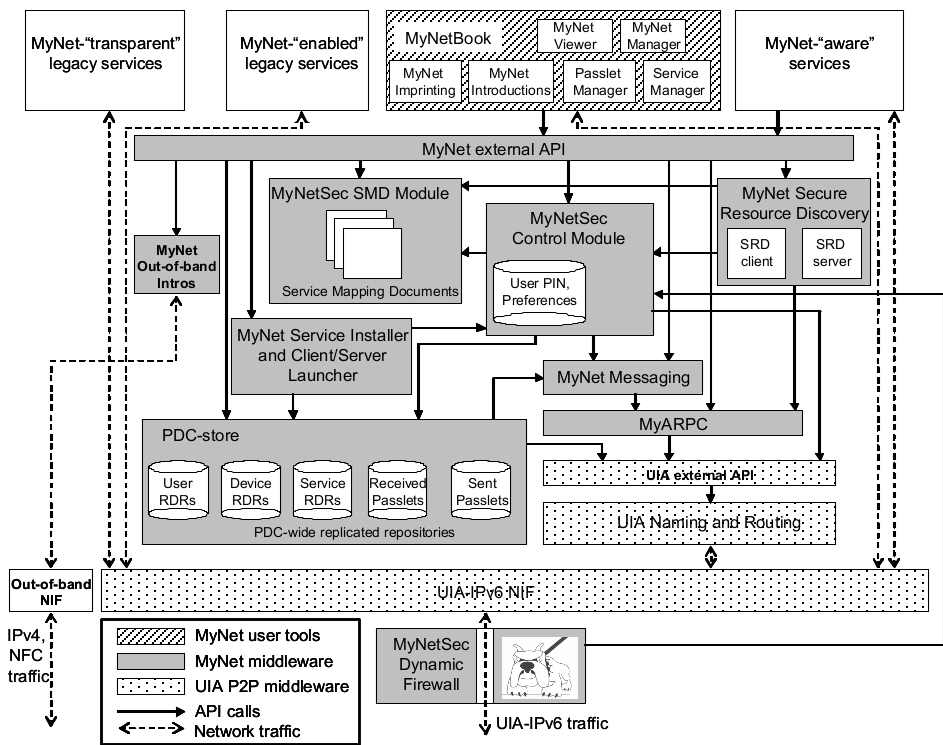
Figure 1: The MyNet architecture shows the interaction between the P2P Overlay (UIA), the Security Control, and the User Interaction tools.
When a Passlet is issued, the Dynamic Firewall on the host device is automatically programmed to intercept and allow only specific RPC (Remote Procedure Call) traffic that matches the Passlet’s parameters. This allows "legacy" applications—those not built with security in mind—to be shared safely.
Experimental Results: Is it Actually Usable?
The team built a functional prototype using Nokia N800 tablets and Linux laptops. They tested it with 13 non-expert users to see if "normal" people could handle P2P security.
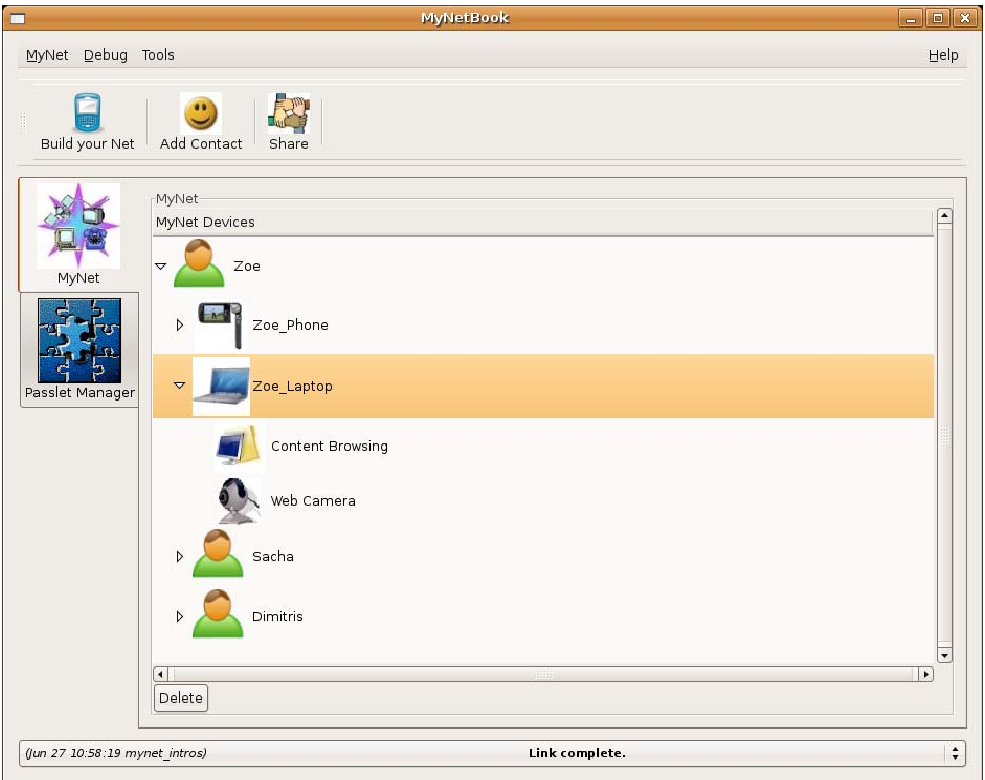
Figure 2: The mobile interface of MyNetBook, showcasing the Personal Network and Passlet Manager.
Key Findings:
- 100% Success Rate: All participants were able to set up their personal network and share resources without manual configuration.
- Intuitive Metaphors: 64% of users immediately understood what a "Passlet" was without extensive explanation.
- TAPing Preference: 78% of users found the physical act of "TAPing" devices together via NFC to be the most natural way to establish trust.
Critical Analysis: A Vision Ahead of Its Time
MyNet’s biggest contribution is the Service Mapping Document (SMD). By mapping high-level user permissions to low-level protocol arguments, they solved the problem of "fine-grained access control" for the masses.
However, the system has limitations:
- Connectivity Dependency: While it handles NAT traversal, it still relies on "eventual consistency" for state replication (the PDC-store), which can lead to conflicts in highly disconnected scenarios.
- Privacy Concerns: The user study highlighted that users are still wary of "auto-sharing" and need even more transparent indicators of what is currently "live."
Conclusion
MyNet serves as a blueprint for a more private, decentralized internet. By replacing centralized servers with a P2P social overlay, it empowers users to own their data and services. As we move into an era of "Edge Computing" and increased privacy awareness, the metaphors of Passlets and social-based routing are more relevant than ever.
Takeaway: Security doesn't have to be a barrier to sharing; with the right human-centric abstractions, it can be the enabler.