
Group Naïve Bayes: Leveraging Overlapping Communities for Higher Link Prediction Accuracy
A naïve Bayes model based on overlapping groups for link prediction in online social networks
This paper introduces a novel Naïve Bayes model for link prediction that leverages overlapping community structures in large-scale online social networks. By proposing the Group Naïve Bayes (GNB) measure and its variants (GNB-CN, GNB-AA, GNB-RA), the study achieves superior AUC and precision on platforms like Flickr, LiveJournal, and Orkut compared to traditional local measures.
TL;DR
Predicting links in massive social networks is akin to finding needles in a haystack. While traditional metrics look at "who you know," this paper focuses on "where you meet." By introducing the Group Naïve Bayes (GNB) model, the authors demonstrate that the influence of a common neighbor is not uniform—it is heavily moderated by the overlapping groups (communities) that users share. Testing across Flickr, LiveJournal, and Orkut, the model shows significant precision gains by treating communities as more than just labels, but as structural anchors for social growth.
Problem & Motivation: The "Single Community" Fallacy
Most link prediction algorithms suffer from two extremes:
- Local measures (CN, AA, RA): Too simple. They treat every common neighbor with a "one size fits all" weight.
- Global measures (Katz, PageRank): Too slow. They are computationally impossible to run on networks with millions of nodes like Youtube or Orkut.
Recent "community-based" efforts tried to bridge this gap but made a fatal assumption: that every user belongs to exactly one community. In reality, you belong to a family group, a work group, and a hobbyist group simultaneously. The authors argue that a common neighbor who shares these overlapping interests with you is a much stronger predictor of a future link than a random shared contact.
Methodology: The Core Architecture
The authors redefine the problem using a Bayesian lens. The core of their strategy is the Overlapping Groups Clustering Coefficient ().
1. Structural Insight
Instead of looking at the global degree of a node , they look at its Overlapping Groups Degree (), which only counts neighbors that belong to at least one group shared with . This filters out the "noise" of unrelated connections.
2. The GNB Framework
The connection likelihood score is derived by calculating the ratio of the probability that a pair is linked versus unlinked, given their shared neighbors in overlapping groups. This results in the GNB measure:
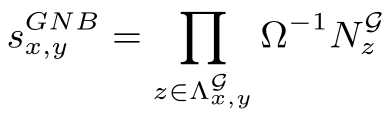
The paper further extends this into three forms: GNB-CN, GNB-AA, and GNB-RA, adapting the classic "Adamic-Adar" and "Resource Allocation" logic to a group-aware Naïve Bayes setting.
Experiments & Results
The researchers conducted a massive evaluation using four large-scale datasets. Below is a snapshot of the topological variety of these networks:
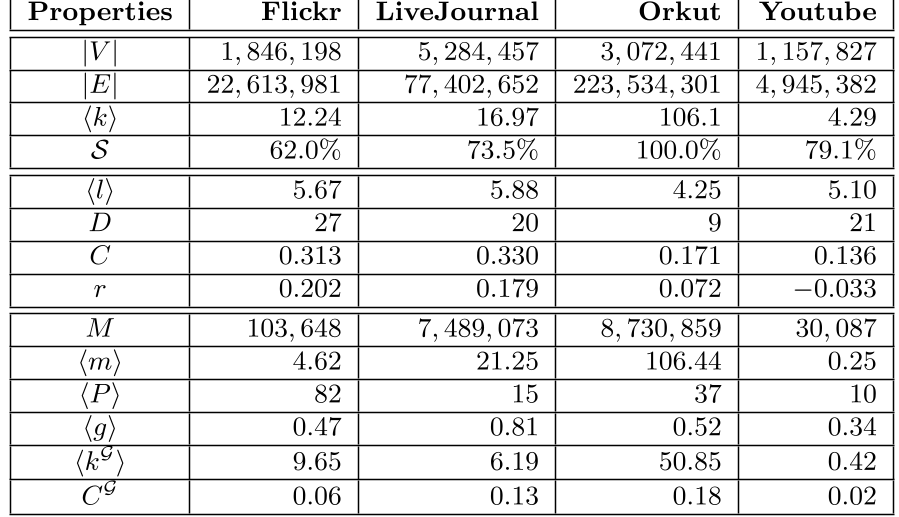
Key Findings:
- Unsupervised Success: In Orkut and Flickr, GNB-based measures consistently ranked in the top tier. GNB-CN, in particular, showed high robustness in precision experiments (ranking 1st or 2nd).
- Supervised Boost: When used as features for machine learning classifiers (J48, NB, MLP), the "VTotal" set (which includes GNB features) outperformed the "VLocal" set (standard metrics) across almost all platforms.
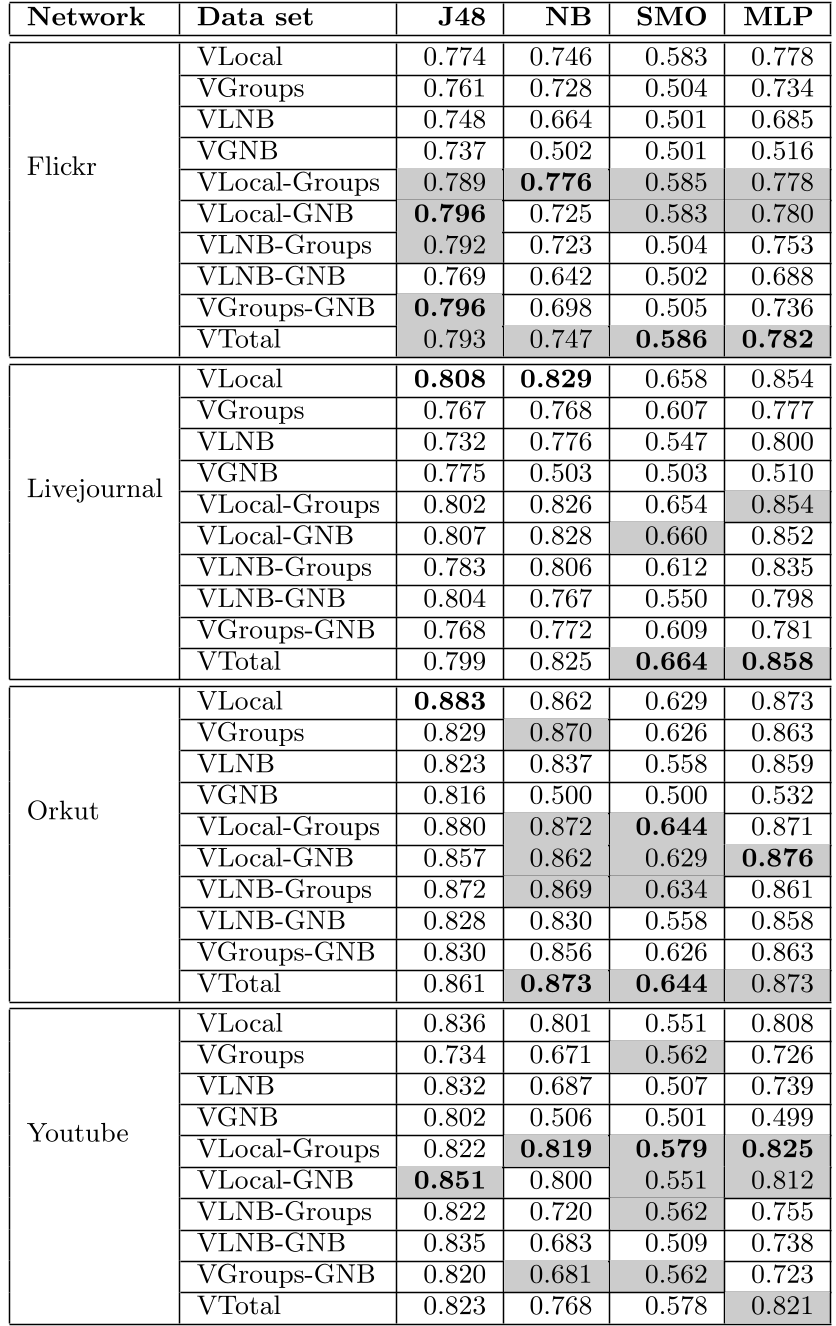
Observation: As seen in Table 5, for the Flickr network, adding overlapping group information (VLocal-Groups/GNB) pushed AUC scores from 0.77 to nearly 0.80, a significant margin in large-scale link prediction.
Critical Analysis & Conclusion
Takeaway
The paper proves that context matters. A neighbor shared within a specific, tight-knit overlapping group provides a much stronger "social signal" than a neighbor shared in a vacuum. By using a Naïve Bayes approach, the authors provide a mathematically grounded way to weight these signals.
Limitations & Future Work
- Group Discovery: The paper assumes groups are already labeled (meta-data). Future iterations would benefit from integrating automated community detection within the GNB pipeline.
- Computational Cost: While faster than global path measures, calculating overlapping group clustering for every common neighbor in a dynamic network still presents a scaling challenge for real-time recommendation.
In summary, this work provides a vital bridge between community detection and link prediction, offering a more nuanced view of the social fabric.