
Identifying the "Asdfs" of the World: Bayesian Name Spam Detection at Scale
11408_Using naive bayes to detect spammy names in social networks.
This paper presents a language-agnostic spam detection system for social networks using a Multinomial Naive Bayes classifier. By decomposing user-entered names into character-level n-grams rather than whole words, the method successfully identifies automated bots and human abusers at registration time, achieving an AUC of 0.85 and reducing LinkedIn's false positive rate by more than 50% compared to legacy regex systems.
TL;DR
LinkedIn researcher David Mandell Freeman demonstrates that we don't need complex behavioral history to catch spammers. By breaking names down into character strings (n-grams) and applying a refined Naive Bayes classifier, LinkedIn halved its false positive rate and created a "Day 0" defense mechanism that works before a user even sends their first message.
Background Positioning
In the hierarchy of trust and safety, this work occupies the Preemptive Detection layer. While most research focuses on post-activity signals (like who a spammer follows or what links they click), this paper addresses the "cold start" problem of account security: How do you judge an account that has existed for exactly three seconds?
Problem & Motivation: The Limits of Regular Expressions
For years, many platforms relied on "Blacklists" or Regular Expressions (regex) to catch fake names. If a name contained a phone number or a banned keyword, it was flagged. However, regex is brittle; it struggles with:
- Internationalization: A pattern that looks like gibberish in English might be a perfectly valid transliterated name in another language.
- Adversarial Adaptation: Spammers can easily bypass specific string matches by adding subtle variations (e.g., "D.av.id" instead of "David").
- The "Unique Name" Wall: On LinkedIn, ~33% of names are unique. A word-based classifier cannot evaluate a name it has never seen before.
Methodology: The Power of Character N-Grams
The core innovation is shifting the feature unit from the word to the n-gram.
1. Feature Engineering
Instead of seeing "David" as one feature, the model sees a sequence. With and boundary markers, "David" becomes:
[^Da, dav, avi, vid, id$]
This allows the model to learn the statistical texture of real names versus spam. For example, specific character clusters like "zzz" or "qwx" have much higher probabilities in the spam class than in legitimate names across various languages.
2. Recursive Back-off (Handling Sparsity)
A major challenge in n-gram models is the "Missing Feature" problem. If a 5-gram doesn't exist in the 60-million-account training set, what is its probability? The author proposes a recursive logic: If a 5-gram is unknown, estimate its probability using its constituent 4-grams. If those are unknown, drop to 3-grams, and so on.
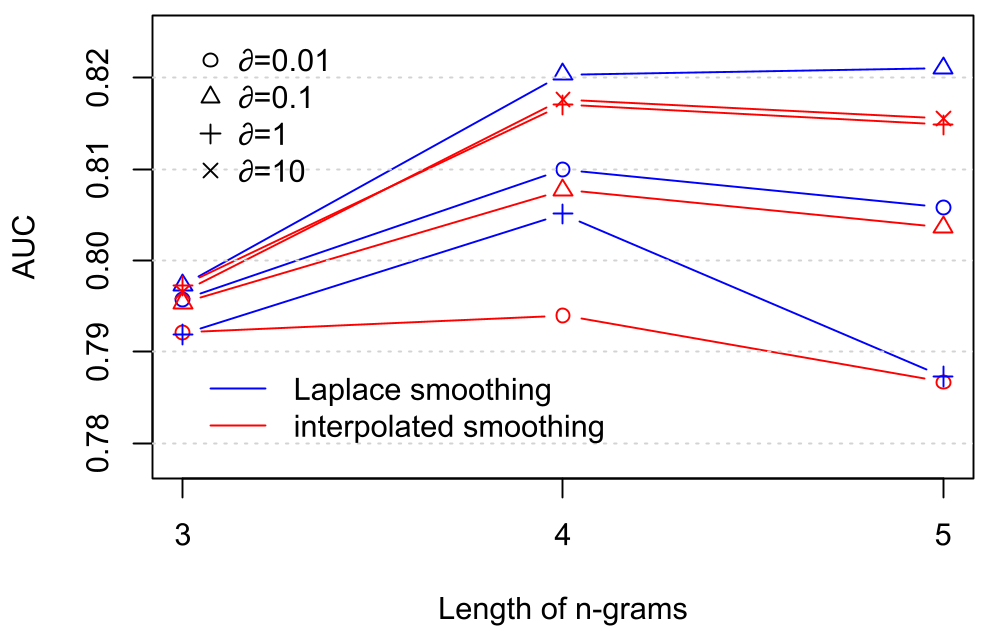 Figure 1: Performance comparison showing that treating First and Last names as distinct feature sets consistently outperforms combined sets.
Experiments & Results: Real-World impact
The author compared a "Full" version (5-grams with recursion) against a "Lightweight" version (3-grams).
- The Findings: The Full version achieved an AUC of 0.852.
- Production Success: When deployed on live LinkedIn traffic, the false positive rate plummeted from 7.0% (Regex) to 3.3% (Naive Bayes).
- Email Synergy: Interestingly, applying the same logic to email usernames (the part before the @) and combining it with the name score provided a "tie-breaker" effect that improved precision in ambiguous cases.
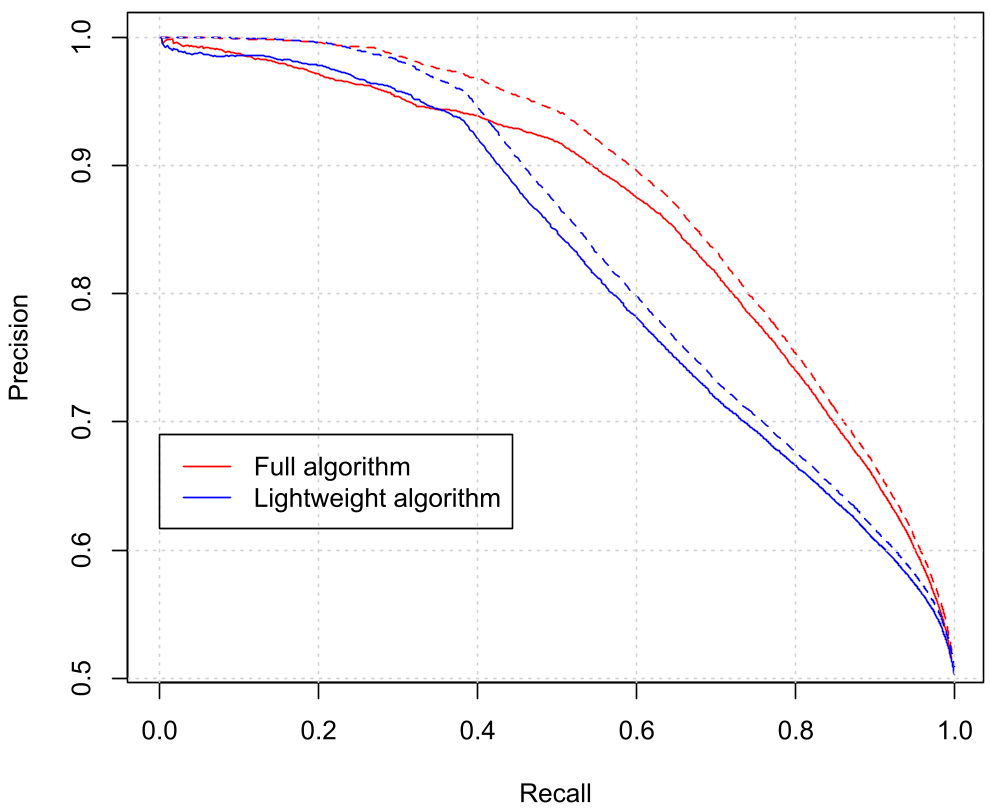 Figure 2: Precision-Recall curves showing the superior performance of the "Full" n-gram model as recall requirements increase.
Critical Analysis & Conclusion
Takeaway
The simplicity of Naive Bayes is its greatest strength here. It is computationally inexpensive enough to run at the moment of registration (low latency) while being robust enough to handle the massive Unicode variety of a global social network.
Limitations
The primary weakness is the Adversarial Model. If spammers realize the system is looking for "unnatural" character distributions, they will pivot to using "stolen" real names or common names from dictionaries. As the author notes, this necessitates a "cat-and-mouse" cycle of regular retraining.
Future Outlook
While this 2013 paper used classical ML, the logic paved the way for modern character-level CNNs and Transformers in cybersecurity. The fundamental insight—that identity carries a statistical signature in its very spelling—remains a cornerstone of account security today.