
The Illusion of Consensus: Why Randomness Kills the Wisdom of Crowds
Naïve learning in social networks with random communication
This paper introduces a "Randomization Approach" to social learning, extending the classic DeGroot model to account for the stochastic nature of social interactions. It demonstrates that even if a social network's average structure (superposition) suggests the "Wisdom of Crowds," the inherent randomness in communication sequences almost always leads a large society to converge on an incorrect belief.
TL;DR
Is a large group of people collectively smarter than an expert? While classic social learning models like the DeGroot model suggest that large societies eventually filter out noise to find the "truth," this paper reveals a fatal flaw. By introducing randomness into how we talk—reflecting that we don't speak to everyone at once—the authors prove that the "crowd" is almost always wrong. Consensus is reached, but it is usually just an anchor to the noise of the first few people who spoke.
Context: The DeGroot Model and its Limits
In the study of social networks, Naïve Learning refers to a process where agents update their beliefs by simply averaging the opinions of their neighbors.
- The SOTA Perspective: Golub and Jackson (2010) famously posited that as long as the influence of the most "famous" person vanishes as the group grows, the group will eventually discover the truth. This is the mathematical foundation of the "Wisdom of Crowds."
- The Fatal Assumption: These models assume that the weight you give your neighbor is a constant, fixed value applied at every single tick of the clock.
The "Random Communication" Insight
The authors argue that real life is stochastic. You may see a colleague once a week or a friend once a month. While your average attention to them is constant, the moment-to-moment interaction is random.
They represent this as a sequence of random matrices . While the average of these matrices (the Superposition) might look like a fair, symmetric network, the actual path of communication is a specific sequence of random draws.
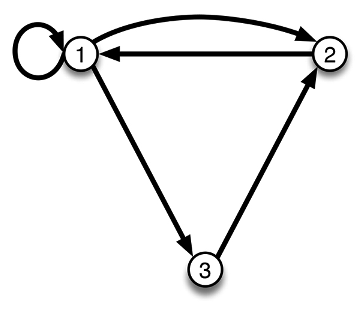 Figure 1: The architecture of interaction. Even if the 'average' network (Superposition) is balanced, the individual components can be highly biased.
Methodology: The Mathematics of Convergence
The paper utilizes Theorem 1 to show that if a network is "consensus-enabling"—meaning it happens to repeat certain influential patterns enough times—the group will reach a consensus.
However, the range of beliefs shrinks geometrically.
- Early Anchoring: In the first few rounds, the range of opinions is wide. A random draw that favors a specific biased agent will pull the entire group toward that bias.
- Irreversibility: Once the group moves toward a biased consensus, even "correct" signals in later rounds cannot pull it back, because the mathematical range of possible beliefs has already narrowed.
Experimental Proof: Simulation of the Ring Network
The authors simulated a ring network where, on average, every agent has equal influence. Under the old DeGroot model, this society would be perfectly "wise."
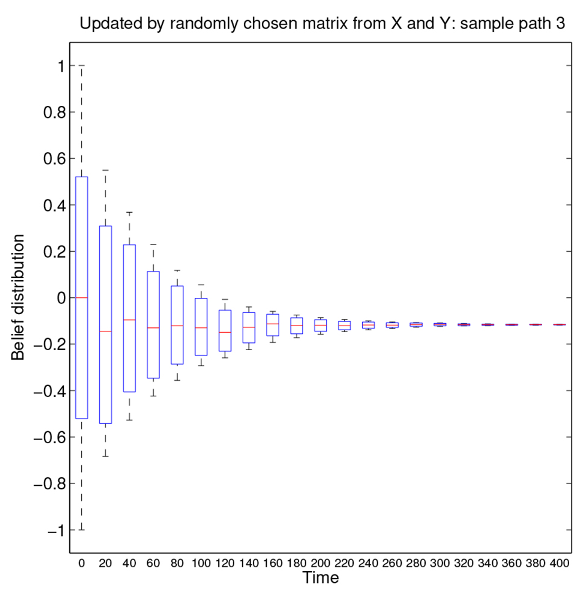 Figure 2: (a) and (b) show how different random paths lead to vastly different consensus levels, while (c) shows the averaged "superposition" which deceptively suggests the truth (mean 0) will be found.
As seen in the results, Sample Path 1 might end up at a belief of +0.5, while Sample Path 3 ends at -0.3. Neither is the truth (0.0). The wisdom is lost in the sequence.
Deep Insight: Critical Analysis
The core takeaway is a warning for organizational design and social media: The order of communication matters more than the structure of the network.
- The Anchor Effect: If a "hiring committee" or a "voting block" allows the first few members to dominate the initial interaction, the "Wisdom of the Crowds" is destroyed. The "consensus" found is merely the frozen noise of the first few participants.
- Measurement Trap: This paper warns researchers against drawing conclusions from "averaged" network data. A measured social graph might look "wise" and decentralized, but the actual daily interactions could be creating informational cascades that lead to bubbles or mass errors.
Conclusion
The study concludes that the crowd is "wrong almost always." By shifting from a static view of social networks to a dynamic, randomized one, the authors provide a chilling mathematical proof that consensus is not a proxy for truth—it is often just the result of who happened to speak first.