
Ising Networks: The Behavioral Foundation of Naive Social Learning
Naive social learning in Ising networks
This paper introduces the "Bayesian without Recall" (BWR) model, a novel framework for naive social learning where agents act rationally but lack memory of past network observations. By specializing this model to binary state and action spaces, the authors demonstrate that optimal decision-making evolves into a weighted majority and threshold function, effectively mapping social learning dynamics onto the mathematical structure of an Ising model.
TL;DR
How do rational individuals end up following the crowd? This paper derives a "Bayesian without Recall" (BWR) model, showing that when rational agents are memoryless, their optimal behavior simplifies to the Ising Model—a classic physics framework for magnetism. This offers a rigorous link between individual utility maximization and collective phenomena like consensus, herds, and mis-learning.
Background Positioning
In the landscape of social learning, we usually see two extremes: Full Bayesian (hyper-rational, mathematically impossible for humans) and DeGroot-style heuristics (simple weighted averages, but lacks a "why"). This work bridges the gap, providing a behavioral justification for simple update rules by assuming agents are rational but have no memory of the network's history.
The Problem: The Complexity of "Thinking About Others Thinking"
If you are a perfectly rational agent in a network, you don't just look at what your friend does. You try to figure out why they did it, which requires knowing who their friends are, what they saw three days ago, and how they interpreted it.
In any realistic network, the recursive logic of "I think that you think that he thinks..." leads to a computational explosion. Prior works either limited the network to 3 people or assumed agents just mindlessly average their neighbors' opinions.
Methodology: Bayesian Logic, Memoryless Execution
The authors propose the BWR Model. The intuition is elegant:
- At , an agent is perfectly Bayesian. They take their private signal and their neighbors' actions to make an optimal choice.
- At , the agent "forgets" the past but keeps the same decision-making logic.
- They treat their neighbors' current actions as if they were fresh, independent signals.
The Mathematical Intuition
When state and action spaces are binary (+1 or -1), the decision rule targets the maximization of expected utility. This transforms into a sign function:
Where:
- : The "observational ability" (expertise) of neighbor .
- : The agent's innate bias or "prior."
- : The strength of the current private signal.
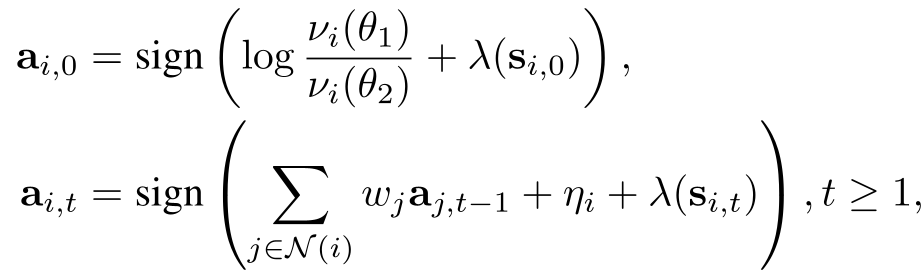 In this framework, the social network becomes an Ising network where nodes represent agents and edges represent the "coupling" of their beliefs.
Experiments & Results: Consensus vs. Truth
The authors analyzed the evolution of these action profiles using Finite Markov Chain theory.
1. The Emergence of Experts
The model naturally identifies "opinion leaders." Agents with high exert more influence not because of a heuristic, but because the network perceives their signal structure as more reliable.
2. Equilibrium and Mis-Learning
A critical finding is that while consensus (everyone doing the same thing) is a stable equilibrium, it is not guaranteed to be the correct one.
- Consensus Condition: If the weight of neighbors exceeds the strength of private signals (), the network enters a stable state.
- The Trap: Because agents are "memoryless," they can get stuck in a feedback loop. Unlike full Bayesian agents who eventually converge to the truth, BWR agents have a positive probability of "mis-learning"—reaching a consensus on an untruth.
 The threshold logic above demonstrates how collective influence can override individual private information.
Critical Insight & Conclusion
Takeaway
The paper successfully demonstrates that many "non-Bayesian" behaviors seen in society—like following a weighted majority—are actually the optimal rational response for agents with limited memory. This links social science directly to the statistical mechanics of Ising models.
Limitations
The model assumes "positive externalities" (you want to align with neighbors). While this fits many social scenarios, it doesn't account for competitive environments or "contrarian" behavior (negative weights), which would technically break the standard Ising symmetry.
Future Outlook
This framework allows researchers to predict which network structures are most prone to misinformation. By quantifying the "weight of influence" vs. "signal strength," we can potentially design networks that are more resilient to the "herding" of untruths.