
Contextual Aggregation: Solving the Sparsity Problem in Social Media NER
Towards Named Entity Recognition Method for Microtexts in Online Social Networks: A Case Study of Twitter
This paper proposes a context-aware Named Entity Recognition (NER) framework tailored for microtexts in Online Social Networks (OSNs) like Twitter. By defining "Contextual Closure" based on semantic, temporal, and social heuristics, the method clusters short texts to provide richer context for a Maximum Entropy-based NER approach.
TL;DR
Conventional Named Entity Recognition (NER) systems are designed for formal, long-form documents. When applied to the fragmented world of Twitter or Facebook, they fail due to "contextual poverty." This paper proposes a structural shift: instead of processing individual tweets, we should process Contextual Clusters. By linking microtexts through semantic, temporal, and social threads, we can recreate the missing context and significantly boost entity extraction accuracy.
The Motivation: Why Twitter is a Nightmare for NER
Traditional NER systems (like those trained on the CoNLL dataset) rely heavily on surrounding syntax to identify entities. However, microtexts present three unique challenges:
- Length Limitation: A 280-character limit provides almost no "neighboring" words for a model to latch onto.
- Dynamic Nature: Social media is a stream, not a static library. Entities emerge and disappear in minutes.
- The "Who" Matters: In OSNs, the relationship between the author and the reader is often more important than the text itself, a factor ignored by standard NLP pipelines.
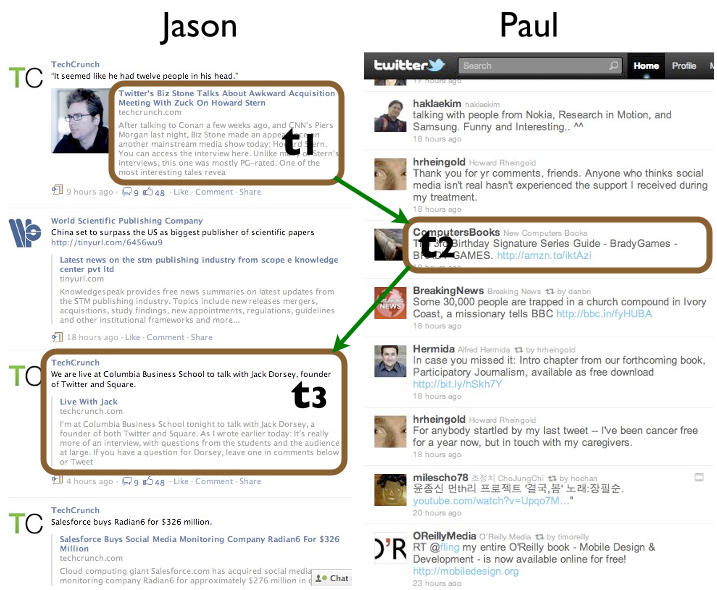
Methodology: The Three Pillars of Contextual Closure
The core innovation of this work is the Contextual Closure Property. The author argues that two microtexts and are part of the same "story" if they satisfy a weighted sum of three heuristics:
1. Semantic Closure ()
Calculated using the intersection of term frequencies. If two tweets share a high degree of vocabulary (measured via vector-space models), they likely discuss the same topic.
2. Temporal Closure ()
Microtexts on social media are often "bursty." If two posts appear within seconds of each other, they are likely related to the same event. The paper uses an exponential decay function to model this:
3. Social Closure ()
This is the most "social-native" heuristic. By looking at the ego-centric social network, the method calculates the shortest path between users and . High interaction frequency or close followership indicates a shared context.
Building the NER Engine
Once these microtexts are clustered, the "Digital ID" () tag is introduced—a crucial addition for the modern web (e.g., @usernames or email addresses).
| Entities | Tags | Examples |
|---|---|---|
| Persons | <PER> | Bill Gates |
| Organizations | <ORG> | MicroSoft |
| Locations | <LOC> | Mountain View |
| Digital IDs | <DID> | @billgates |
The author then applies a Maximum Entropy Approach to these enriched clusters. By merging and , the classifier sees a "macro-document" that contains redundant and reinforcing entity signals, leading to higher confidence scores.
Critical Analysis & Conclusion
The value of this research lies in its holistic view of data. It recognizes that a tweet does not exist in a vacuum; it is a node in a multiplex network of time, language, and human connection.
Limitations:
- The paper is an "ongoing study," meaning large-scale benchmark comparisons against modern transformers (like BERT or RoBERTa-based NER) are missing.
- The computational overhead of calculating "Social Closure" () for every pair in a massive stream could be a bottleneck.
Future Outlook: This work paves the way for "Graph-Augmented NLP," where the social graph acts as a non-local attention mechanism. Integrating these closure properties into a Graph Neural Network (GNN) would be the logical next step for SOTA social media analytics.