
Beyond Words: Giving IVR Systems an Emotional Pulse Through Acoustic Features
Natural Language Dialog System Considering Speaker’s Emotion Calculated from Acoustic Features
This paper presents an intelligent Interactive Voice Response (IVR) system that integrates acoustic emotion recognition with verbal dialogue generation. By combining 384 acoustic features via a Support Vector Machine (SVM) and an expanded Artificial Intelligence Markup Language (AIML), the system achieves more human-like, multi-modal interactions.
TL;DR
Standard voice assistants often sound like "machines" because they only listen to what you say, not how you say it. This paper introduces an intelligent dialogue system that uses SVM-based emotion recognition to analyze 384 acoustic features. By expanding the AIML (Artificial Intelligence Markup Language) framework to include emotional states, the system can pivot its response strategy—offering sympathy when you sound sad and matching your energy when you're happy.
Context: The Monotony of Verbal-Only Systems
Most Interactive Voice Response (IVR) systems operate on a simple stimulus-response model. If you say "I'm fine," the system matches the text and moves on. But in human communication, a gloomy "I'm fine" is a cry for help, while a cheerful "I'm fine" is a confirmation of status. Current systems suffer from a lack of non-verbal intelligence, making interactions feel rigid and "systematic."
Methodology: Fusing Sound and Logic
The authors propose a dual-track processing architecture:
- Verbal Track: Uses standard Speech Recognition (Julius) to convert audio to text.
- Non-Verbal Track: Uses openSMILE to extract 384 acoustic features, including Mel-Frequency Cepstral Coefficients (MFCC), Zero-crossing rates, and Fundamental Frequency (F0).
The Brain: Expanded AIML
The core innovation lies in the expansion of the AIML <pattern> tag. Traditionally, AIML only matched text patterns. The authors added an Emotion condition, creating a state-aware logic:
- Text: "Rain..."
- Emotion: Negative
- Resulting Response: "Is it bad for you?" (Sympathetic)
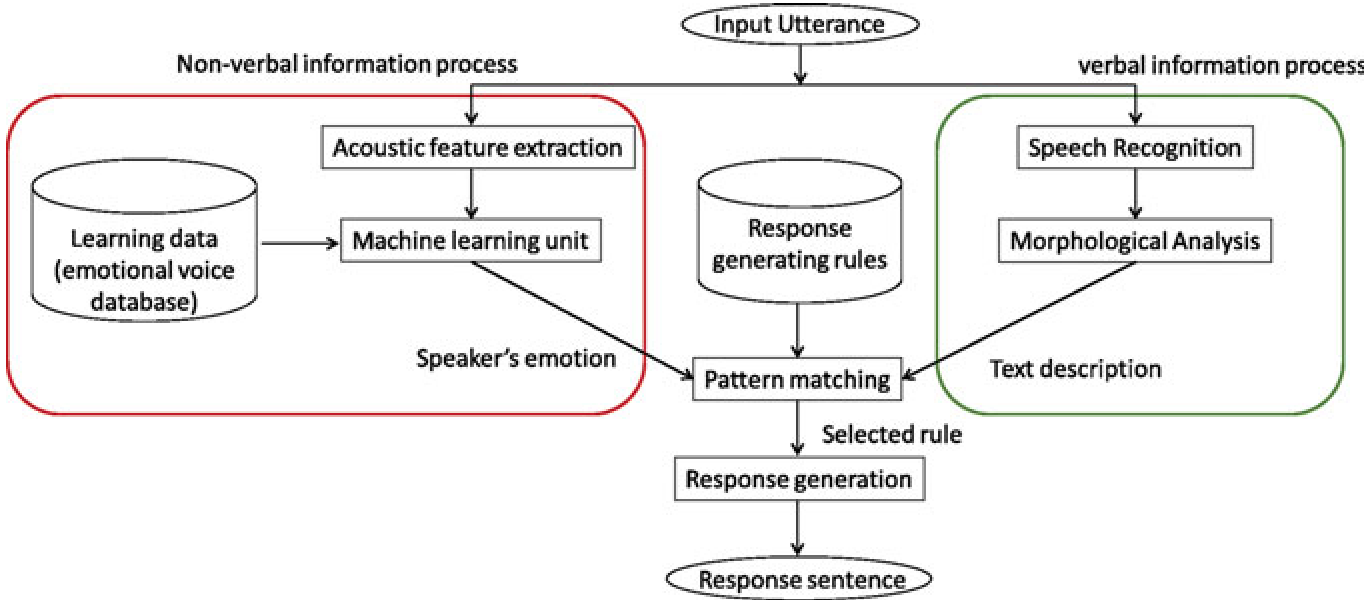 Caption: The workflow showing the integration of verbal text and non-verbal emotion estimation into the response generation unit.
Experiments and Results
The emotion classifier (SVM) achieved an accuracy of 0.71, with the "Neutral" state being the most distinct, while "Positive" and "Negative" occasionally confused the model.
Human Perception Factors
The researchers conducted a user study (10 subjects) measuring factors like "Likeability," "Personality," and "Machine-Creature Likeness."
- Likeability: The emotion-aware system scored significantly higher on "pleasing" (p < 0.001) and "want to be friends" (p < 0.001).
- Machine-Creature Likeness: Users felt the text-only system was "machine-like," while the proposed system felt "creature-like," even when the emotion estimation was slightly off.
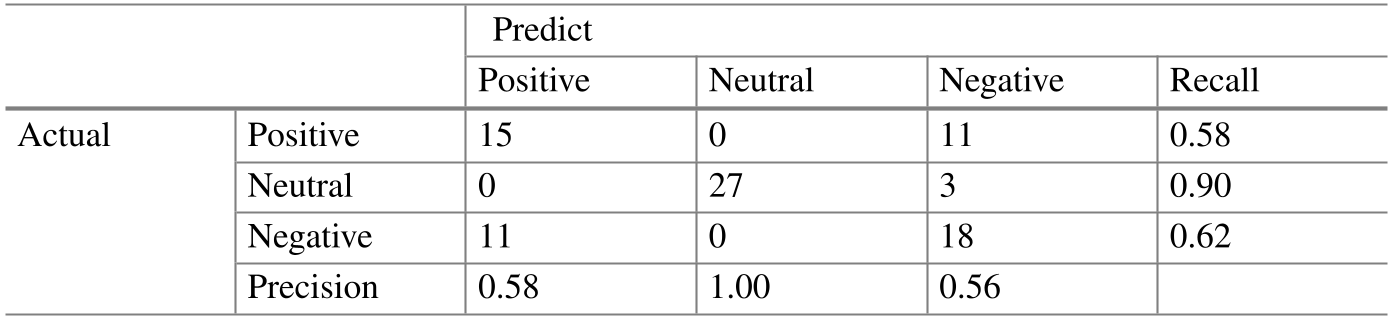 Caption: The confusion matrix for emotion estimation, showing high precision for neutral states but challenges in discriminating between positive and negative valences.
Critical Analysis & Conclusion
This work provides a foundational step toward Affective Computing in practical dialogue systems.
Key Insights:
- Inductive Bias for Persona: By simply changing a response based on a classification label (Positive/Negative), the system develops a "personality" that users find more engaging.
- Robustness of Perception: Interestingly, even when the system made "Inadequate Estimations" (misidentifying the emotion), users still rated it as more "creature-like" than the baseline. The mere attempt at emotional variation breaks the monotony of standard IVR.
Limitations:
- Scalability: The system relies on manually crafted AIML rules. While effective for small-scale demos, scaling this to open-domain conversation requires more generative approaches (e.g., fine-tuning LLMs with emotion tokens).
- Single Modality: As the authors noted, adding facial feature analysis (Computer Vision) would likely resolve the confusion between "Positive" and "Negative" acoustic tones.
In conclusion, this paper demonstrates that the "feeling" of a dialogue system depends as much on its sensitivity to tone as it does on its factual accuracy.