
Needle in a Haystack: Tracking Down Elite Phishing Domains in the Wild
Needle in a Haystack: Tracking Down Elite Phishing Domains in the Wild.
The paper introduces SquatPhi, a systematic measurement framework designed to identify "elite" phishing domains that impersonate popular brands at both the domain (via squatting) and content levels. By analyzing 224 million DNS records and 702 brands, the authors identify 657K candidate domains and deploy an evasion-resilient machine learning classifier using OCR and visual analysis.
TL;DR
Phishing has evolved beyond simple "fake emails." This paper uncovers a class of "Elite" phishing—attacks that use domain squatting (like faceb00k.bid or goofle.com.ua) to deceive users at the URL level while using heavy content obfuscation to hide from security scanners. The researchers developed SquatPhi, a tool that uses OCR to "see" the page like a human, successfully uncovering 1,175 domains that traditional blacklists missed by over 90%.
The Evolution of the "Elite" Phish
Most phishing detection tools look for signatures in the HTML source code or match URLs against known blacklists. However, modern attackers have realized that if they obfuscate their JavaScript or use images instead of text, these tools go blind.
The researchers identified a major blind spot: Domain Squatting Phishing. By combining deceptive domain names with pixel-perfect visual clones, attackers create a highly convincing trap. Because these domains are "zero-day" and the code is obfuscated, they remain active for months, whereas typical phishing links die in days.
Methodology: If You Can't Read the Code, Read the Screen
The core insight of the SquatPhi framework is that a phishing page must be readable to a human to work. Even if the keyword "PayPal" is hidden in the source code using String.fromCharCode() or chopped into CSS-positioned divs, the rendered image must still show the logo and the login prompt.
1. The Detection Pipeline
The authors scanned 224 million DNS records to find domains targeting 702 popular brands using five techniques:
- Homograph: Using international characters (e.g.,
fàcebook.com). - Typo: Common misspellings (
faceboook.com). - Bits: Single bit-flips in hardware (
facebnok.com). - Combo: Adding keywords (
facebook-login.com). - WrongTLD: Changing the extension (
facebook.audi).
2. The OCR-Powered Classifier
To bypass obfuscation, the team used OCR (Optical Character Recognition). By processing screenshots with Google’s Tesseract engine, the classifier extracts "Visual Keywords" directly from the rendered UI—capturing brand names and sensitive prompts (e.g., "enter password") that were invisible to text-based scanners.
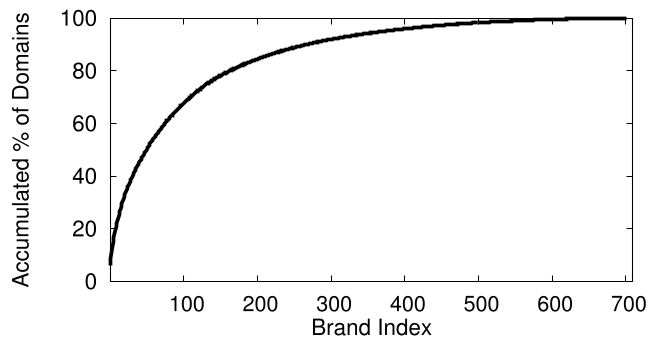 Figure: The distribution of candidate squatting domains. Combo-squatting is the most prevalent, representing the "long tail" of the attack surface.
Key Findings: The Blacklist Blind Spot
The experimental results were a wake-up call for the security community:
- Longevity: Unlike standard phishing which is taken down quickly, 80% of squatting phishing domains stayed online for over a month.
- Blacklist Failure: Popular services like VirusTotal and PhishTank missed 91.5% of these domains.
- Evasive Techniques: Squatting phishing pages are twice as likely to use string obfuscation compared to regular phishing.
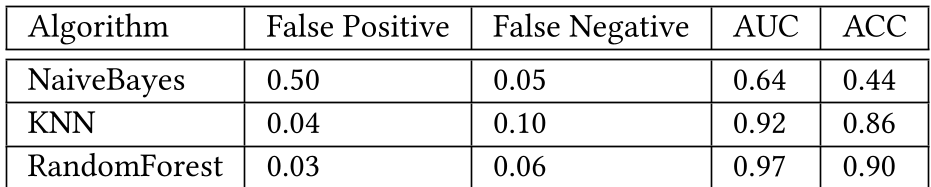 Table: Comparison of ML algorithms. Random Forest with OCR features achieved an AUC of 0.97, proving that visual signals are highly predictive of phishing intent.
Real-World Case Studies
The paper highlights several dangerous "Elite" scams:
- Fake Search Engines:
goofle.com.uawas used to intercept search queries and serve malicious ads in Ukraine. - B2B Fraud:
go-uberfreight.comtargeted truck drivers to steal logistics credentials for potentially high-value physical theft. - Payroll Scams:
mobile-adp.commimicked HR portals to redirect employee salaries to attacker-controlled accounts.
Critical Analysis & Conclusion
The value of this work lies in its cross-layer analysis. By bridging the gap between DNS measurement and computer vision, it reveals how attackers exploit the "logical gap" in modern browsers—specifically on mobile, where narrow address bars make squatting domains even more effective.
Limitations: While OCR is powerful, the authors acknowledge that future attackers might use "Adversarial Noise"—subtle pixel changes that confuse OCR engines while remaining legible to humans. However, as it stands, SquatPhi represents a significant step forward in turning the attackers' visual deception against them.
Takeaway for Organizations: Relying on URL blacklists is no longer sufficient. Security teams must monitor the DNS "neighborhood" of their brands and use visual analysis tools to catch impersonators before they cause massive data breaches.