
NLS: Refining Network Dismantling via Neighborhood Link Sensitivity
A neighborhood link sensitive dismantling method for social networks
This paper introduces the Neighborhood Link Sensitive (NLS) dismantling method, a novel approach for identifying the minimal set of nodes required to fragment social networks. By integrating a neighborhood-link-sensitive centrality measure and an optimized greedy re-insertion strategy, the method achieves state-of-the-art performance in network dismantling across various real-world and synthetic datasets.
Executive Summary
TL;DR: The Neighborhood Link Sensitive (NLS) method is a two-stage framework (deleting and re-inserting) that identifies critical nodes in social networks by analyzing not just their connectivity, but how their neighbors are linked to each other. By penalizing nodes that reside within dense local clusters, NLS targets the true "weak points" of a network, achieving a dismantling performance that is remarkably close to theoretical optima.
Context: This work sits at the intersection of network science and discrete optimization. It bridges the gap between simple centrality-based heuristics (which are fast but often inaccurate) and decycling-based methods (which are accurate but prone to massive over-deletion).
The Core Motivation: Why Existing Centralities Fail
Most centrality measures, including the popular Collective Influence (CI), assume that a node's importance is a function of its neighbors' degrees. However, they suffer from a "Local Loop Blindness."
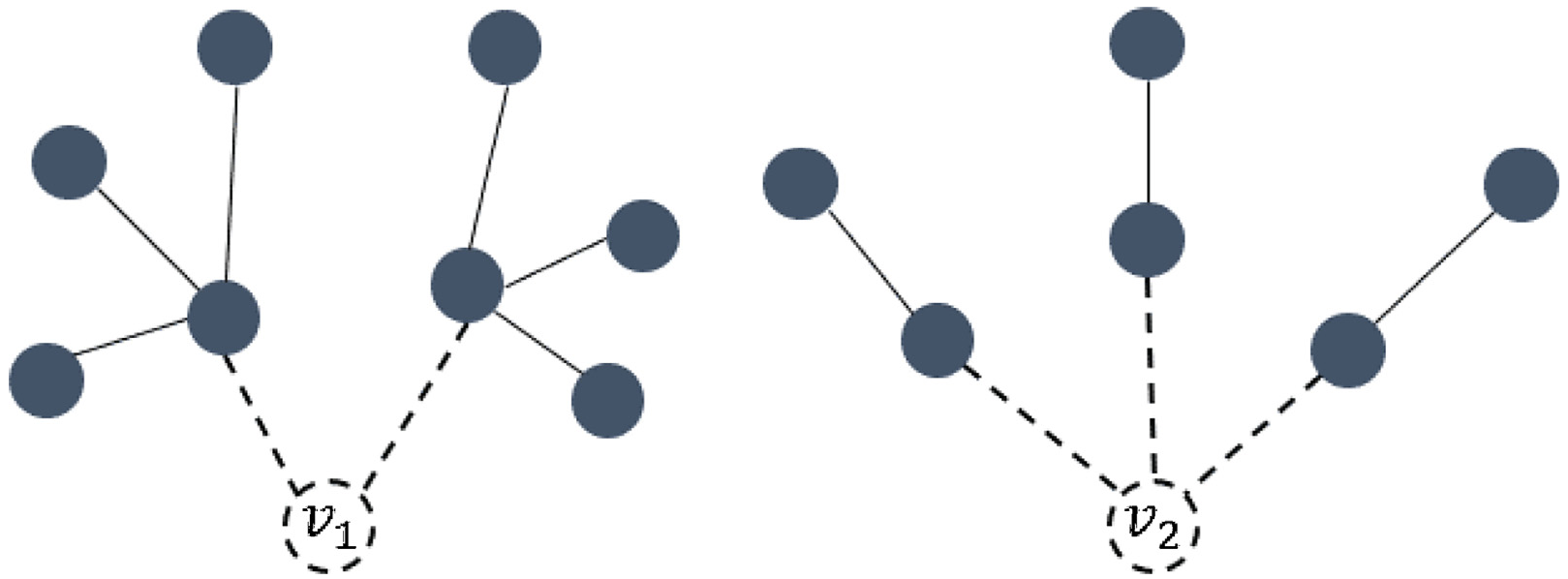
Imagine a node connected to and . If and are themselves linked, removing does not disconnect and . Conventional CI would still give a high score, whereas the proposed NLS recognizes that 's removal is redundant for fragmentation. The authors argue that a "weak node"—one that truly holds different clusters together—is often a low-degree node surrounded by hubs, but crucially, its neighbors should have minimal direct links.
Methodology: The NLS Framework
The NLS approach consists of two refined phases:
1. The Dismantling Factor ()
The authors define a "Dismantling Factor" for node : Where is the degree and is the number of links between neighbors. This factor effectively "devalues" nodes that are part of tight-knit cliques. The overall centrality then incorporates this factor into a neighborhood degree product:
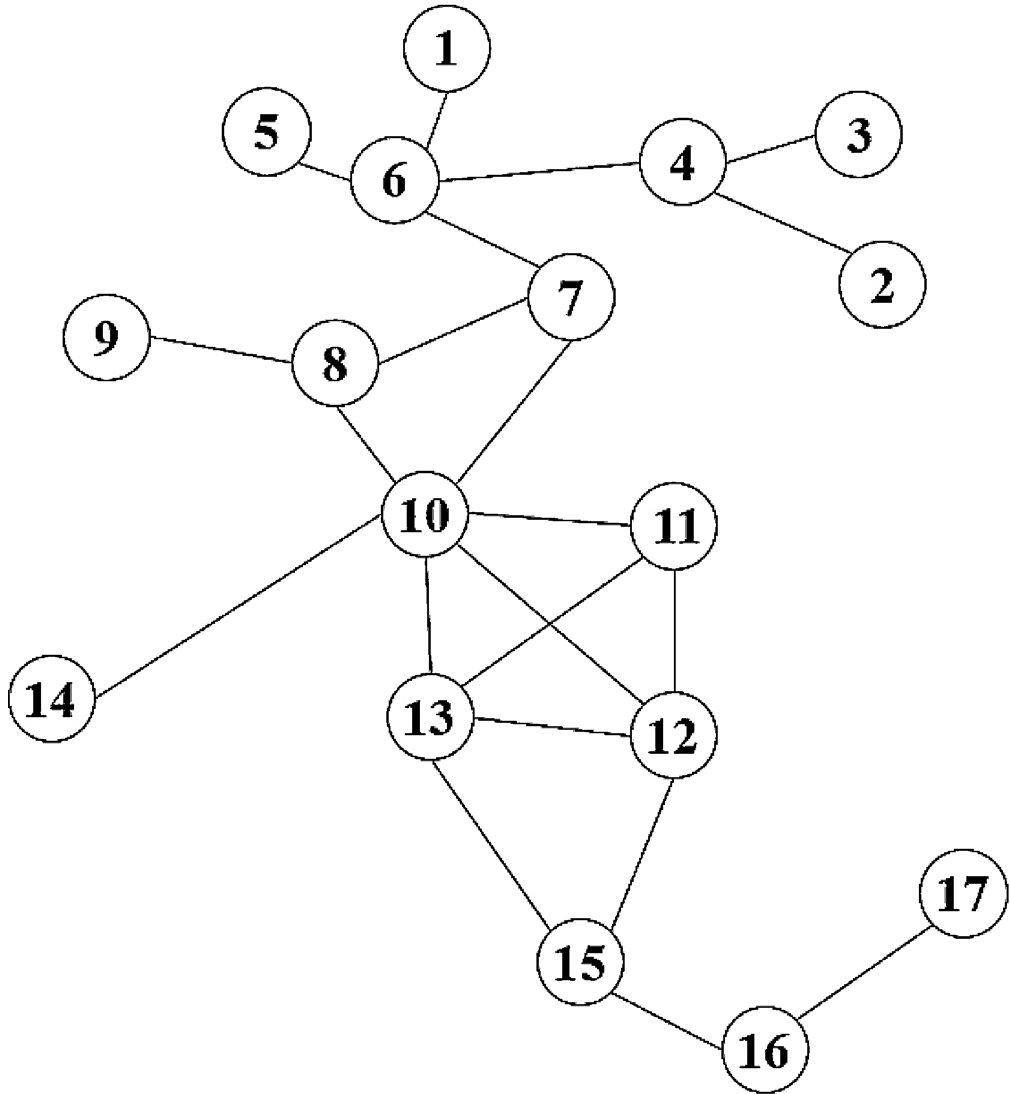 In Fig 3. of the paper, the authors demonstrate how NLS correctly identifies node B as more critical than A for dismantling, despite A having a higher degree.
2. Precise Re-insertion
After the initial deletion phase (until the largest component ), NLS enters a refined re-insertion phase. The paper systematically tests three strategies and finds that the most effective is Strategy 1: choosing nodes that, when put back, connect components with the smallest total node count. This keeps the largest connected component (LCC) growth as slow as possible.
Experimental Validation
The authors tested NLS against CI, BPD, and CoreHD on diverse datasets, from European road networks to the WebPage graph (875k nodes).
SOTA Comparison
In almost every scenario, NLS required fewer node removals to achieve the same level of network collapse.
- Grid Network: NLS outperformed all, coming within 0.26% of the theoretical lower bound.
- RoadTX (Texas Road Network): NLS successfully bypassed the over-deletion issue seen in CoreHD, which originally deleted 243,969 nodes only to re-insert 223,680 of them.
 The decay of the LCC (q) as a function of removed nodes (f) shows NLS (red line) consistently dropping faster or staying lower than competitors.
Critical Insight & Conclusion
The true value of this work lies in its Inductive Bias: the explicit recognition that network connectivity is maintained by local cycles. By quantifying these cycles through the parameter, NLS moves beyond "degree-counting" and enters "topology-aware" dismantling.
Limitations: While NLS is highly effective, its time complexity of (due to the iterations) might still be heavy for hyper-scale graphs with billions of edges where one-pass heuristics are preferred. Additionally, its performance on purely random Erdos-Renyi graphs is slightly lower than BPD, likely because ER graphs lack the community/loop structures that NLS is designed to exploit.
Future Outlook: Integrating this neighborhood-link sensitivity into modern Graph Neural Networks could lead to even more robust, learnable dismantling policies for dynamic networks.