
The Illusion of Architecture: Unifying Optimizers and Chains via Nested Learning
Nested Learning: The Illusion of Deep Learning Architectures
The paper introduces Nested Learning (NL), a paradigm that reformulates machine learning models as systems of inter-connected, multi-level optimization problems. It presents the Hope architecture, which combines a self-modifying "Titans" module with a Continuum Memory System (CMS) to achieve SOTA results in continual learning and long-context reasoning.
TL;DR
Is the distinction between a "Transformer," an "RNN," and an "Adam Optimizer" actually arbitrary? This paper introduces Nested Learning (NL), a paradigm shift that views every component of a model as an associative memory module trying to compress its own "context flow." By introducing the Hope architecture—combining self-modifying mechanisms with a Continuum Memory System (CMS)—the authors demonstrate a path toward models that truly learn continually and handle context lengths up to 10 million tokens.
Problem: The Static Nature of Modern LLMs
Current Large Language Models (LLMs) suffer from what the authors call "Anterograde Amnesia." Once pre-training ends, their weights are frozen. While they can perform In-Context Learning (ICL), this knowledge is volatile; it disappears the moment the context window is cleared. There is no mechanism to "consolidate" these immediate experiences into long-term parameters without expensive re-training (which often leads to catastrophic forgetting).
The Insight: Everything is an Optimization Problem
The authors' core breakthrough is the realization that architectures and optimizers are the same thing at different "levels."
- Pre-training is just ICL with an ultra-large context dataset.
- Optimizers (like Adam or Momentum) are associative memories that compress the history of gradients.
- Attention is a non-parametric solution to a regression objective on tokens.
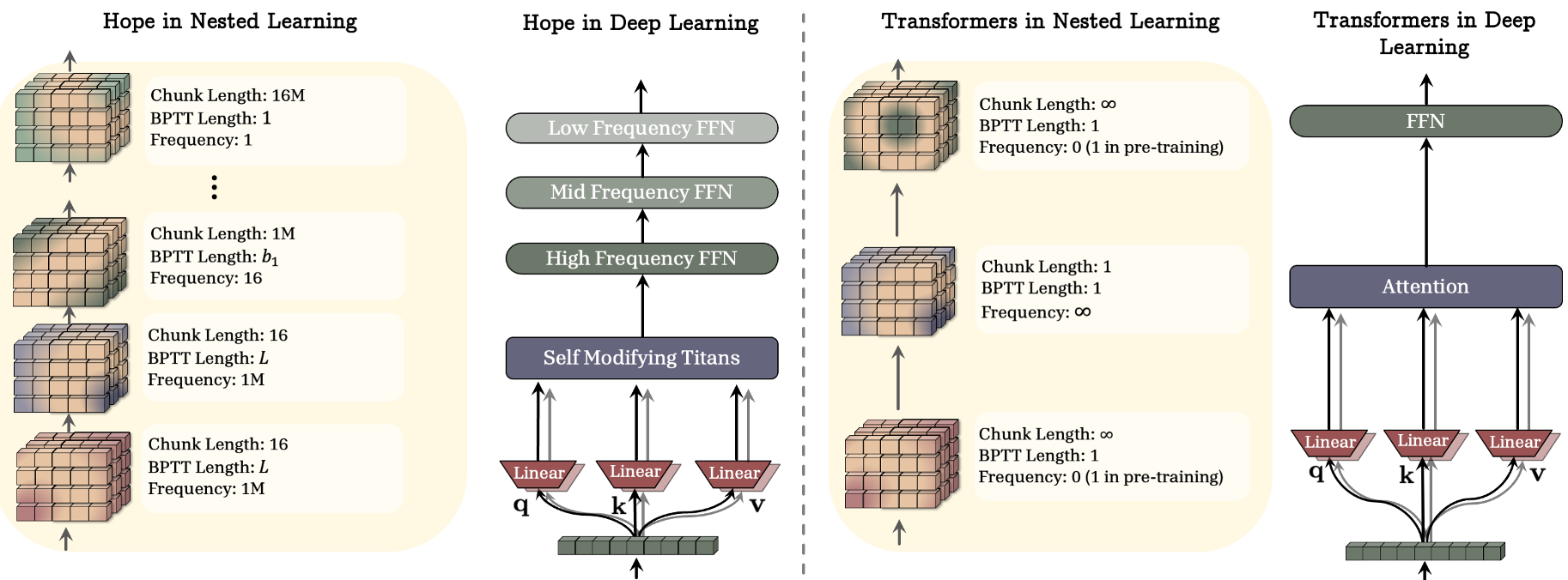
By ordering these processes by their Update Frequency, we see a nested hierarchy. A model is not just a stack of layers; it’s an inter-connected system where one level generates the data (context/gradients) for the next.
Methodology: The Hope Architecture
The researchers propose Hope, a neural learning module designed to act more like the human brain's multi-timescale processing system.
1. Self-Modifying Titans
Unlike standard Transformers where projection matrices () are static, Hope uses Self-Referential Titans. These modules learn to generate their own update values in-context. They don't just process data; they learn how to modify their own internal algorithm based on the sequence they are currently reading.
2. Continuum Memory System (CMS)
Instead of a binary "Short-term vs. Long-term" memory, CMS uses a chain of MLP blocks updated at different frequencies.
- High-frequency neurons adapt fast to the immediate context.
- Low-frequency neurons store persistent knowledge.
- Knowledge Transfer: Levels are linked via backpropagation or meta-learning, creating a "loop" where knowledge can be recovered even if it starts to fade from the faster levels.
Experiments: Performance at the Edge
The results prove that "more levels" equate to better learning:
- Continual Learning: In class-incremental tasks (CLINC, Banking), Hope achieved higher accuracy than traditional EWC or ICL by effectively transferring knowledge between its frequency levels.
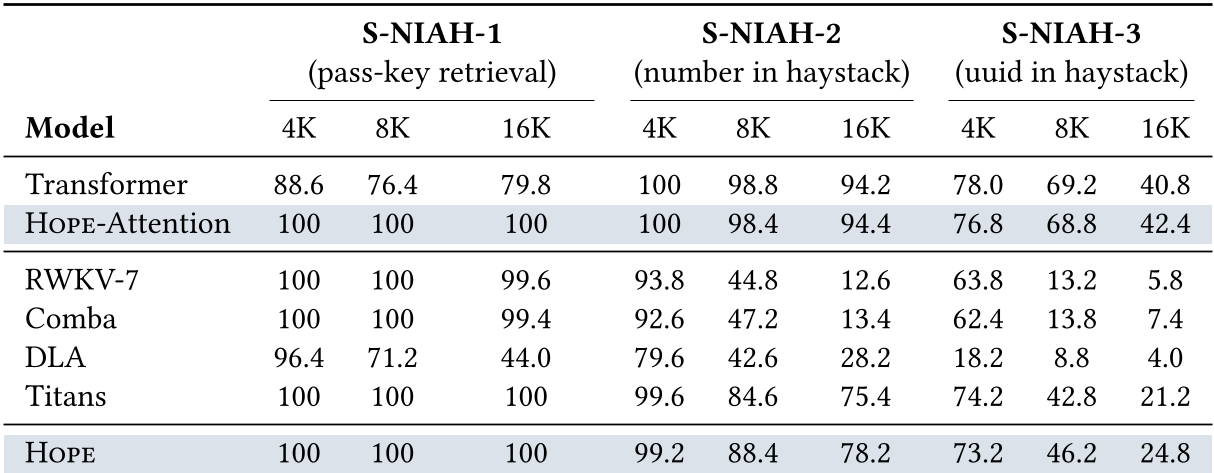
- The 10M Token Frontier: On the BABILong benchmark, most models (including GPT-4) collapse after 256k tokens. Hope successfully reasoned through context containing 10 million tokens.
- M3 Optimizer: The authors also introduced the Multi-scale Momentum Muon (M3) optimizer, proving that applying CMS logic to the optimizer itself leads to faster convergence and more effective loss-landscape navigation.
Deep Insight: Beyond Static Weights
The philosophy of NL suggests that we have been looking at deep learning through a narrow lens. The "heterogeneity" of different architectures (Attention vs. MLP vs. RNN) is largely an illusion. From the NL perspective, they are all just uniform sets of artificial neurons. The real "magic" happens in the Nested Optimization—the frequency and logic with which these neurons update.
Summary & Future Outlook
Nested Learning provides a roadmap for "Superintelligence from Experience." It moves us away from the "train then deploy" paradigm toward models that continually manage their memory across a spectrum of timescales. While catastrophic forgetting isn't "solved"—as it's a natural byproduct of compression—the multi-level CMS structure provides a much more robust "loop" for retaining critical information.
Key Takeaway: Stop looking for a perfect static architecture. Start looking for a more expressive nested learning system.