
NetTube: Leveraging Social Graphs to Revolutionize P2P Short-Video Sharing
NetTube: Exploring Social Networks for Peer-to-Peer Short Video Sharing
NetTube is a novel peer-to-peer (P2P) assisted delivery framework specifically designed for short-video sharing platforms like YouTube. It leverages the small-world clustering properties of video social networks to implement a bi-layer overlay, utilizing a Bloom filter-based indexing scheme and a social-network-assisted pre-fetching strategy to optimize streaming performance.
TL;DR
NetTube is a P2P-assisted streaming framework tailored for the unique challenges of short-video platforms (e.g., YouTube). By treating related videos as a "social network" and using a bi-layer overlay with smart pre-fetching, it slashes server costs by 75% and provides a much smoother playback experience than traditional P2P or Client/Server models.
Background: The Scalability Crisis of Short Videos
As of 2008, YouTube's bandwidth consumption was comparable to the entire Internet's traffic from the year 2000. While P2P has successfully accelerated long-form movies and live TV (PPLive, Bitterrent), the "Short Video" paradigm presents two fatal flaws for traditional P2P:
- High Churn: Videos are so short that users switch before a P2P mesh can even stabilize.
- Swarm Fragmentation: With millions of videos, most "swarms" are too small to support effective sharing.
The Core Insight: Videos have Social Lives
The authors performed a massive measurement study on 5 million YouTube videos and discovered a "Small World" phenomenon. Related video links create clusters with high clustering coefficients (0.2 - 0.3). This means a user's next video is highly predictable, and the peers watching "Video A" are likely to watch "Video B" soon.
Methodology: The Bi-Layer Overlay and Social Pre-fetching
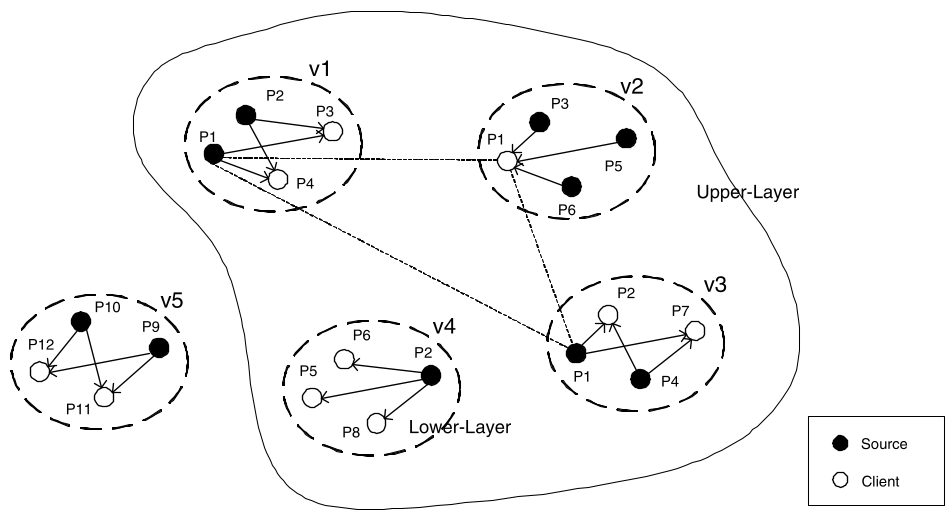
NetTube moves away from isolated swarms toward a Bi-layer Overlay.
1. Bi-Layer Architecture
- Bottom Layer: Individual video swarms (BitTorrent-style).
- Top Layer: A conceptual overlay where neighborhood relations are formed between swarms that share common peers.
2. Social Network Assisted Pre-fetching
Instead of waiting for a user to click a video, NetTube uses the local social graph to pre-fetch the top related videos. Because of the "Small World" clustering, the accuracy of this pre-fetching increases as the user watches more videos, reaching nearly 90% accuracy after 5 videos.
3. Efficient Indexing
To avoid overwhelming the server, NetTube uses Bloom Filters to index cached videos. This allows peers to quickly query their "Friend-to-Friend" (F2F) neighbors for content without massive storage overhead.
Experimental Validation
The system was tested via large-scale simulations and a prototype on PlanetLab.
Server Load Reduction
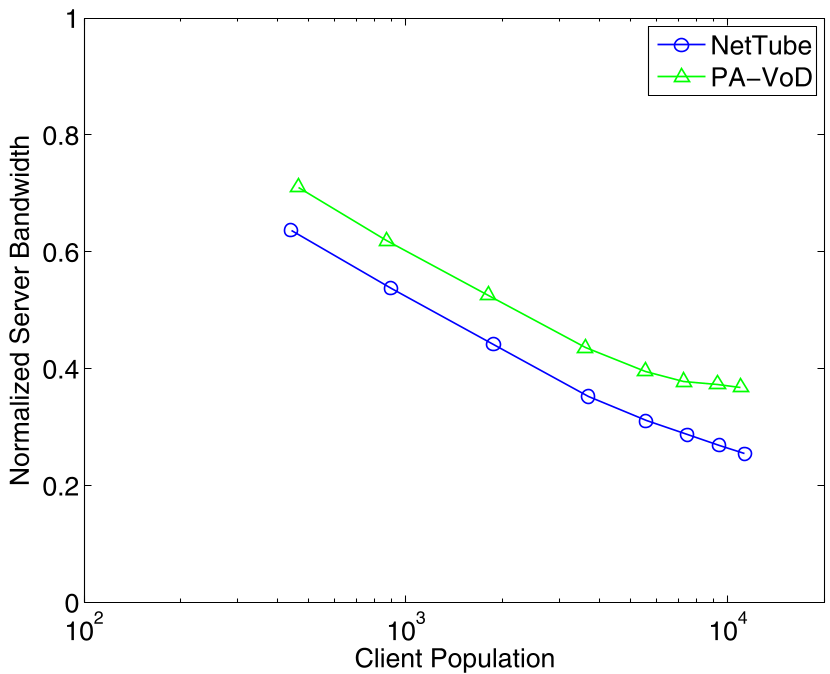
Compared to PA-VoD (a state-of-the-art system at the time), NetTube's server bandwidth consumption drops significantly more as the client population grows. At 12,000 clients, it requires only 25% of the bandwidth of a standard C/S model.
User Experience: Continuity and Delay
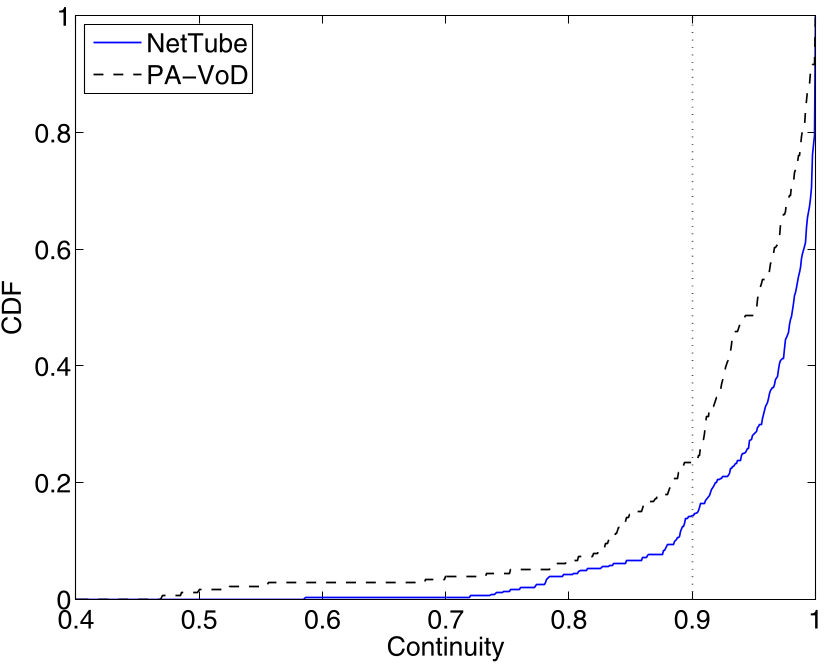
In PlanetLab tests, NetTube achieved an average startup delay of 2.18 seconds, compared to 4.41 seconds for PA-VoD. 90% of NetTube users enjoyed a playback continuity over 0.9, proving the system's resilience to the frequent "switches" inherent in short-video consumption.
Critical Insight & Conclusion
NetTube proves that for high-churn applications, caching is not enough—structure matters. By leveraging the inherent social links between content, NetTube transforms a fragmented sea of short videos into a cohesive, searchable mesh.
Limitations: The system assumes users follow the "Related Videos" links. If users primarily use search or external links, the pre-fetching accuracy might drop. Furthermore, modern HTTPS/DRM requirements would necessitate more complex security layers than those discussed in this 2008-era paper.
Future Outlook: This work laid the groundwork for modern "Edge-assisted" pre-fetching and suggests that Recommendation Engines and Delivery Networks should be more tightly integrated.