
The Concentrated World: Unveiling the Hidden Architecture of French Law
A network approach to the French system of legal codes—part I: analysis of a dense network
This paper introduces a network analysis approach to the French legal system by modeling 52 national codes as vertices and their cross-citations as edges. It identifies a unique "Concentrated World" topology characterized by high density and the presence of a "Rich-Club" consisting of 10 central codes, achieving a structural mapping of national legal complexity.
TL;DR
Lawyers and policymakers have long complained about "legal inflation," but how do we actually measure the complexity of an entire nation's legal backbone? This paper applies Ph.D.-level graph theory to the French system of legal codes, revealing that law is not a "Small-World" like a social network, but a "Concentrated World"—a hyper-dense web where everything is closer than it looks, governed by an elite "Rich-Club" of codes.
From Legal Chaos to Mathematical Order
Modern legal systems are built like cathedrals: generation after generation, texts are added, revised, or removed, creating a labyrinth of cross-references. While most network science deals with "sparse" systems (like the Internet or social networks where you only know a tiny fraction of the total population), the French Legal Code (FLC) system is remarkably dense.
The authors argue that the traditional "Small-World" model fails here. In a small world, you have local clusters and occasional shortcuts. In the FLC, the density is so high (over 40% of all possible connections exist) that the system requires a new classification: the Concentrated World.
The Core: The "Rich-Club" Phenomenon
By analyzing the citation links between 52 major French codes, the researchers identified a Rich-Club. In network theory, a rich-club exists when the most "powerful" nodes (those with the most links) are also incredibly well-connected to each other.
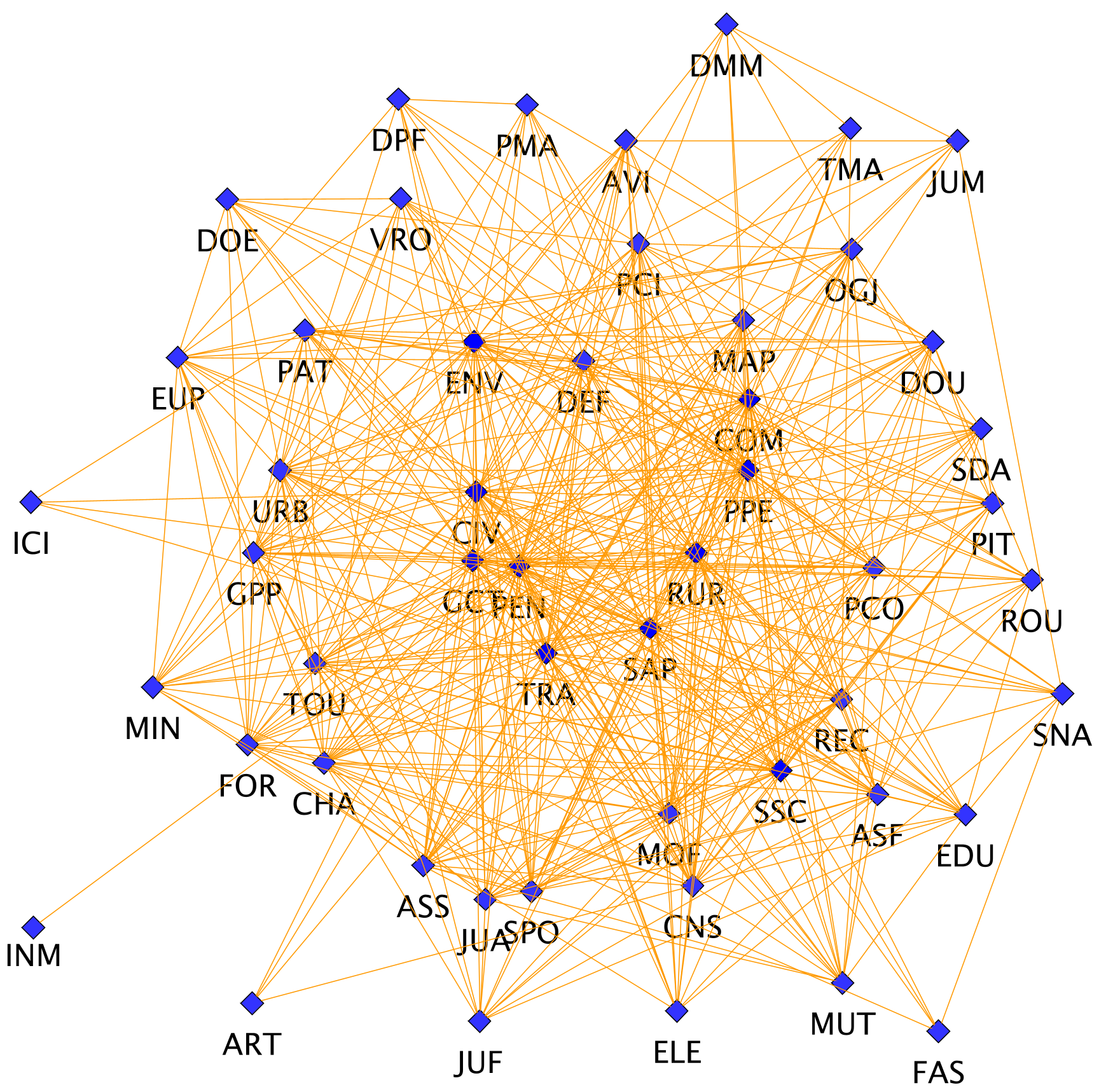 Figure 1: The initial visualization of 52 codes. Note the high density of edges making typical "clump" identification nearly impossible to the naked eye.
The "Rich-Club" of French Law consists of 10 codes, including:
- The Penal Code (PEN): The most central node, acting as the "hinge" of the system.
- The Civil Code (CIV): The historical and foundational matrix.
- Unexpected Powerhouses: The Code of Local Authorities (GCT) and Public Health (SAP), which regulate vast, diverse areas of social life.
Methodology: Finding Stability in Density
To find meaningful communities in such a "crowded" graph, the authors didn't rely on just one algorithm. They cross-referenced three: Fast-Greedy, Spectral Partitioning, and Walk-trap.
Where these three algorithms agreed, the authors found "Stable Communities." This revealed two major pillars of non-central law:
- Social Issues Community (12 codes): Education, Tourism, Insurance, and Consumer law.
- Territories and Resources Community (11 codes): Urbanism, Forestry, Mining, and Housing.
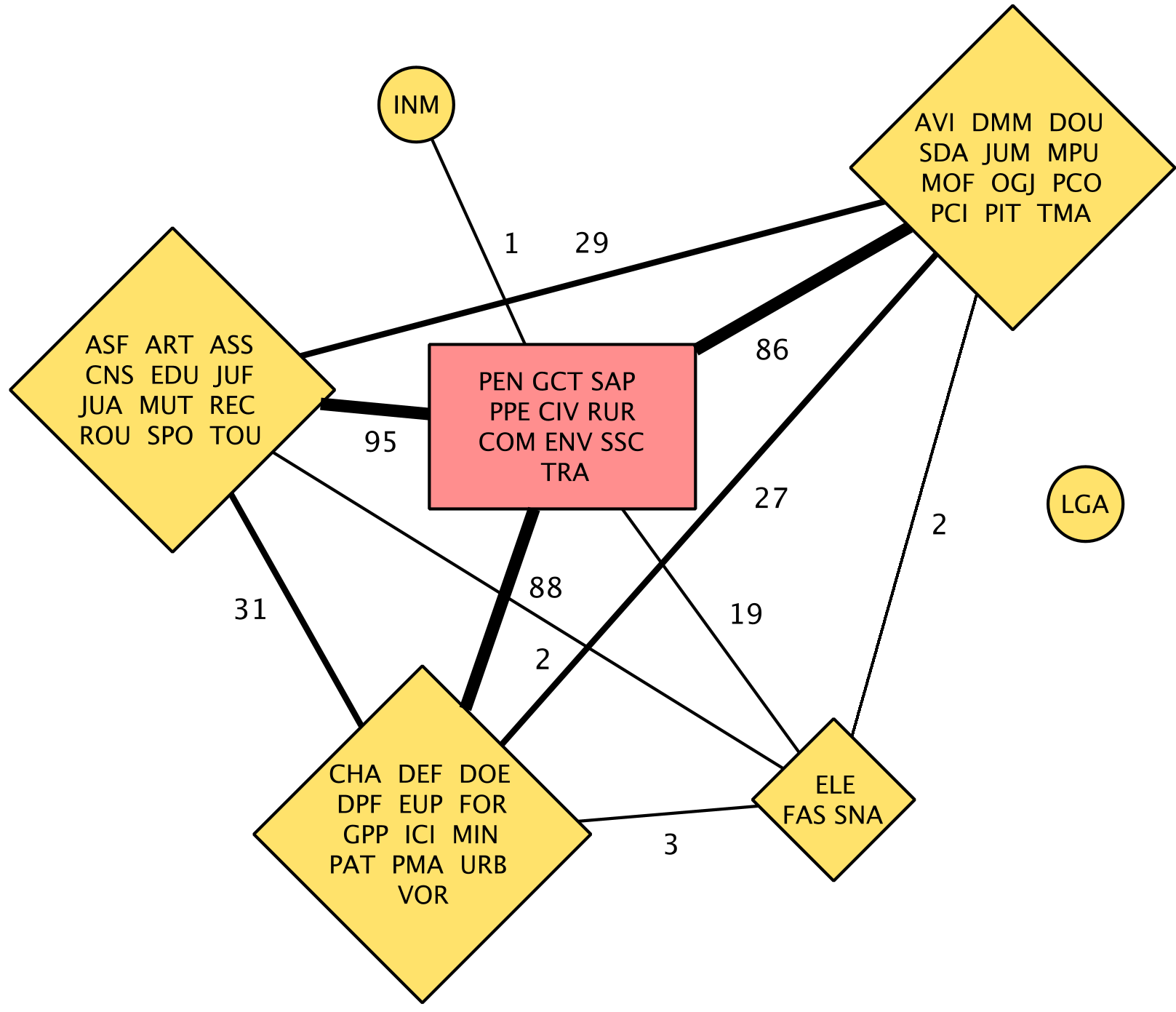 Figure 2: A modular view showing how the "Rich-Club" (center rectangle) acts as a gravity well for other code clusters.
A New Perspective: The Hemicycle Visualization
Because standard network graphs look like "hairballs" when density is high, the authors proposed a brilliant Hemicycle-like plot. Using Principal Component Analysis (PCA) and the Czekanovski-Dice dissimilarity index, they mapped the codes onto a semi-circle, similar to a parliament seating chart.
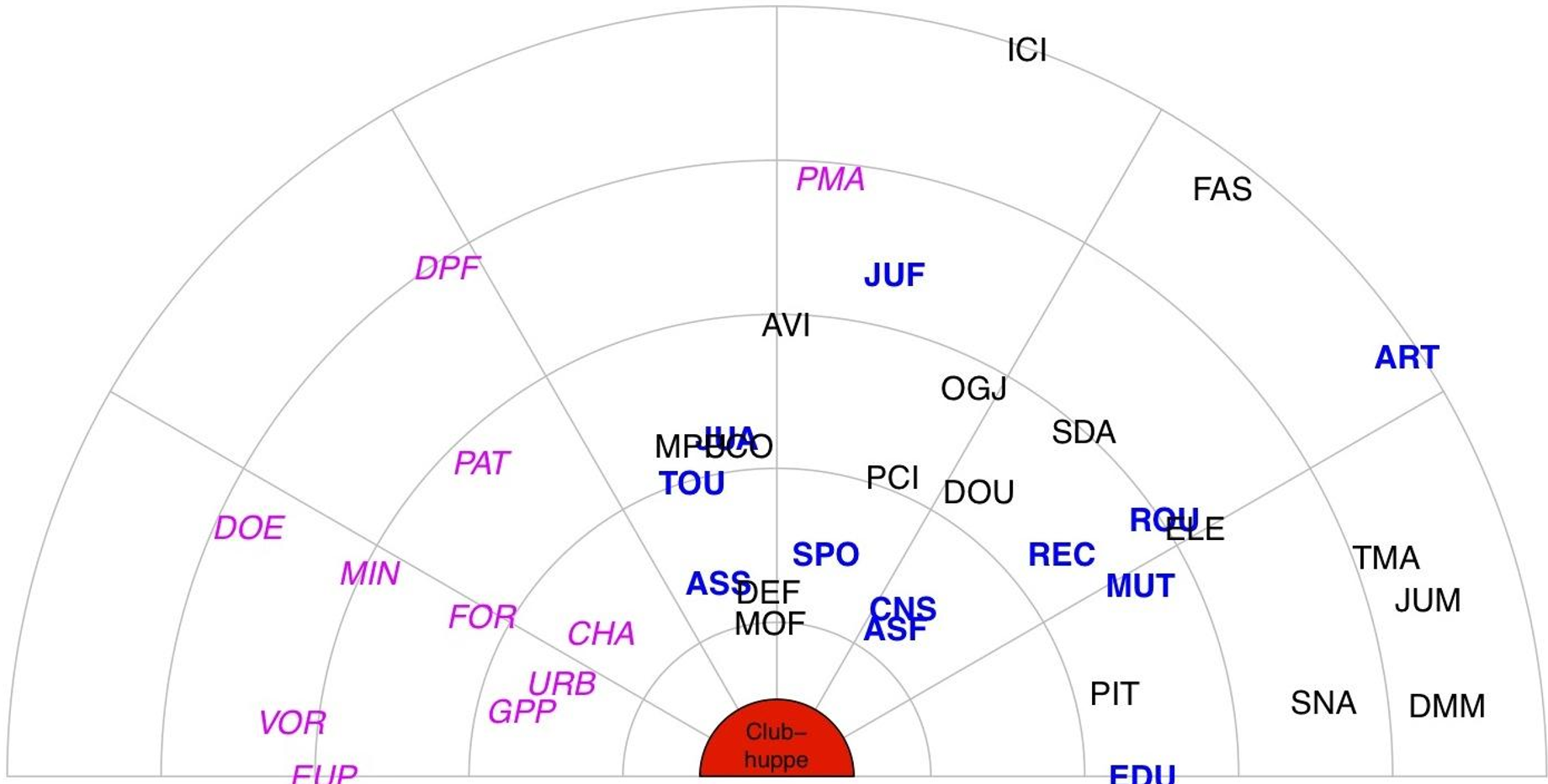 Figure 3: The Hemicycle Plot. The distance from the center represents a code's relationship to the Rich-Club, while the angular position reveals its community affiliation.
In this visualization, the "Social Issues" community (pink/italic) and the "Resources" community (blue/bold) naturally separate into different sectors of the "amphitheater," proving that these mathematical clusters correspond to real-world legal logic.
Critical Analysis & Takeaways
This paper represents a significant shift from "qualitative" legal theory to "quantitative" legal engineering.
- The "Concentrated World" Insight: The realization that legal systems are inherently dense is a warning to legislators. Adding a single new code doesn't just add a node; it potentially adds dozens of dependencies that increase the "cognitive cost" for citizens and lawyers.
- Limitations: The study uses unweighted links (it doesn't care if Code A cites Code B once or a thousand times). However, the authors note that Part II of their research will address weighted citations to add even more granularity.
- Future Work: This framework could be used to detect "Legal Fragility"—identifying codes that, if changed, would cause a cascade of necessary revisions across the entire national architecture.
Conclusion: By treating the law as a complex system, we move from being "craftsmen" of individual texts to "architects" of a coherent national infrastructure.