
Network-Based Synthesis: A New Frontier for Decomposable Crowdsourcing
A network based mechanism for managing decomposable tasks via crowdsourcing
This paper proposes a network-based mechanism for managing decomposable tasks in competitive crowdsourcing environments. By modeling individual task decompositions as a directed acyclic graph and transforming it into a weighted network, the authors use Dijkstra’s algorithm to select an optimal mixture of sub-tasks from multiple workers that minimizes the total cost.
TL;DR
Solving complex, large-scale tasks via crowdsourcing usually involves a trade-off between the quality of a single expert and the cost of the crowd. This paper introduces a network-based mechanism that allows a requester to "mix and match" sub-task solutions from various competing workers. By transforming the problem into a shortest-path search on a directed network, it guarantees a budget-feasible, minimum-cost solution that outperforms any single worker's complete submission.
Background: The Problem with All-or-Nothing Competition
In traditional platforms like 99Designs or Freelancer, workers compete to provide a total solution. However, for a "decomposable task" (like building a website or writing a complex report), Worker A might be excellent at the backend but expensive at the frontend, while Worker B is the opposite.
Current competitive models don't allow the requester to take the backend from A and the frontend from B easily because:
- Selection Independence: Winners are usually selected as single entities.
- Decomposition Mismatch: Different workers might break the task at different points.
Methodology: From Task Graphs to Collaborative Networks
The authors propose a two-phase mapping process to move from independent submissions to a unified selection framework.
1. The Task Graph
Each worker decomposes the task into sub-tasks . This is represented as a directed path. Since tasks move forward toward a deadline, these paths are inherently acyclic (no loops).
2. The Network Transformation
The breakthrough is how the model handles collaboration. If two workers happen to break the task at the same logical point, the mechanism creates a bridge (a zero-cost bidirectional edge) between their nodes.
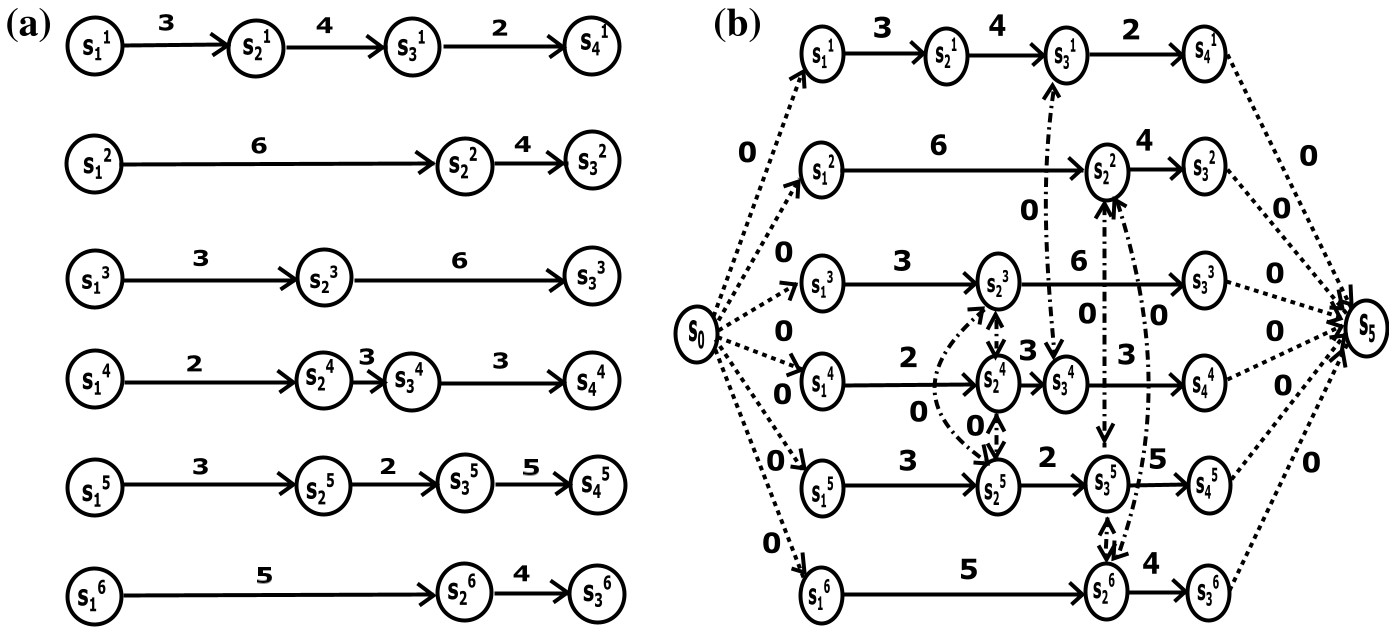 In the figure above, the Task Graph (a) is transformed into the Network View (b), allowing the algorithm to jump between Worker 1's and Worker 2's solutions at node .
3. Shortest Path Optimization
By adding dummy start () and end () nodes, the requester can apply Dijkstra’s Algorithm with a complexity of . The "shortest path" in this network is literally the most cost-effective sequence of sub-tasks.
Experimental Proof: Density Leads to Efficiency
The authors conducted simulations to test two main hypotheses:
- Is a mixture better than a single worker? Yes. The empirical data shows that the "Best Cost" (network-derived) is consistently lower than individual or even simple combined costs.
- Does more decomposition help? Yes. As the number of sub-task breakpoints increases, the granularity allows for more "shortcuts" in the network, driving the price down.
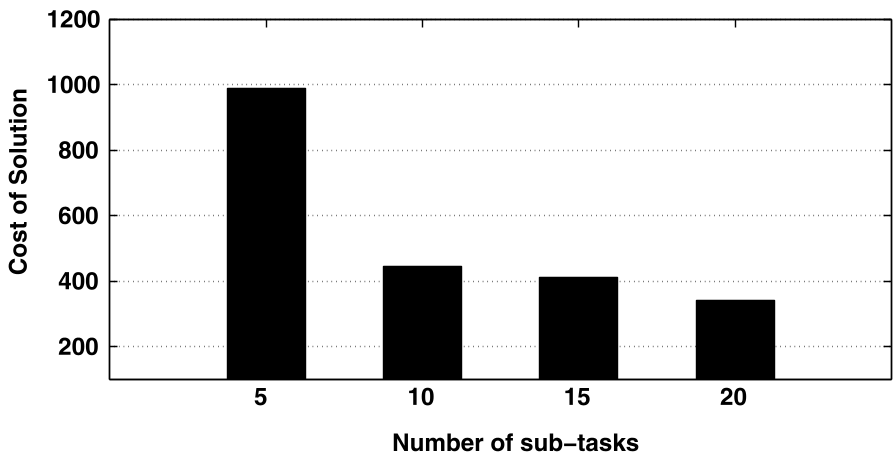 Fig 4: As the task is decomposed into more sub-tasks (5 vs 20), the optimal cost significantly decreases.
Critical Insight & Future Directions
The mechanism is mathematically sound and budget-feasible (Theorem 5.1 proves the optimized cost will never exceed the initial budget ).
Limitations:
- Contextual Integrity: The authors acknowledge that a "Frankenstein" solution—assembled from five different workers—might lack a unified "style" or context, which is vital for creative tasks like design.
- Common Breakpoints: The model relies on workers choosing the same breakpoints. If no workers overlap, the model collapses back into a standard competitive auction.
Future Work: The next step for this research is incorporating quality metrics. Currently, the algorithm only minimizes for cost. In a real-world scenario, a requester might pay 10% more for a 50% increase in quality. Integrating a "Price-Quality" weight into the edge costs would make this model ready for commercial deployment on platforms like mTurk or Freelancer.
Conclusion
This paper shifts the view of crowdsourcing from a "competition of individuals" to a "combination of sub-solutions." By treating task management as a network routing problem, it provides a scalable, algorithmic way to lower costs for requesters while allowing workers to specialize in micro-segments of larger projects.