
Dynamic Pricing in Social Data Markets: Leveraging Network Effects and Congestion
Network Effect-Based Sequential Dynamic Pricing for Mobile Social Data Market
The paper proposes a Sequential Dynamic Pricing (SDP) scheme for a monopoly mobile service provider to manage social data demand. By integrating network effects and congestion costs into a multi-period game-theoretic framework, the method achieves a "win-win" outcome where both provider revenue and user utility are maximized.
TL;DR
Mobile data consumption is no longer a solitary activity; it is driven by social interactions. This paper introduces a Sequential Dynamic Pricing (SDP) scheme that accounts for both the "Network Effect" (users want what their friends have) and "Congestion Effects" (network slowdowns). Unlike traditional static models, this dynamic approach allows providers to adjust prices over time, resulting in higher profits for the provider and higher satisfaction for the users.
The Motivation: Why Static Pricing Fails
In a social network, your utility increases when your friends consume more data (e.g., sharing videos, interactive gaming). This is the Network Effect. Conversely, as everyone uses more data, the wireless channel becomes crowded—the Congestion Effect.
Existing literature typically treats the interaction between a Mobile Service Provider (MSP) and users as a "one-shot" game. This is unrealistic. In reality:
- Users make decisions repeatedly.
- The provider can observe past data usage and adjust prices.
- Static models ignore the "feedback loop" where current consumption drives future social demand.
Methodology: The SDP Framework
The authors model the user utility as a linear-quadratic function that balances three forces:
- Intrinsic Value: The personal benefit of the data.
- External Benefit: The positive impact of social ties ().
- Congestion Cost: The shared negative impact of total network load ().
The MSP's goal is to maximize cumulative revenue. The unique technical contribution here is solving the order-independence problem. In a sequential market, does it matter if you price User A before User B?
Through rigorous proof (Theorems 1 & 2), the authors demonstrate that the optimal demand and revenue are independent of the visiting order, provided certain stability conditions (Assumption 1) are met. This allows the MSP to use a streamlined algorithm to set prices in each time period .
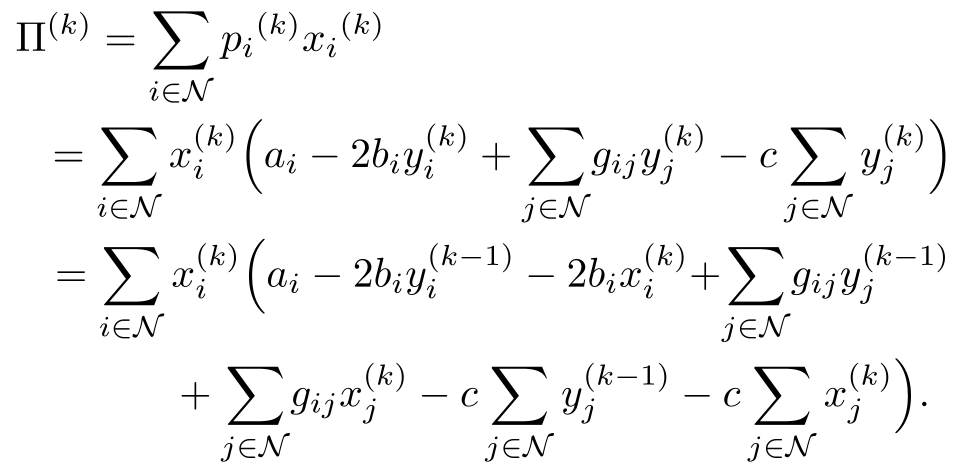 (Equation 8: The dynamic revenue formulation used to derive the optimal price path)
Experimental Results & Insights
The researchers simulated a network of 100 users over 80 time periods. The findings were conclusive:
- Fast Convergence: The dynamic pricing system stabilizes quickly, usually within the first 25 iterations.
- The "Win-Win" Result: As shown in the figures below, the Sequential Dynamic Pricing (SDP) consistently yields higher total utility and revenue compared to the Optimal Static Pricing (OSP).
- Scalability: The advantage of SDP becomes more pronounced as the number of users grows or as social ties become stronger.
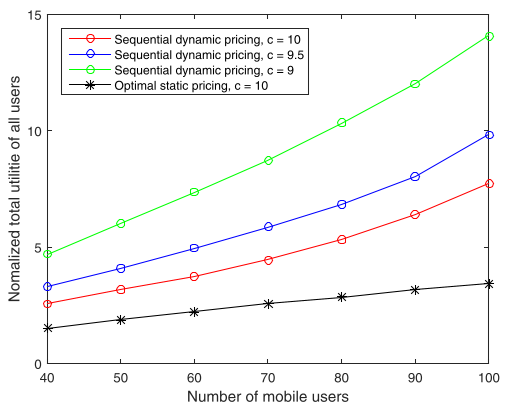 Figure: Comparison of convergence between SDP and OSP. Note the significant gap in total utility.
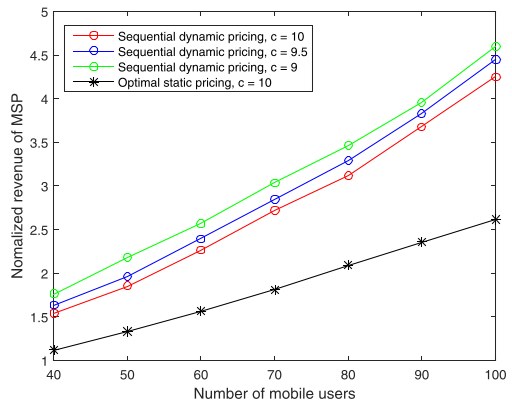 Figure 4 & 5: Revenue increases as social ties () strengthen and as congestion () is managed more efficiently.
Critical Analysis & Conclusion
The beauty of this work lies in its mathematical elegance—specifically the proof that sequential ordering doesn't break the optimization. By internalizing the social history () into the pricing mechanism, the MSP effectively "incentivizes" the network effect to work in its favor.
Limitations:
- The model assumes a monopoly. In a competitive market with multiple providers, users might churn to a cheaper provider, which would complicate the dynamic pricing strategy.
- It assumes complete information regarding the social graph, which might be difficult to obtain in privacy-sensitive environments.
Final Takeaway: This research provides a robust theoretical foundation for the next generation of "social-aware" data plans. For providers, it means higher revenue; for users, it means a network that understands and rewards social connectivity.