
MCFM: Solving Information Overload with Network-Flow Based Influence Optimization
A Network-Flow Based
This paper introduces the Minimum Cost Flow Model (MCFM), a network-flow based influence propagation framework for social networks. By leveraging a cycle-cancelling algorithm, it achieves optimal influence spread while minimizing transmission costs and eliminating redundant information overlap.
TL;DR
In the era of social media, "more" isn't always "better." This paper proposes the Minimum Cost Flow Model (MCFM), which treats influence as a fluid flow. Unlike traditional models that often bombard users with redundant information (noise), MCFM uses a Cycle-Cancelling Algorithm to find the most efficient, non-overlapping paths for information propagation, effectively minimizing "marketing noise" while optimizing the cost of reach.
Contextualizing the Problem: The Chaos of Overlap
Current social network influence models, such as the Linear Threshold (LT) and Independent Cascade (IC) models, primarily focus on how to reach the maximum number of people. However, they ignore a critical human factor: information fatigue.
When a user receives the same marketing message from multiple friends (as shown in the paper's motivational example), the influence often turns negative. Traditional models treat this as a success (more activations), but in reality, it creates noise. The challenge lies in propagating influence such that each node is reached via the most "cost-effective" path without redundant, overlapping signals.
The Solution: A Network-Flow Perspective
The authors pivot from greedy heuristics to a mathematically rigorous Minimum Cost Flow framework. By representing the social network as a directed graph where each arc has a cost () and capacity (), the problem becomes one of satisfying demands (reaching nodes) with minimum total cost.
Methodology: The Cycle-Cancelling Intuition
The core of the paper is the application of the Negative Cycle Optimality Condition. If a residual network contains a negative cost cycle, the current flow is not optimal.
The Cycle-Cancelling Algorithm follows these steps:
- Establish an initial feasible flow using a maximum flow approach.
- Search the residual network for cycles where the sum of costs is negative.
- Augment flow along these cycles to reduce total costs.
- Repeat until no negative cycles remain.
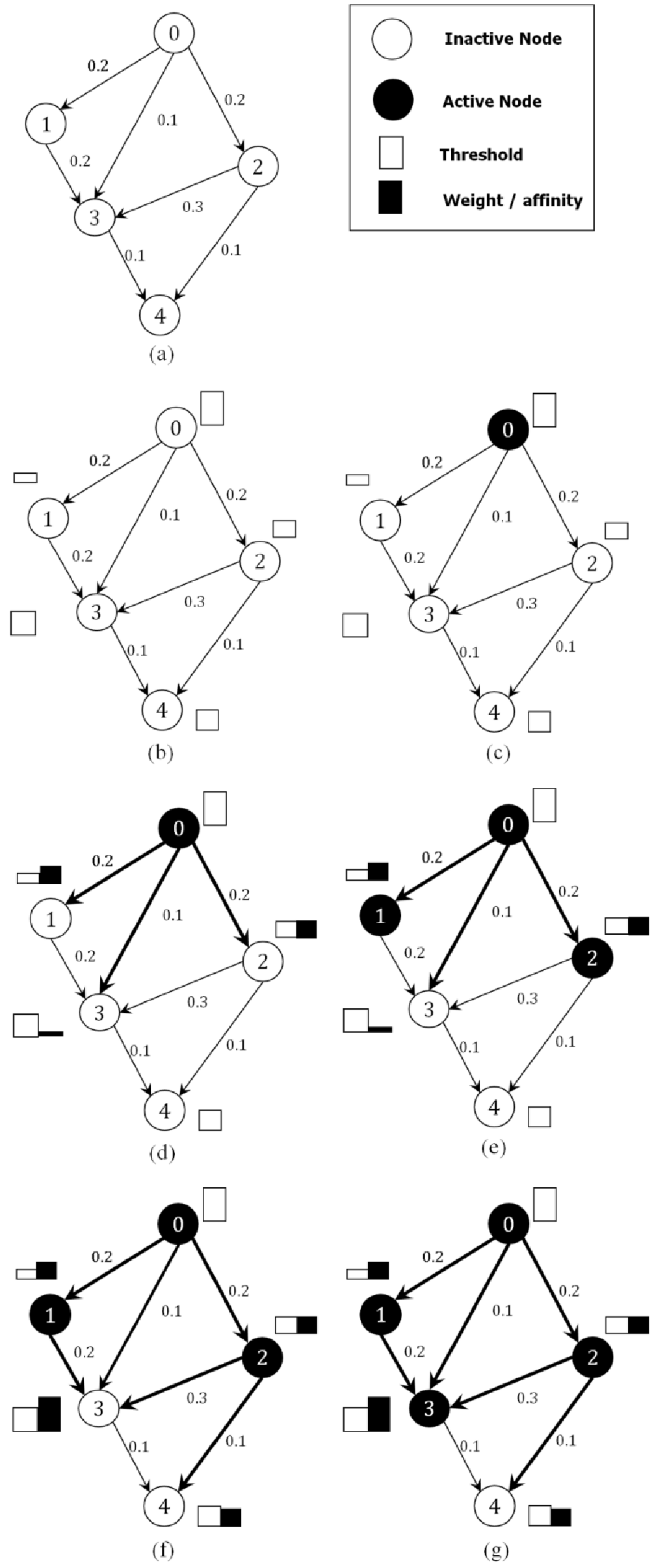 Above: Traditional Linear Threshold propagation showcasing how weights accumulate, potentially leading to redundant activations.
Experimental Insights
The authors tested their model against a power-law distributed network (Karate Club dataset). The results highlight two major advantages:
- Elimination of Noise: As shown in Figure 10, while conventional models see a surge in overlapping influence as the network density increases, MCFM remains flat. This is because the MCFM structure naturally gravitates toward an acyclic tree-like propagation for each unit of flow.
- Energy Efficiency: Figure 11 displays the "influence propagation on the hop," showing that MCFM uses significantly fewer arcs to achieve its goals, especially at the 2-hop range.
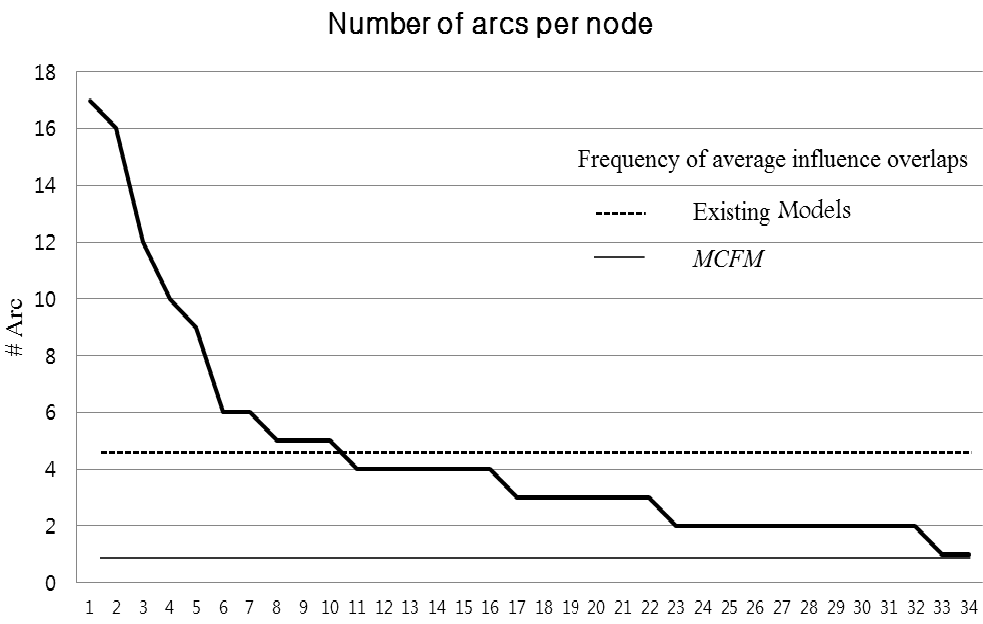 Figure 10: Comparison of arc count and overlapping influence frequency. MCFM (the flat line) avoids the noise inherent in traditional models.
Critical Analysis & Conclusion
Takeaway
This paper provides a robust theoretical foundation for Precision Marketing. By framing influence as a cost-minimization problem, it allows for a more "polite" propagation that respects the user's information threshold.
Limitations & Future Work
While the mathematical proof is solid, the experimental scale is relatively small (34 nodes). In real-world SNS environments with millions of nodes, the computational complexity of cycle-cancelling may become a bottleneck. The authors acknowledge this, planning future work to integrate Social Network Clustering to group similar nodes and reduce the search space for the optimization algorithm.
In conclusion, the MCFM represents a shift from "Quantity of Spread" to "Quality of Path," a necessary evolution for sustainable social computing.