
Navigating the Social IoT: How Objects Can "Friend" Their Way to Efficient Service Discovery
Network navigability in the social Internet of Things
This paper explores "Network Navigability" within the Social Internet of Things (SIoT) framework, proposing five link selection heuristics to manage object friendships. By simulating these strategies on a synthetic network modeled after real human social data (Brightkite), the study identifies optimal ways to maintain a "small-world" architecture while limiting computational overhead for decentralized service discovery.
TL;DR
As the Internet of Things (IoT) matures, we are moving from human-object interaction to a world of autonomous object-object interaction. To prevent centralized search engines from collapsing under billions of queries, researchers are proposing the Social Internet of Things (SIoT). This paper investigates how objects can intelligently select which "friends" to keep to ensure the entire network remains navigable—finding any service in just a few hops—without overloading device memory or battery.
The Scalability Crisis in IoT
The current IoT model often relies on centralized mediators. This works for static data, but fails when billions of mobile, heterogeneous devices generate constant updates. The authors argue that the solution lies in decentralized search, mimicking the "Six Degrees of Separation" observed in human society.
However, there is a catch: if an object (like a smart sensor) has thousands of social connections, the computational cost of managing those links becomes prohibitive. The fundamental challenge is: How can a node limit its number of friends while still ensuring it can reach any other node in the network?
Methodology: Five Strategies for Social Selection
The authors propose that objects should apply local heuristics to decide which friendship requests to accept or discard once they hit a predefined limit (). They tested five distinct behaviors:
- Static: No new friends after reaching the limit.
- Maximize Neighborhood Degree: Befriend the "popular kids" (hubs).
- Minimize Neighborhood Degree: Befriend the "loners" to expand reach.
- Maximize Local Clustering: Build tight-knit local communities.
- Minimize Local Clustering: Avoid redundant connections to seek out "long-range" shortcuts.
Theoretical Foundation
The work builds on Kleinberg’s Navigability Principle, which states that a network is navigable if it contains short paths and structural clues (like high clustering or node similarity) that guide local search.
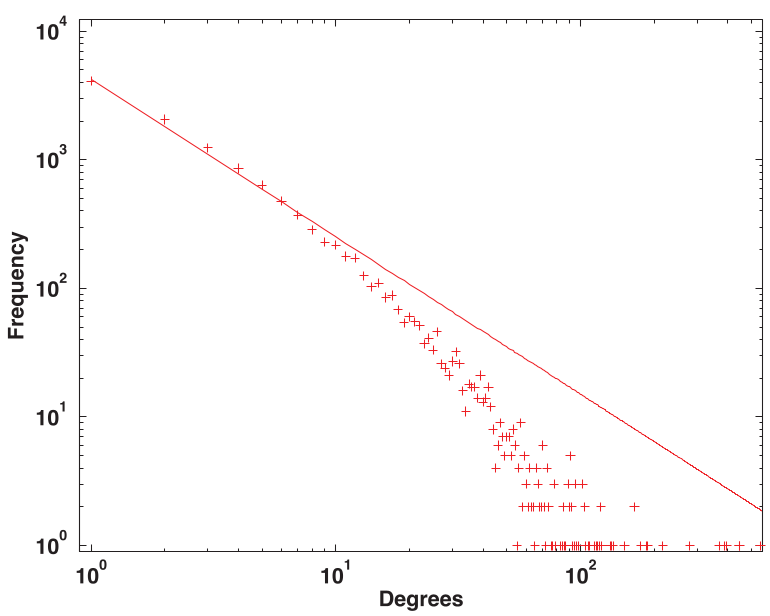 Figure 1: Illustration of the link selection process when a node reaches its connection limit.
Experimental Insights: Long Ties Win
Using a synthetic network based on the Brightkite social dataset (14,500+ nodes), the authors compared these five strategies. The results were striking:
- The Power of Bridges: Supporting the "Weak Ties" theory, Strategy 3 (Minimizing neighborhood degree) and Strategy 5 (Minimizing clustering) performed best. By connecting to nodes that aren't already well-connected or part of a clique, objects created "shortcuts" across the network.
- Path Length: Strategy 3 and 5 maintained the lowest Average Path Length, meaning services could be found faster across the decentralized web.
- Connectivity: While Strategy 2 (favoring hubs) caused the network to fragment as connections became restricted, the "loner-favoring" strategies maintained a 100% Giant Component (all nodes reachable).
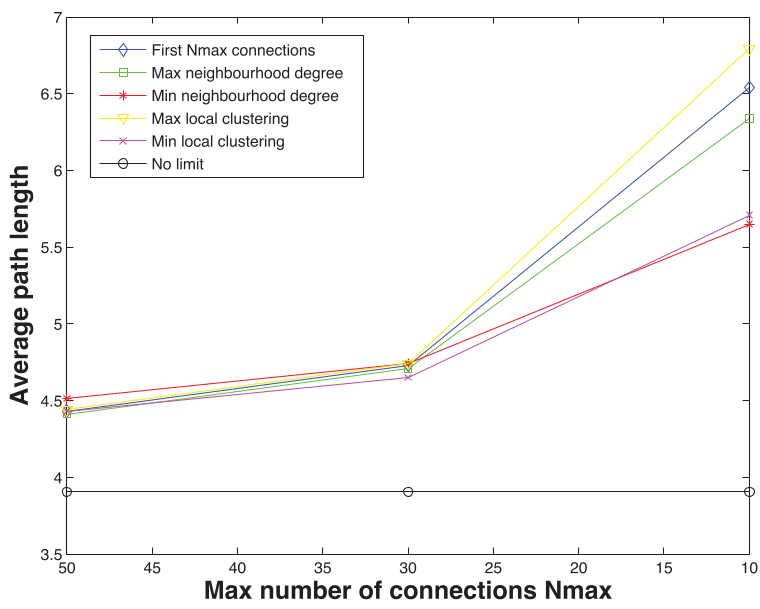 Figure 2: Impact of different strategies on network path length as the maximum allowed connections () decreases.
Critical Analysis & Future Outlook
The paper successfully demonstrates that local decisions significantly impact global navigability. By choosing to befriend "unpopular" or "isolated" nodes, an object actually improves the efficiency of the entire system.
Limitations:
- The study uses a synthetic model (Barabási-Albert with triad formation). Real-world IoT movements might be more chaotic than human social patterns.
- The "Trustworthiness" of nodes is mentioned but not fully integrated into the link selection heuristics in this specific simulation.
Takeaway: For developers building decentralized IoT protocols, the lesson is clear: Avoid cliques. To build a scalable, navigable network of devices, ensure your nodes are incentivized to maintain "diverse" connections rather than just clustering with their immediate neighbors.